




A new video illustrating the spread of COVID-19 in the Tucson-area shows how the virus has moved in and out of the community over the last two months.
The video, posted to the Pima County Health Department’s Facebook page Wednesday, uses red dots to map the general location of positive cases in Pima County over time. As each dot ages beyond 15 days, it falls off the map to show the cases that are no longer infectious. New cases, represented by new red dots, surface on the map as quickly as others disappear.
“One of the things that is not clear with the maps available on the Arizona Department of Health Services website is that because the number of cases are growing, it doesn’t give you a sense of how those cases change over a period of time,” said Pima County’s Chief Medical Officer Francisco Garcia. “We wanted to give folks a sense of how a case appears in our community and how it disappears from our community. We know that people are infectious for at least 14 days, and this was a way of portraying the fact that at some point, all those cases will stop being infectious.”
The first dot on the map appears Feb. 18 and is located south of Sahuarita. The next dot appears on Feb. 22 near Cienega High School on the far east side of the county. As the time-lapse continues through April 24, the dots eventually cover almost every populated area in Pima County. The map does not include cases located on Indian reservations.
“This is a really dynamic situation, and it’s impacting every single corner of Pima County,” Garcia said. “Cases are being identified every day, and other cases are disappearing.”
Although health officials are assuming that someone will stop being infectious after 14 days, Garcia said this can vary and that they are still trying to determine when someone can be declared recovered. There is some evidence that people who are immunosuppressed and people who are older may be infectious for longer than 14 days, and there are also people who will be infectious for fewer than 14 days.
According to Garcia, the data may also be skewed because they start counting from the day that someone was tested, not necessarily from the day that their symptoms began. So, if someone didn’t seek medical care until their fourth day of symptoms, they could stop being infectious sooner than the data will show.
“We will overestimate some, and we will underestimate others, but hopefully what we are portraying is a dynamic representation of how this infection is moving in and out of our community and the fact that it’s really affecting every single geographic segment of Pima County,” Garcia said.
Pima County released a map Wednesday showing the approximate location of positive COVID-19 tests to show how the virus has spread throughout the Tucson community.
Even with the decision to extend Arizona’s stay-at-home order through May 15, Gov. Doug Ducey announced Thursday that he will allow certain businesses to reopen with certain restrictions as early as Monday, May 4. This has community members wondering when social distancing standards will relax even further.
For Garcia, the fight isn’t over yet, however. Pima County still has not reached a point in the curve that would make health officials comfortable with a full reopen. Garcia said it’s important that community members stay patient and continue following the protocols.
“The reason that we have not overwhelmed our hospital system and why we have not had more cases and more deaths is because this community has been able to achieve a fairly high degree of social distancing,” he said. “We’re hoping that this kind of information encourages people to continue doing the same because we need that in order to get to the downward slope of that infection curve.”
Photos for April 23: Tucson gets by during Coronavirus Pandemic
Tucson, coronavirus
Updated
Erika Munoz, owner of Seis Kitchen, hands over a bag of meals to Michael Gallagher Carondelet, a registered nurse at St. Joseph's Hospital, to distribute to other nurses and hospital workers, on April 23, 2020. The donation was made in conjunction with A+C (Athletes/Artists+Causes) Foundation's “Project Frontline.” In two deliveries, 400 meals (200 poc chuck chicken and 200 puerco verde burritos) will be given to medical personnel at Carondelet St. Joseph’s Hospital. The particular donation was made possible by the Houston Astros' Pitching Coach Brent Strom, who lives in Tucson.
Tucson, coronavirus
Updated
Hospital workers wheel in carts full of catered meals donated by Seis Kitchen to Carondelet St. Joseph's Hospital, on April 23, 2020. The donation was made in conjunction with A+C (Athletes/Artists+Causes) Foundation's “Project Frontline.” In two deliveries, 400 meals (200 poc chuck chicken and 200 puerco verde burritos) will be given to medical personnel at Carondelet St. Joseph’s Hospital. The particular donation was made possible by the Houston Astros' Pitching Coach Brent Strom, who lives in Tucson.
Tucson, coronavirus
Updated
Kristi Hall, a sixth grade teacher at Desert Sky Middle School, participates in planning a lesson with a fellow teacher on Zoom, at her home on April 17, 2020. Schools in the Vail School District are supposed to open in July due to their year-round school calendar. Plans are being made for the possibility of students returning to the physical classroom.
Tucson, coronavirus
Updated
Bry Kelley, a warehouse assistant, places a pallet filled with food down next to other items donated to the Community Food Bank of Southern Arizona on on April 21, 2020. Forty-one thousand pounds of flour, pasta and canned goods were donated by The Church of Jesus Christ of Latter-day Saints. The donation is part of an ongoing global effort by the church to address immediate needs of people and orgainzations due to the coronavirus disease (COVID-19) pandemic.
Tucson, coronavirus
Updated
A pallet of food is placed down next to other items donated to the Community Food Bank of Southern Arizona on on April 21, 2020. Forty-one thousand pounds of flour, pasta and canned goods were donated by The Church of Jesus Christ of Latter-day Saints. The donation is part of an ongoing global effort by the church to address immediate needs of people and orgainzations due to the coronavirus disease (COVID-19) pandemic.
Tucson, coronavirus
Updated
Christian Bergman, 4th year University of Arizona medical student, takes the temperature of a patient outside the Z Mansion, 288 N. Church Ave., in Tucson, Ariz., on April 19, 2020. Medical students from the University of Arizona and other universities volunteer to help the homeless population with the growing concerns of Coronavirus Disease (COVID-19) within the homeless population. “This is a vulnerable population in our community; they can’t defend themselves in a society already running short on supplies and resources,” said Bergman. Medical students and medical personal help by giving out food, drinks with electrolytes and masks to the homeless. Those who are sick, medically impaired or have been exposed to those with COVID-19 are isolated outdoors in tents on the property. As of Sunday April 19, there were 13 individuals whom are isolated in tents.
Tucson, coronavirus
Updated
Lekha Chesnick, 1st year medical student at Burrell College of Osteopathic Medicine, talks with a homeless man (whom choose to not give his name) outside of the Z Mansion, 288 N. Church Ave., in Tucson, Ariz., on April 19, 2020. Medical students from the University of Arizona and other universities volunteer to help the homeless population with the growing concerns of Coronavirus Disease (COVID-19) within the homeless population. Medical students and medical personal help by giving out food, drinks with electrolytes and masks to the homeless. Those who are sick, medically impaired or have been exposed to those with COVID-19 are isolated outdoors in tents on the property. As of Sunday April 19, there were 13 individuals whom are isolated in tents.
Tucson, coronavirus
Updated
Christian Bergman, 4th year University of Arizona medical student, checks on a patient outside the Z Mansion, 288 N. Church Ave., in Tucson, Ariz., on April 19, 2020. Medical students from the University of Arizona and other universities volunteer to help the homeless population with the growing concerns of Coronavirus Disease (COVID-19) within the homeless population. “This is a vulnerable population in our community; they can’t defend themselves in a society already running short on supplies and resources,” said Bergman. Medical students and medical personal help by giving out food, drinks with electrolytes and masks to the homeless. Those who are sick, medically impaired or have been exposed to those with COVID-19 are isolated outdoors in tents on the property. As of Sunday April 19, there were 13 individuals whom are isolated in tents.
Tucson, coronavirus
Updated
Elliott Dumont, owner of Roadrunner Bicycles, 6177 E. Broadway Blvd., works on a customer's bike on April 22, 2020. The coronavirus disease (COVID-19) has not slowed down bike shops. With many people at home, they are bringing bicycles for repairs and buying new ones for exercise. Dumont says he's booked out till the first week of May for tuneups on bikes.
Tucson, coronavirus
Updated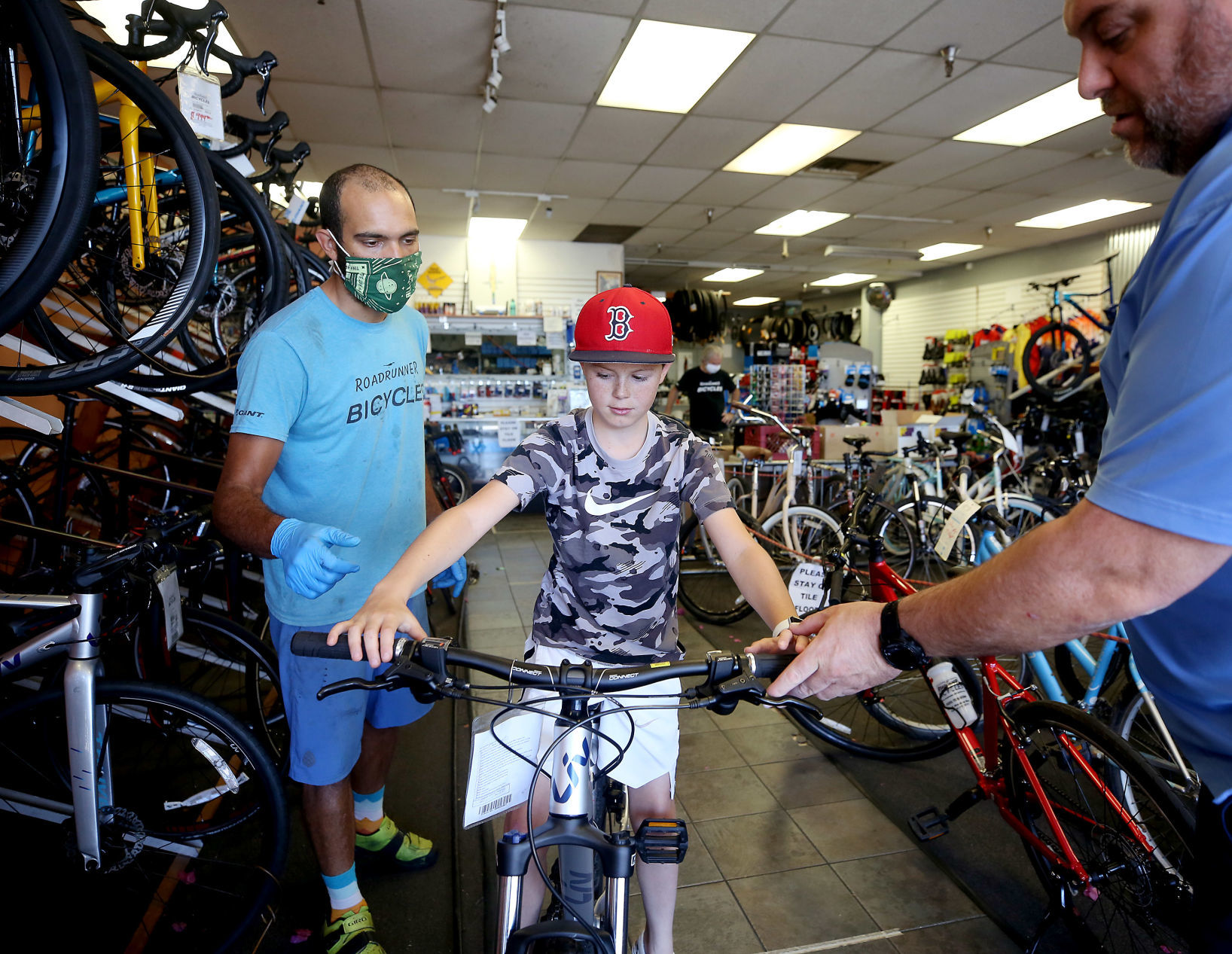
Elliot DuMont, owner of Roadrunner Bicycles, 6177 E. Broadway Blvd., far left, helps Ethan Sasz, far right, and his son, Evan, 10, with a mountain bike purchase on April 22, 2020. The coronavirus disease (COVID-19) has not slowed down bike shops. With many people at home, they are bringing bicycles for repairs and buying new ones for exercise. Dumont says he's booked out till the first week of May for tuneups on bikes.
Tucson, coronavirus
Updated
Marcella Montoya waits in her vehicle as general manger David Kessler brings out her order, as Bear Canyon Pizza serving their customers despite COVID-19 restrictions, April 22, 2020, Tucson, Ariz.
Tucson, coronavirus
Updated
Kitchen manger Koa Hoffmann tosses dough while working up a crust for a call-in order as he and few others keep cooking at Bear Canyon Pizza despite COVID-19 restrictions, April 22, 2020, Tucson, Ariz.
Tucson, coronavirus
Updated
Alvaro Enciso, a local artist, works in one of his studios at his home on April 9, 2020. Every Tuesday Enciso travels into the Sonoran desert to post crosses where migrants have died after crossing illegally over the U.S./Mexico border as part of a project he's titled Donde Mueren Los Suenos / Where Dreams Die. With the outbreak of the coronavirus disease his six year project is on hold and instead he works on other artwork at home.
Tucson, coronavirus
Updated
Dolly Spalding works on a pen and ink drawing in her apartment at the Redondo Tower Apartments on April 7, 2020. During her quarantine, Spalding has been creating drawings of all the Greek goddesses. She is collaborating with Emlyn Boyle, an artist from Ireland, and plans to publish a book with Boyle's writings.

