


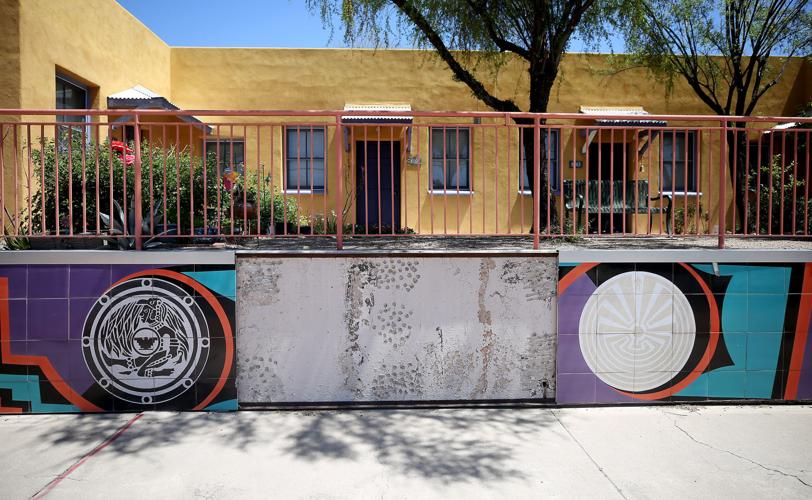
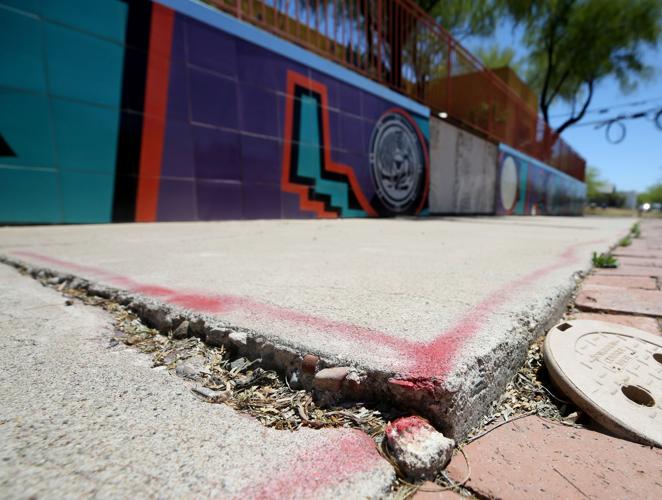
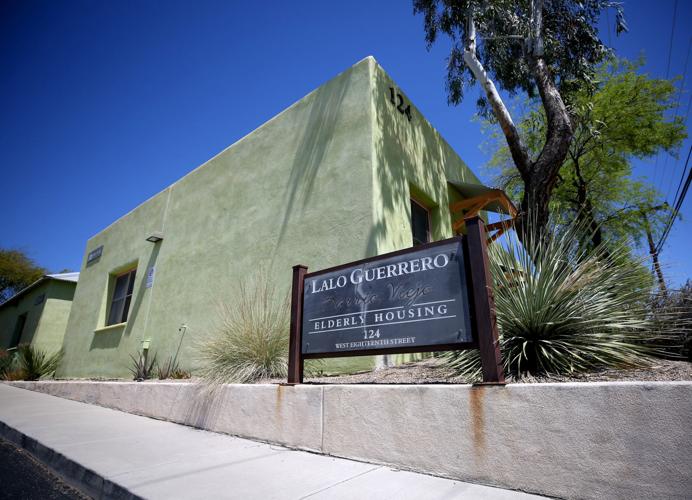
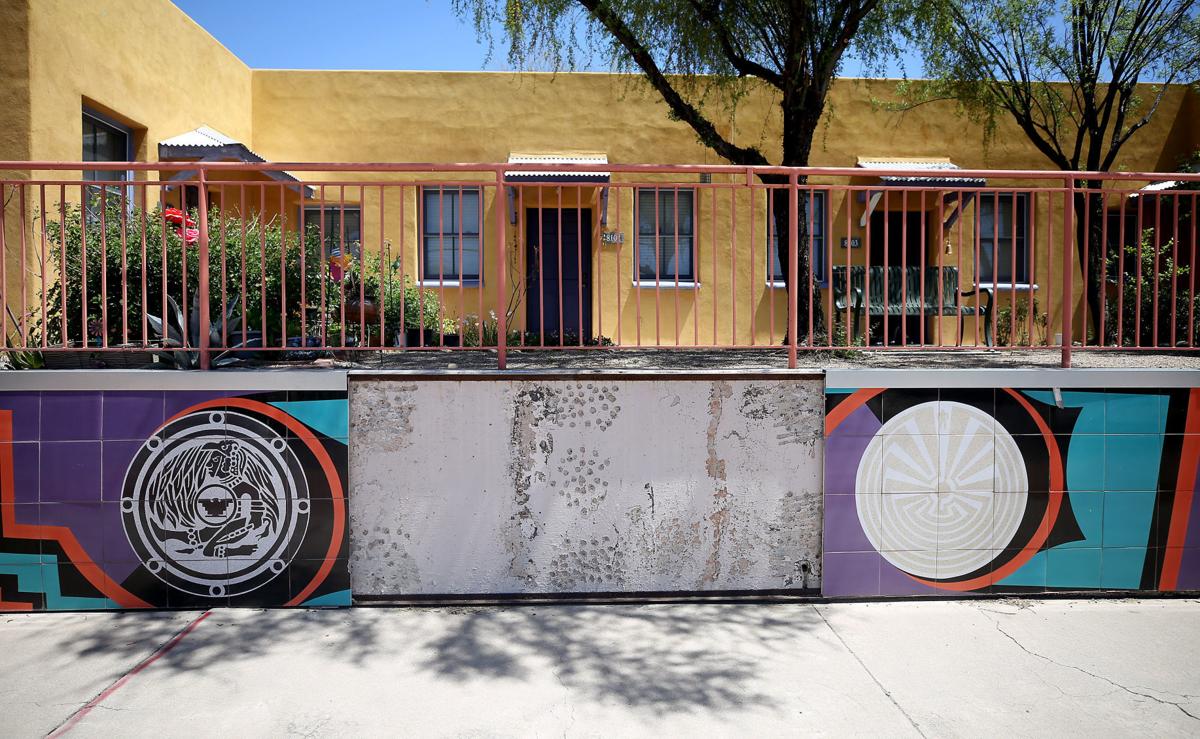
Above the peeling tiles and uneven sidewalk, 62 brightly painted single-story casitas line the street in downtown Tucson’s historic Barrio Viejo. Their lilac, coral, sky-blue and lime-green facades fill the block between Convent Street to Seventh Avenue on 18th Street.
Though built to match the style of the surrounding homes, a waiting list of around 300 seniors distinguishes the Lalo Guerrero Barrio Viejo Elderly Housing complex from neighboring adobe structures.
In 2003, the housing complex became one of only seven Section 202 living facilities for low-income seniors in Tucson, offering subsidized rent through the U.S. Department of Housing and Urban Development.
For the past 17 years, the casitas have offered independent — but supported — living for more than five dozen at-risk seniors at a time. Now, the nonprofit that runs them, Catholic Community Services, is struggling to find funds for urgent repairs.
As Section 202 housing, the Lalo Guerrero apartments offer subsidized rents and rely heavily on HUD funding. The complex offers housing to its seniors at a sliding scale — 30% of each tenant’s income, occasionally lowered to accommodate financial pressure from medical bills.
HUD then covers the difference between rent payments and cost of operations but, according to Peg Harmon, chief executive officer of CCS, the federal funding isn’t quite enough.
“The money available from HUD doesn’t address maintenance,” said Harmon, who has been involved with the project since its initiation in 1999.
The community has stepped up to help. A group of dedicated snowbirds and volunteers from the Knights of Columbus, a fraternal Catholic organization, have worked to tackle dire window repairs. Meanwhile, residents of Barrio Viejo created a Barrio Home Tour to raise funds.
The home tour follows in the footsteps of past community fundraising efforts. In March of 2000, when the Lalo Guerrero housing complex was still just an idea, the then-neighborhood association raised $10,000 toward its realization.
Like their modern counterparts, the old Barrio Historico Neighborhood Association opened the doors of homes in the barrio, charging the public $7 each for the tour. At $25-$30 per person, the 2020 tour hopes to raise around $37,000 for facility repairs.
Originally scheduled for April 4, the Barrio Home Tour postponed the event until October in response to the coronavirus. In the meantime, the association has launched a GoFundMe campaign, and repairs that were anticipated to be funded in April may have to wait.
Harmon called the needed repairs fairly urgent.
“They’re not in good shape, and they’re getting in worse shape,” she said.

Lalo Guerrero Elderly Housing relies heavily on federal funding. However, the funding isn’t enough to address maintenance, says Catholic Community Services CEO Peg Harmon.
Necessary renovations include addressing the crumbling tile mural on the front wall, repairing the sidewalk around the facility, replacing components on hundreds of the windows, and fixing the old concrete steps that lead up to the facility.
Bobbie Jo Carter, a Barrio Viejo resident who organized the home tour fundraiser, owned property across the street from the senior living facility. She said the increasing state of the complex’s disrepair was apparent.
“We could just see the deterioration on the outside of the apartments,” said Carter.
When she went to the facility to ask about the situation, Carter was told it was a nonprofit and just didn’t have the funds.
“We have a crisis in this community for affordable housing,” said Harmon, who’s been challenged with finding adequate funding for the Lalo Guerrero casitas for the past 20 years.
In 2019, the Tucson Housing Foundation, which oversees Section 202 housing, released a report on senior housing in Tucson.
“As our population has continued to age, and as rental rates have risen for a variety of reasons,” they wrote, “the availability of low-income, affordable and subsidized housing in the greater Tucson metro area has never been more critical.”
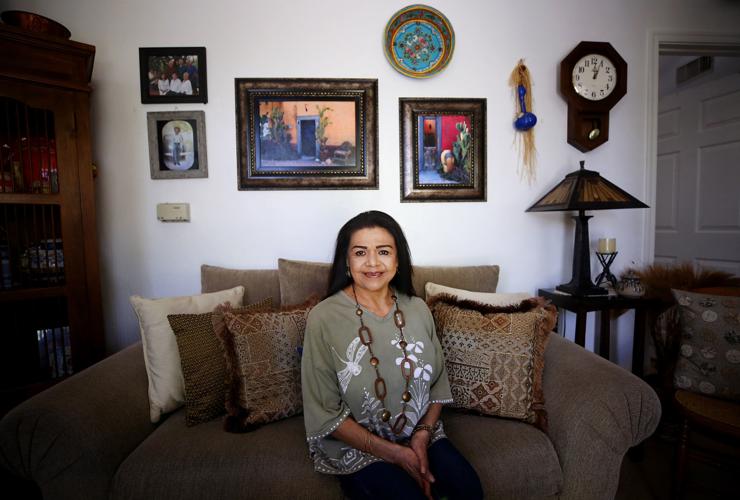
Residents such as Enedina Perez have experienced the need firsthand. After a recent divorce, the 63-year-old found herself with few options. She applied for housing at the Lalo Guerrero Apartments and 18 months later she finally got in.
“I love it. I just love it,” said Perez of her new home. It has one bedroom, a small living room, a kitchen, a wheelchair-accessible bathroom, and is in the heart of the barrio she grew up in — her parents and older siblings went to school on the exact property she now inhabits.
In 1901, the original Drachman School was built where the apartments now stand. A 1948 fire destroyed about 80% of the structure, but the Tucson Unified School District rebuilt, remaining on the property until 1997 when the new Drachman Montessori School was constructed on 10th Avenue.

Enedina Perez, 63, had to wait a year and a half to get into the Lalo Guerrero Elderly Housing complex, which has a waiting list of around 300. “I just love it,” she says.
After TUSD abandoned the site, the neighborhood debated the best use of the property. According to Catherine Morton, former president of the neighborhood association, a senior living facility was the only option with viable funding.
“That’s how you make things happen — you find the money,” said Morton. Around 2000, after years of working with CCS and the city of Tucson, with over 75 neighborhood meetings, Morton said the project was finally approved by HUD and awarded $4.2 million to build the Section 202 housing complex.
By July 2003, the first residents were moving in and soon after there was a neighborhood block party to celebrate. The headlining musician was Lalo Guerrero himself, whom the apartments were dedicated to. Guerrero was born and raised in Barrio Viejo and has been called the father of Chicano music.
“It was magical,” remembers Morton, who fought hard for the complex to reach completion. “I have three beautiful children I’ve given birth to, and I feel the same way about this project.”
With their 62 units, the Lalo Guerrero Elderly Housing complex has been able to make a small dent in the growing need for low-income senior living in Tucson. Barrio Viejo resident Sandra Leal, whose aunt lives in the apartments, said many of the residents feel like they’ve won the lottery.
“We are very, very grateful to have this place,” said Perez. If she hadn’t gotten into the apartments, she doesn’t know what she would have done. Now, she’s been able to come full circle.
“This is the last place I plan on living,” said Perez, who remembers the neighborhood as a child. “It’s like coming home.”

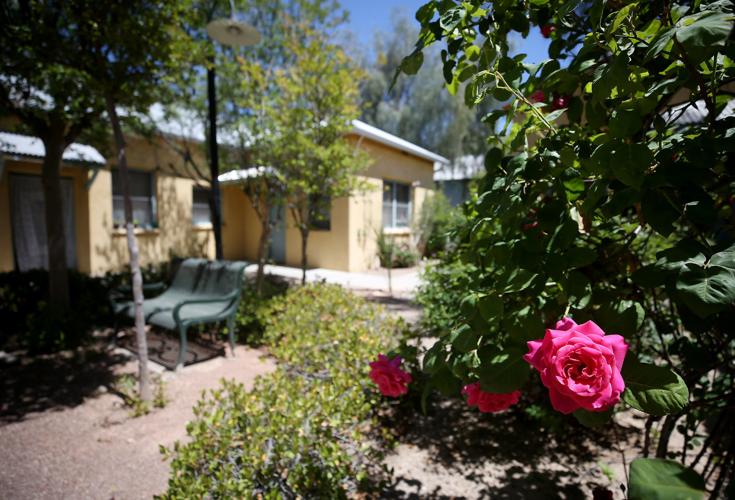
A rose bush blooms in one of the courtyard areas at the senior housing complex at 124 W. 18th St. Community volunteers and neighbors have stepped up to help with needed repairs.

The complex was built on the site of the original Drachman School, which was heavily damaged by fire in 1948. In the summer of 2003, its first residents moved in.

