

Whether Mohamed Abdirahman Osman is a refugee who lied about terrorist links to get immigration benefits or if he’s been wrongly targeted by a flawed government investigation that matches the Trump administration’s rejection of certain refugees is being played out in a Tucson courtroom.
Hearings here last week illustrated the difficulty in finding facts in the case, including whether Mohamed Abdirahman Osman is even his real name.
Osman, 28, is charged with eight counts of making false statements when he applied for refugee status and legal permanent residency. For the sake of consistency, the Star is using the name listed on court documents.
The government alleges Osman lied about his ties to the terrorist group al-Shabab, his name, his nationality, his father’s name, a brother whom the government identifies as an al-Shabab associate, and that he presented a fraudulent Somali passport to obtain immigration benefits.
Osman remains detained pending trial after a magistrate judge ruled last week that although the government did not “prove by clear and convincing evidence” that he is a danger to the community, it showed he’s a flight risk.
“Given the nature and seriousness of the offense charged, the weight of the evidence against the defendant and the defendant’s family and community ties, the court finds that no combination of conditions exist that would reasonable assure defendant’s appearance at future court proceedings,” Magistrate Judge Jacqueline Rateau said.
During the hearing, Osman’s defense attorney, Jonathan Young, told the court that he will prove his client’s real name is Mustaf Adan Arale — the name the lawyer used throughout the hearing to refer to his client — that he was born in Somalia, not Ethiopia as the government claims, and that he was never an active member of al-Shabab.
The deadline for a plea in the case is Aug. 31 and the trial is set for Sept. 18.
Fled Somalia
His wife, Zeinab Abdirahman Mohamed, 25, was released on Aug. 10 on her own recognizance after the judge determined she was not a flight risk or a danger. She faces three counts of providing false information in support of Osman.
Mohamed attended Osman’s arraignment hearing with their four children — they have a fifth child who lives in Somalia — along with members of the local Somali community. Osman, wearing a prison jumpsuit and thick-rimmed glasses, listened through an interpreter and briefly smiled when he saw his family.
The hearing last week was to determine whether Osman should remain in detention, but it offered an insight into the case if it goes to trial.
Osman, together with his wife, fled Somalia after he lost both of his hands and vision in one eye during a 2010 bomb attack. Then, the couple was kidnapped by Al-Shabab and held hostage in an abandoned milk factory.
Osman paid $500 to be smuggled to Beijing via Kenya, where he was given a Somali passport with a visa for China, FBI special agent Benjamin Trentlage, part of the Joint Terrorism Task Force, testified. The couple lived in Beijing for three years before applying and getting refugee status to resettle in Tucson in 2014 with their daughter.
Osman has told different stories about what happened, including how he lost his hands, to different people. And he seems to have issues telling the truth, Assistant U.S. Attorney Beverly Anderson told the judge.
The couple gave differing stories during their interview for legal permanent residency in 2017, Trentlage said. In the interview, conducted in English and without an interpreter, Osman told immigration officers he lost his hands during a bomb explosion at the Bakaara market in Mogadishu, the capital of Somalia, while working nearby. Later, the couple, along with Osman’s father, were kidnapped by the terrorist group for two to four months until they escaped during fighting between Somali government forces and Al-Shabaab.
Anderson pointed out Osman didn’t ask for an interpreter nor said he didn’t understand during the interview.
His wife gave a similar story about how he got injured, Trentlage told the court, but said they had been held captive for less than a month, didn’t mentioned anything about her father-in-law and said they were able to walk out after Somali government forces intervened, which the government considered to be significant differences in their stories.
Differing accounts
During a search of the couple’s apartment last year, agents found cell phones and documents, including a type of school report card from Ethiopia with Osman’s name and photo, and what Trentlage referred to as a study guide. It was a piece of paper with dates, names and cities that Osman drafted to prepare his wife for her immigration interview.
A month later, the FBI returned to the couple’s home and Trentlage said they interviewed Osman in English and he admitted that his real name was not Arale, gave his father’s real name and listed all of his siblings, including the brother the government says has ties to Al-Shabaab. Osman also told agents he had been recruited by the terrorist group, although he didn’t become an active member, and that he lost his hands while handling a homemade explosive in 2009.
The prosecution alleges Osman has maintained communication with relatives considered to be associates of Al-Shabaab and sent back about $10,000 a year to family since. Anderson, however, said the government cannot prove without reasonable doubt that the money has gone to fund terrorist activities.
They also couldn’t prove Osman had a criminal history, she said, or that he had hurt anybody.
But she said the couple had given notice on their Tucson apartment and bought tickets to Minneapolis, where there’s a large East African population, and that he had the means and capability to obtain fake documents to leave the country.
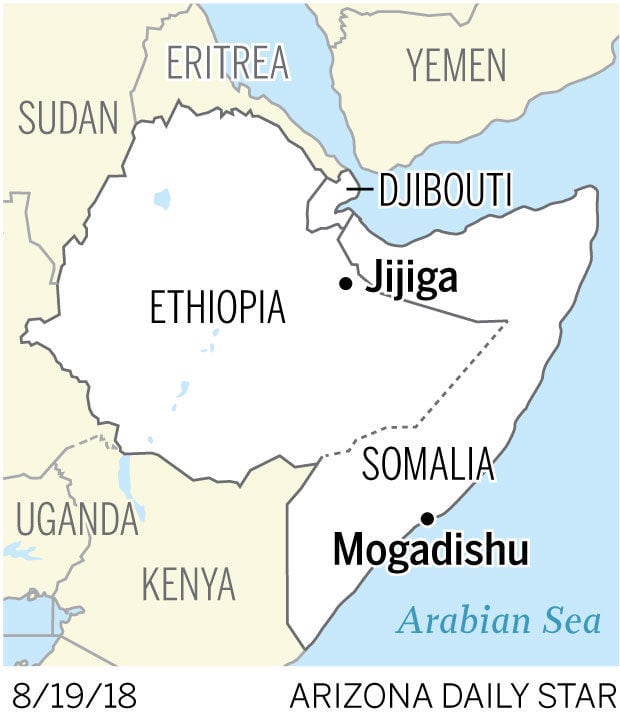
During the hearing, Young, the defense attorney, asked FBI special agent Trentlage about his knowledge regarding border disputes between Somalia and Ethiopia and how Jijiga, the city the government says Osman was born, is about six miles from the border.
He also questioned the government’s assertion of his relatives’ connections to al-Shabab based on a conviction in absentia in Somaliland, a region ruled by a government not recognized by the United States, for their alleged involvement in a 2014 terrorist attack in neighboring Djibouti.
Young also asked whether Trentlage knew whether anyone had gone to verify his father’s information in Ethiopia. “No,” he responded. But Trentlage said Ethiopian officials verified Osman’s place of birth.
The charge comes as the administration scales down the country’s refugee resettlement program.
“I fully understand, I think, the government’s position on refugees,” Young told Rateau, and clarified he didn’t mean Assistant U.S. Attorney Anderson.
“The Somalis see themselves repeatedly called a disaster. ... They see themselves compared to poisoned Skittles,” he said in reference to a 2016 tweet from Donald Trump Jr. where he compared Syrian refugees to a bowl of Skittles sprinkled with a few that “would kill you.”
“They hear wishes that they came from Norway, instead of these scatological countries. They hear the United States be called a dumping ground, a migrant camp, a refugee holding facility. And then the government brings this indictment?” he asked. “This is an attempt to find a terrorist where there are no terrorists.”

