


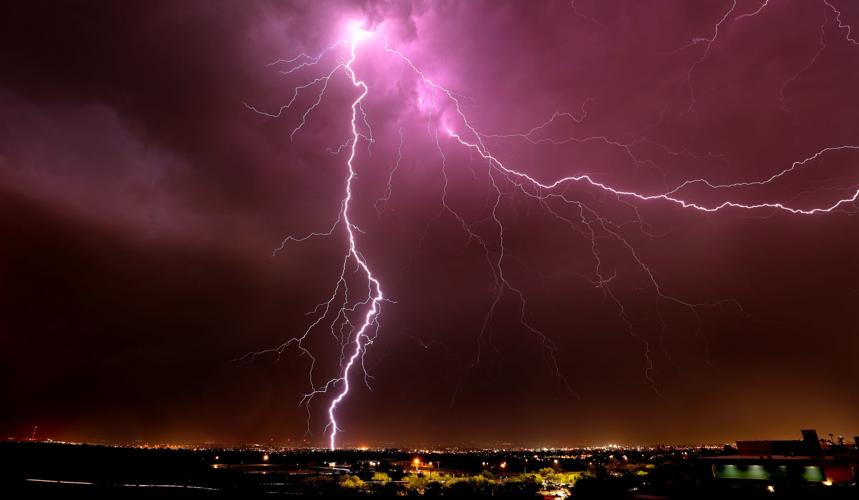


Tucson’s below average rainfall for August, which is typically the wettest month during monsoon season, might mean it’s time to face the music and prepare for a potential short-term drought, according to local weather experts.
As of Aug. 30, Tucson saw just over 1½ inches of rain during the month, falling 0.80 of an inch below normal. There was a slight chance of rain forecast for Saturday, which could bring up the month’s total. Rain remains in the forecast for most of the week.
“The main reason is that the monsoon ridge that kind of helps bring in moisture hasn’t been in a favorable position for a lot of August, so we’ve had a downtick in storm activity this month,” said National Weather Service meteorologist Aaron Hardin.
An average Tucson monsoon, which runs from mid-June through Sept. 30, brings about 6 inches of rain. With only one month left, Tucson has just over 2.6 inches of rain. The Climate Prediction Center is forecasting normal rain through September — 1.29 inches — so it’s unlikely the last month of monsoon will be enough to catch up to a normal season. If the monsoon ended today, it would be the 21st driest on record for Tucson, according to the weather service.
“If the recent past is any indication of the future, we don’t have a ton of hope,” said University of Arizona climatologist Mike Crimmins. “We’re really late in the season for any major catch-ups. I think the chance of us going above average at this point would really require an exceptionally wet September, and I think that’s unlikely. Reaching average is also going to be really tough to do and it would require some pretty heavy rain and fairly frequently going forward.”
Even with unlikely chances of heavy rain, in September Crimmins said the East Pacific tropical storm season just began to pick up within the last week or so, which could potentially have an impact on the storms we see in Tucson.
After experiencing above-average showers for winter and spring earlier in the year, weather experts are still unsure what this year’s winter will look like in terms of rainfall.
“Last year was exceptionally wet in the later part of winter from January and especially February,” Crimmins said. “It’s not super clear why that was the case because El Niño was kind of weak. We currently don’t have an El Niño on deck for the upcoming winter. The forecast is showing kind of neutral conditions for El Niño, so that doesn’t give us a lot of insight into what the winter might have in store for us. So, we’re kind of in that wait-and-see window.”
According to Crimmins, local climatologists have been in contact with the United States Drought Monitor based on data showing abnormally dry conditions for most of the state.
“Not seeing precipitation at the right time during the summer has impacts on ecosystems and agriculture, so we do have short-term drought creeping back into the state,” he said. “Last winter was really, really helpful and erased a lot of that short-term drought, but it’s pretty easy for us to slip back into that. So, given one wet winter and a crummy summer, that doesn’t leave us in a great spot and could cause things to deteriorate pretty quickly.”
A dry winter could cause Tucson to slip back into short-term drought conditions, lasting up to six months. As a state, Arizona is still facing a multi-decade, long-term drought from many years of below average precipitation, which continues to impact the state’s water resources.

