


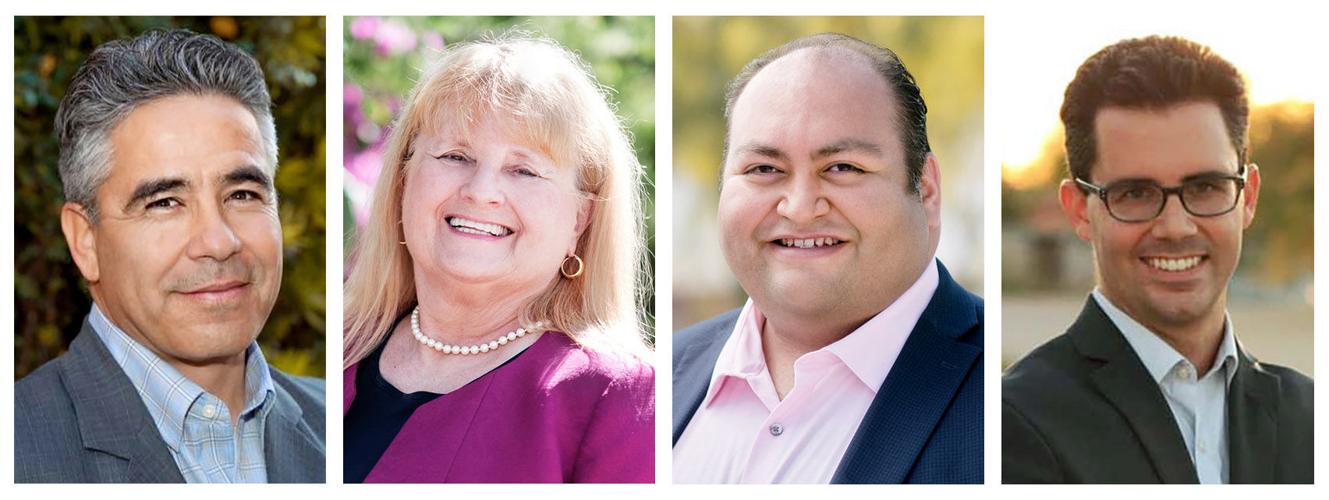
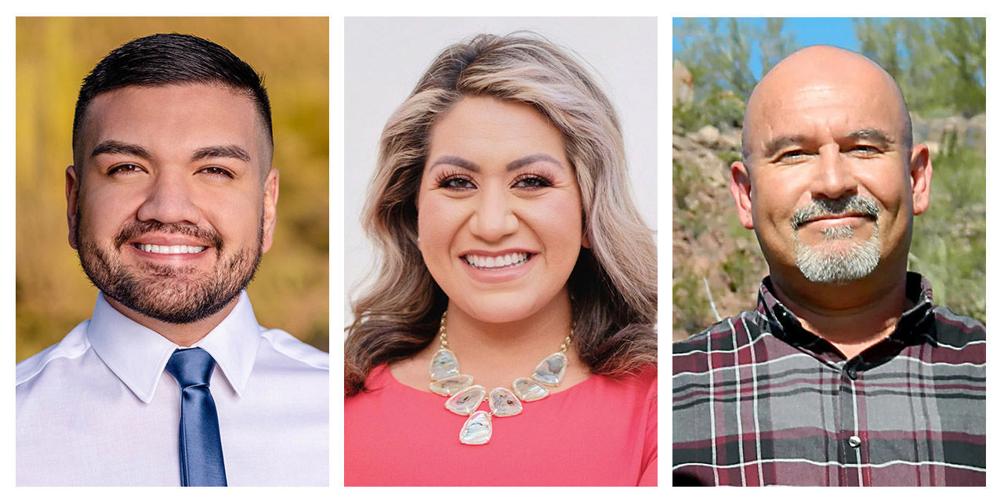

Voters from Tucson’s south side to Santa Cruz County will choose among several lawyers, a retired schoolteacher, a health policy expert, and a union organizer in the Aug. 4 Democratic primary for state representatives.
Seven Democratic candidates are running in Legislative Districts 2 and 3. The top priority for many of the candidates is the coronavirus pandemic, particularly the need to support public education and health care.
Voters in each district will choose two candidates for state representative to move on to the Nov. 3 general election. The Arizona Daily Star sent questionnaires to candidates in races with more than two candidates.
Republican Deborah McEwen is running unopposed in the LD 2 primary, and no Republicans are running in the LD 3 primary.
Legislative District 2
Voters will choose two of the four candidates in the Democratic primary in LD 2, which includes south-side neighborhoods east of Nogales Highway, South Tucson, Davis-Monthan Air Force Base, Sahuarita, Green Valley, Arivaca and Santa Cruz County.
Daniel Hernandez has held one of the seats since 2017. Rosanna Gabaldon has held the other seat since 2013, but she is running for the district’s state Senate seat.
The candidates in the LD2 primary are Hernandez, newcomers Luis Parra and Billy Peard, and Andrea Dalessandro, who has been a legislator since 2013, first as a representative and then as a senator.
Peard said his top priority is to “stem the damage caused by COVID-19,” which he said the Legislature has done a poor job of managing.
“During a time of crisis, the Legislature has been in recess since early May. Arizona is experiencing an unprecedented emergency, and yet the Legislature has authorized the government to spend only 10% of Arizona’s ‘Rainy Day’ fund,” Peard said. “The Legislature has done nothing to protect teachers, workers, inmates, domestic violence victims, and nursing home residents.”
In addition to protecting public health, Peard said the state needs a recovery plan for the recession.
“We must ensure we don’t repeat the mistakes of the 2008-2009 recession, where policies exacerbated the gap between rich and poor,” Peard said.
He called for policies to “protect small businesses, prevent evictions, improve workplace safety, expand paid sick leave, and release nonviolent offenders from county jails where they are at greater risk of disease.”
Peard, a Tucson resident, works as an attorney in civil rights and immigration cases. He graduated from Canyon del Oro High School and earned a law degree from Vermont Law School.
Peard said voters should choose him because they would “gain a representative who takes no money from corporations, listens to local concerns, advocates tirelessly for the working class and has spent his career defending immigrants and suing the Trump administration.”
Arizona ranks near the bottom on “almost every measure of well-being,” Peard said, calling that a “pretty good argument for ditching the status quo.”
Parra’s top priority is to “help get our economy back on track” during the global health crisis.
“I will support policies and bold legislation that stimulates small business owners to compete in the digital marketplace at the local, state, national and international level,” Parra said. “These policies must also consider the current physical and mental health concerns of all workers throughout our state.”
He pointed to an “urgent need” to generate well-paying jobs in Arizona. He plans to “incentivize a start-up culture in our local communities,” while also addressing the challenges faced by brick-and-mortar retailers.
Parra is an attorney who has lived in Rio Rico for 20 years. He earned his law degree from Arizona State University and runs a law firm in Nogales, where he handles cases in state court, federal court and federal appeals court. He worked as a public defender for Tucson, city attorney for Nogales, and chief civil deputy for the Santa Cruz County Attorney’s Office. He served in the U.S. Army during Operation Desert Storm in Iraq in 1991. He is the former chairman of the Kino Border Initiative, a Catholic group that helps migrants and deportees in Nogales, Sonora.
Parra says voters should choose him because of his personal and professional experience in Southern Arizona. His 20 years of practicing law in Southern Arizona “endowed me with the unique international and regional perspective on the main issues that require legislative solutions at the state level,” Parra said.
He raised his family in Southern Arizona and will “strive to give great value to the history, heritage and pristine environment of our region,” Parra said.
Hernandez said his top priority is “protecting health care,” particularly by “shoring up the infrastructure in our rural areas of Santa Cruz County and Green Valley.”
“While we have many other priorities for after the pandemic, nothing is more important than protecting and caring for our community,” Hernandez said. “I will work to expand testing in rural areas as well as provide additional support for communities that are hardest hit.”
Hernandez, a Tucson resident, has a bachelor’s degree in political science from the University of Arizona. He served on the Sunnyside Unified School District governing board from 2011 to 2019. He was state director for Everytown For Gun Safety from 2012 to 2014 and program manager at Planned Parenthood’s Raiz Program from 2016 to 2017.
As a state representative, Hernandez said he partnered with Republican Gov. Doug Ducey to secure more than $3.6 million for the Santa Cruz Valley Regional Hospital in Green Valley and $1 million for Holy Cross Hospital in Nogales. Last year, he helped secure $20 million for counselors and social workers at public schools, he said.
“When we work to recover, the next-highest priority will be economic development, particularly getting people safely back to work and ensuring they get paid a livable wage to take care of themselves and their families,” Hernandez said. He called for increasing unemployment insurance payments, “so people do not go back to work before it is safe.”
Hernandez says voters should choose him because he has been an effective lawmaker.
“I led the coalition to repeal the anti-LGBTQ ‘No Promo Homo’ law,” he said. “I also worked to stop guns in our schools. I’ve held my Republican colleagues to task on anti-woman, anti-worker, and anti-democracy legislation.”
For Dalessandro, the “overarching issue is how our businesses, educational institutions and constituents will survive the COVID-19 pandemic.”
Her top priority is supporting public education, particularly the safety of students, educators and support staff. She called for a national and state response to provide personal protective equipment that includes “everything from masks to hand sanitizer.”
School districts will need pandemic “flexibility and funding,” she said. She called for school openings to be delayed in many areas of the state until it is safe to return.
“The issue of the ‘digital divide’ must be addressed for rural and areas without access to the internet,” Dalessandro said. “Students, educators, support staff and families must be supplied with the resources for the students to have a positive learning experience without risk.”
Dalessandro has lived in Sahuarita since 2004. She has a master’s degree in mathematics education from New Jersey City University and an MBA in professional accounting from Rutgers University. She taught mathematics and accounting for 25 years. She is a retired certified public accountant and ran her own accounting practice for 25 years.
She was elected as a state representative in LD2 in 2012 and appointed to the state Senate in 2014. She won re-election in 2016 and 2018. She is the ranking member of the Education Committee, senior member of the Judiciary Committee, and a member of the Natural Resources and Energy Committee. She is one of eight legislators with 100% attendance for Senate votes.
Dalessandro said voters should choose her because she is a “proven and experienced progressive leader” who has drafted bills to support public education, a sustainable environment, local business, and fair and affordable health care.
Legislative District 3
Voters will choose two of the three candidates in the Democratic primary in Legislative District 3, which covers Tucson’s west and southwest sides including the University of Arizona and downtown, stretching from Ryan Airfield north to Prince Road at about First Avenue.
Democrats Andres Cano and Alma Hernandez have held the seats since 2019. The lone challenger in the primary is Javier Soto. No Republicans are running in the primary.
Soto said one of his top priorities is to make sure taxpayer money is spent wisely.
“I’m concerned about who pays and where it’s going,” Soto said. “When businesses ask for tax incentives to bring their company into Arizona, the state loses revenue. One way to balance that is to require that these businesses hire a majority of their workforce from local communities with stipulations, such as fair wages and benefits.
“We also must ensure those projects are built under a Project Labor Agreement, and contracts are awarded to local contractors,” Soto said. “When the workforce requires specially trained or certified positions, we can develop training classes through our own community college. This will keep taxpayer money circulating within the state.”
Soto is an organizer for the International Brotherhood of Electrical Workers. He was born in Nogales, Arizona, and grew up in Tucson on the south side in Barrio Vista, also known as Western Hills. As a student, he was bused to Catalina High School and then went to the Fred G. Acosta Job Corps for Building and Maintenance training.
He got his start in the workforce as an electrician and later joined the IBEW and became a journeyman wireman. He became an organizer for the Local 570. He also started working to make sure union members were registered to vote and armed with the information they needed to “vote in the interests of organized labor and working families.”
Soto also served as the chair of the Pima Area Labor Federation’s legislative committee, which involved going over Arizona’s legislation every week when the Legislature was in session and taking action.
“I bring a fresh new perspective to the table,” Soto said. “I am a first-time candidate, and I bring my own unique life experience. My constituents are literally the working families in southern Arizona, and I will represent them proudly.”
Alma Hernandez said her top priority is health care.
“As the only one with public health experience in this race, now more than ever we need elected officials who understand the issues on health care and protecting public health,” Hernandez said.
“This is the main reason I ran for office in the first place and after serving on the health and human services committee the last two years, I know there is much more we can do,” Hernandez said.
Hernandez is a Tucson resident and a health policy professor at Arizona State University. She has a bachelor’s degree in sociology and public health and a master’s degree in public health from the University of Arizona.
“I know we must continue to work on improving the health care and health human services that we provide to Arizonans,” Hernandez said. “I will continue to work on issues like vaccinations, especially now that COVID has affected us all, and will push for issues for the elderly in our communities.”
Hernandez said voters should choose her because she has “advocated for the issues and delivered to my community since Day 1.”
“When I said I wanted to see change with police officer trainings I worked hard in a bipartisan manner to ensure school resource officers were properly trained to work in schools with mental health and deescalation training,” Hernandez said. “I was able to get $1 million in the budget for that and I am proud of that as it will help ensure the safety of our children.”
Cano said his top priority is to support public education, saying, “We must put more dollars into our classrooms if we truly want a strong economy and opportunity for our kids.”
Cano is a Tucson resident. He graduated from Arizona State University and studied at the Harvard Kennedy School Executive Education program. He is the director of the LGBTQ+ Alliance Fund. Before becoming a state representative, he worked for eight years as an aide to Pima County Supervisor Richard Elías.
“As we recover from COVID-19, we must also lift up working families and small businesses who need relief,” Cano said. “We must expand health-care access and increase our state unemployment benefits during these uncertain times. Together, we will heal and move Arizona forward.”
Cano says voters should choose him because he is the “only candidate who will hold Governor Ducey accountable.”
Ducey “defunded our schools, universities, and community colleges — all while the Department of Corrections budget has skyrocketed year after year,” Cano said. “We spend more money sending Arizonans to prisons than we do on our three state universities combined.”
Ducey’s response to the pandemic was “slow and not science-based,” he said.
“I have no problem calling him out, and I will continue holding him accountable in my second term,” Cano said.

