

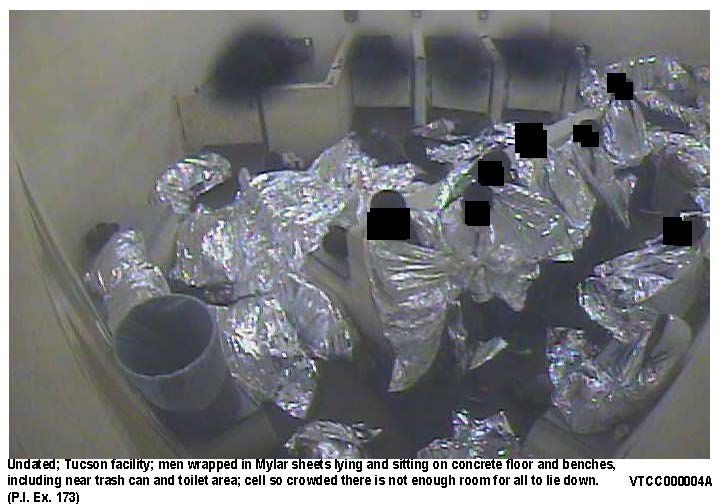

Recently unsealed evidence in a federal court case show what advocates call inhumane conditions inside Border Patrol detention centers.
Video stills taken by Border Patrol cameras inside several detention facilities in the Tucson Sector were unsealed Thursday morning as part of a federal lawsuit filed in Tucson on behalf of three detainees.
The lawsuit alleges "inhumane and punitive conditions" inside cells, which were designed to house detainees for only a few hours but regularly hold people for days, often at such low temperatures the cells are known as "hieleras" or iceboxes.
The images show a mother changing a baby's diaper on top of a mylar blanket placed on a trash-strewn cell floor; detainees sleeping on cell floors while mats lie idle in nearby empty cells; and detainees crowded so tightly in a cell there is little space to move around.
The Border Patrol's public affairs office in Tucson said it is agency policy not to comment on pending litigation.
The lawsuit was filed in 2015 by lawyers with the Morrison and Foerster law firm, the National Immigration Law Center, the American Immigration Council, the ACLU Foundation of Arizona, and the Lawyers' Committee for Civil Rights of the San Francisco Bay Area.
The plaintiffs claim the Border Patrol violates detainee's constitutional rights to due process by depriving them of sleep, sanitary conditions, medical screening and care, adequate food and water, and warmth.
The lawsuit cited Border Patrol guidelines to hold detainees for no more than 12 hours in the cells. However, records obtained by the plaintiffs under a Freedom of Information Act request showed 80 percent of the 72,198 people detained in the Tucson Sector in the first half of 2013 were held in Border Patrol custody for more than 24 hours, while 34 percent were in custody for more than 48 hours, and 11 percent were held for more than 72 hours.
The plaintiffs asked the court to issue an injunction barring the Border Patrol from depriving detainees of their constitutional rights and ordering the agency to provide beds, hygiene products, clean water and food, avoid overcrowding cells, provide medical care, and award the plaintiffs their costs.

