



Three ongoing Tucson art exhibits invite viewers to reflect on the constancy of immigration throughout history, with all of its joys and challenges, as well as the psychological and environmental impacts of man-made and natural borders.
The three independent exhibits — at the Tucson Desert Art Museum, Tohono Chul and the Arizona-Sonora Desert Museum — all opened in January, at a time of intense focus on immigration in news and politics.
“We thought it was more important than ever to discuss immigration, and immigration history in particular,” said Alyssa Travis, curator at the Tucson Desert Art Museum. The museum’s exhibit, “The Twisted Road: Finding Home in America,” runs through June 28.
Part of the show includes a survey of the last 200 years of immigration to the U.S., “a comprehensive and definitely a macro view” that features archival materials and artifacts on loan from the Arizona Historical Society, Travis said. Those include items owned by immigrants in Arizona, and century-old political cartoons calling immigrants “anarchists” and “criminals,” mirroring the anti-immigrant rhetoric of today, she said.
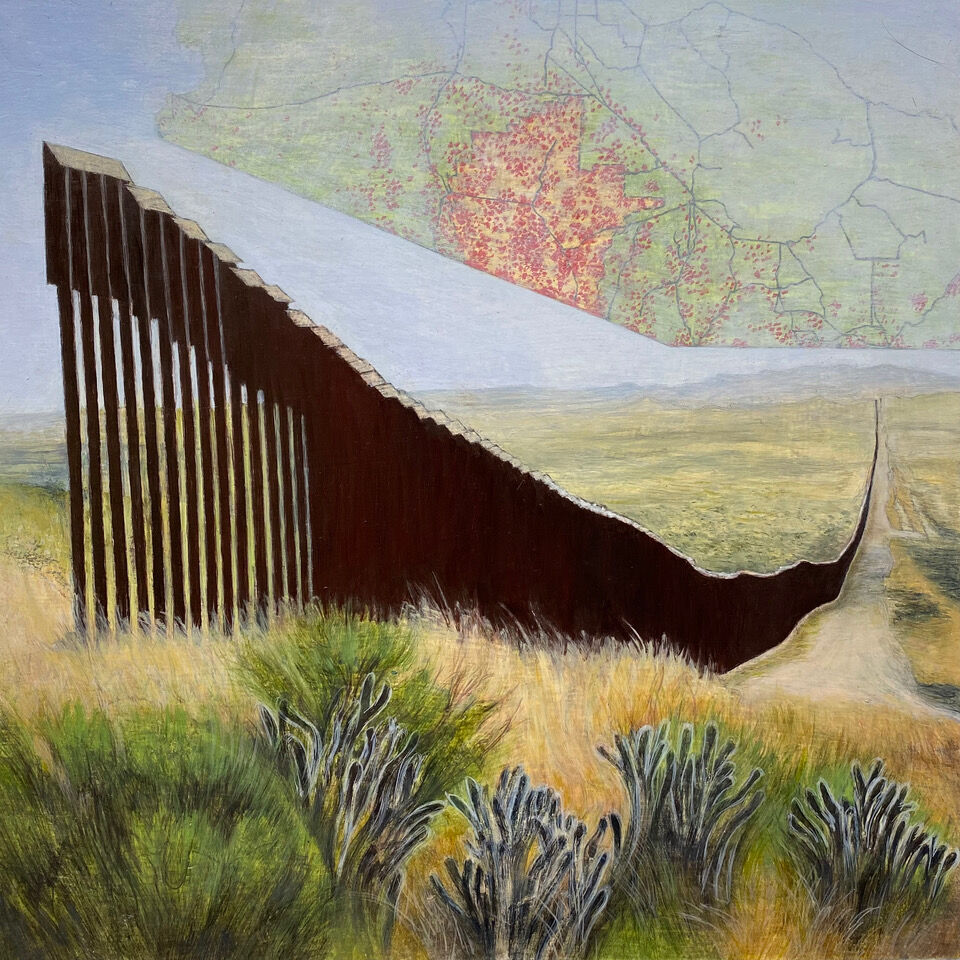
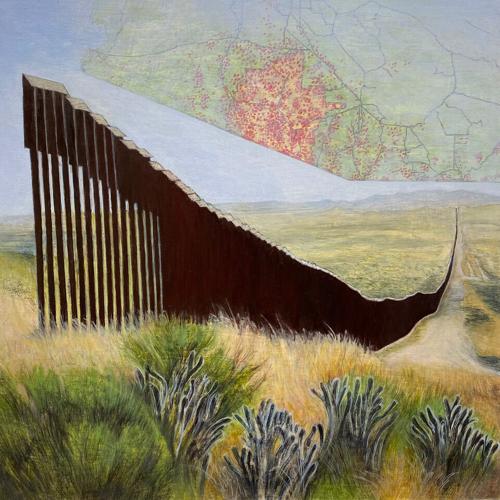
In this 2022 painting “El Corredor de la Muerte,” part of the “Postcards from the Border” exhibit at Tohono Chul, Tucson artist Susan Lyman imagines the Humane Borders’ migrant-death map above a border landscape, based on a photo by photojournalist Nick Oza. Of her Tohono Chul exhibit, Lyman writes, “I find inspiration in the investigative photography and writing of photojournalists covering the border, and also work from my own photographs taken in the borderlands. As the series has progressed, I have been using multiple or layered images to create a re-imagined landscape.”
To bring more immediacy and individual perspective to the exhibit, Travis also sought out three Arizona-based artists whose work speaks to their experience as immigrants: Anh-Thuy Nguyen, a Vietnamese-American artist; Perla Segovia, born in Peru; and Safwat Saleem, originally from Pakistan.
Saleem, now based in Phoenix, was born in Pakistan, grew up in the United Arab Emirates and moved to the U.S. as a teenager. Those experiences infuse all of his art, he said.
A graphic designer by training, Saleem said his work uses humor and satire to reflect the joy, and the tensions, of being an immigrant parent. And much of that work is aimed at his U.S.-born 7-year-old daughter, to help her one day understand the “immigrant perspective of her father.”
“She’s not an immigrant, but I am,” he said. “It’s part of my job as a parent to help her understand the complexity of what it means, but for her to never even question if she belongs here or not, because she 100 percent does — no matter what anybody else says.”
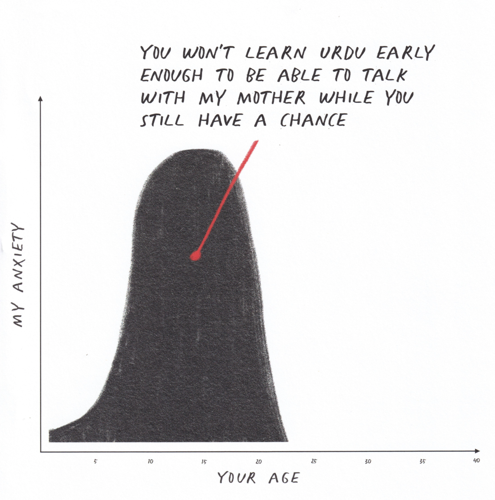
He described one project, “Anxieties of an Immigrant Father,” comprising 50 charts documenting the evolution of his anxieties over the course of his daughter’s life.

Phoenix artist Safwat Saleem, who was born in Pakistan, describes his project "Anxieties of an Immigrant Father" as "a series of charts that map my current and future anxieties about being an immigrant parent. Addressed to my daughter, the anxieties rise and fall based on my daughter's age as I make assumptions about whether something will make me less or more anxious in the future." One chart centers on the worry that she won't be able to learn Pakistan's language, Urdu, soon enough to talk with her grandmother before she dies, he said.
One chart, that peaks very early, depicts Saleem’s level of his anxiety that “you’ll poo when I’m out and I won’t have any spare diapers,” he said with a laugh.
But the concern that his daughter, who is half white, will struggle with a sense of belonging persists well into her adulthood, he said.
Another worry is that she won’t be able to learn Pakistan’s language, Urdu, soon enough to talk with her grandmother before she dies, he said.
Saleem said he wants his art to also evoke the everyday joys of being an immigrant, not only the challenges.
“I very intentionally make art that has humor, that has joy, along with the negative as well,” he said. “I feel there are multiple dimensions to the immigrant experience, and it’s important for my art to reflect more than one dimension. It can’t just be about the trauma.”
At Tohono Chul, Susan Lyman’s “Postcard from the Border” exhibit runs through Feb. 23. Lyman said the project idea stemmed from images she began shooting from along the border wall in 2020 and continued through a period of heightened migration and militarization at the wall.
Of the exhibit, Lyman writes, “I find inspiration in the investigative photography and writing of photojournalists covering the border, and also work from my own photographs taken in the borderlands. As the series has progressed, I have been using multiple or layered images to create a re-imagined landscape.” Her works are often a combination of Lyman’s painting and collage work, overlaid on images captured by border journalists and documentarians, whom she credits.

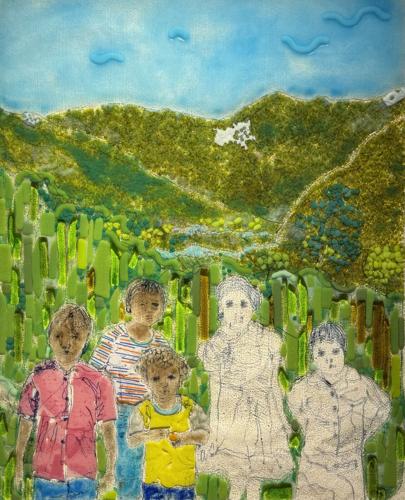
Perla Segovia, born in Peru, uses glass and textile techniques to address social themes involving women and immigration. Her work is part of the Tucson Desert Art Museum exhibit, “The Twisted Road: Finding Home in America,” which examines 200 years of U.S. immigration history through the lens of art and historical narratives. The exhibit runs through June 28.
The underlying image in one of her pieces is a “distressing” shot taken by Southern Arizona conservationist Laiken Jordahl. The photograph shows a dead deer at the base of the border wall, which has disrupted migration routes throughout the borderlands, she said.
With paint, Lyman depicts an imagined water source above the dead animal.
“I’m trying to express the sadness I feel about what’s going on,” Lyman said. “For me, it’s not an in-your-face political painting; it’s inviting my viewer to have some empathy about the situation.”
At the Arizona-Sonora Desert Museum’s Art Institute, the “UnNatural Borders” exhibit runs through March 16. The collection is presented by BorderLens/SW, a collective of women photographers and cinematographers from the Southwest, who also work with “sister collectives in Mexico to enrich cross-border dialogues.”
The collection explores “visual interpretations of borders and barriers, natural and man-made, ranging from literal imagery like fences to abstract imagery of shapes,” Victoria Westover, co-founder of BorderLens/SW, wrote in an email. “Through the work, we aim to encourage viewers to think about the psychological impacts of barriers, specifically physical ones.”
Borders are not just political, Westover said.
“They are deeply embedded in nature and culture. The ‘unNatural Borders’ exhibit challenges viewers to reconsider how they define and engage with borders in their own lives,” she said.
Saleem said he ultimately hopes his work provokes greater empathy for the immigrant experience — a backstory most U.S. residents share, he points out — and broader understanding of the challenges of navigating a complicated, outdated immigration system.
“This system is complex by design. It is designed to exclude people,” he said. “If they understood how difficult it is, maybe they will be a bit more empathetic about how complex this problem is and maybe it will reframe their thinking a little.”
DANCE WITHOUT BORDERS Backed by musicians from Fly Pan Am and members of the UK-based collective United Visual Artists (UVA), choreographer Dana Gingras imagines FRONTERA, a new ambitious work that stretches the boundaries of the performing arts. A dazzling, subversive blast of energy!
Video courtesy of United Visual Artists.

