


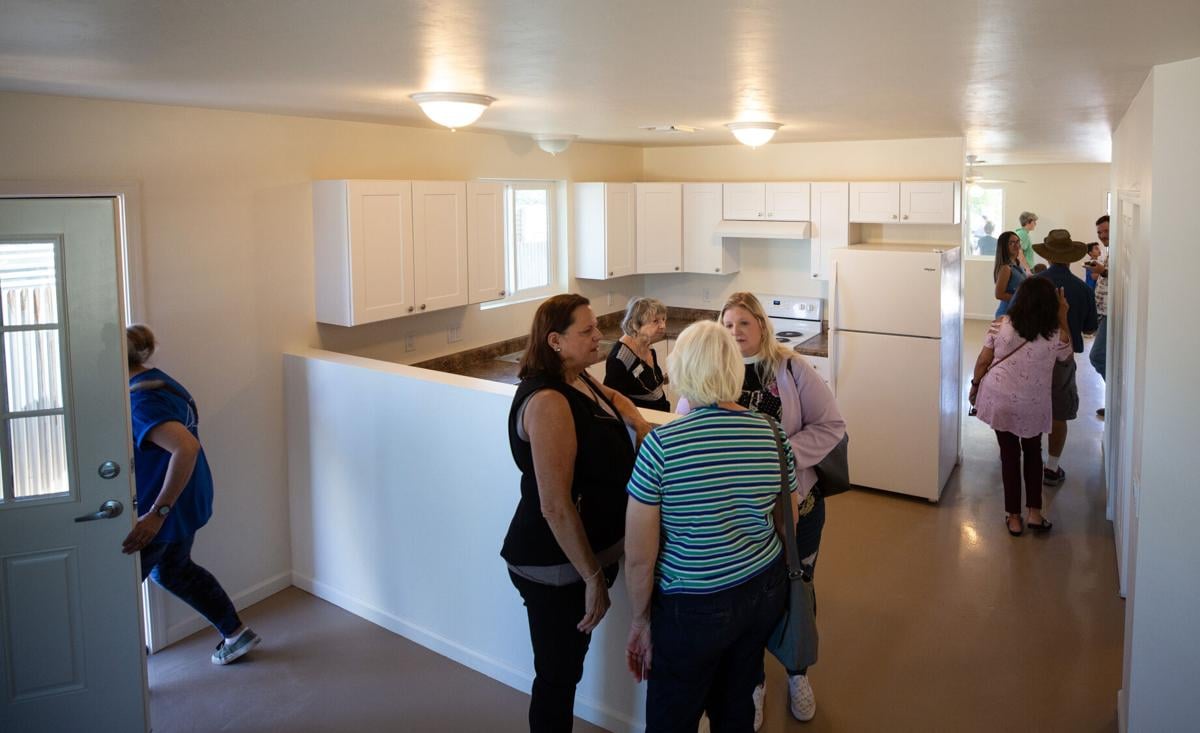
The face of homelessness has changed, said Allison Lenocker, executive director of The Coalition for Compassion and Justice, a nonprofit organization in Prescott.
According to the Arizona Department of Economic Security, 13,553 Arizonans experienced homelessness in 2022. This number has increased by 25% since 2020. The number of unhoused people in Tucson and Pima County was 2,227, about 16% of the state average and about a 68% increase since 2020.
A lack of affordable housing is contributing to the increase, according to the report. Lenocker says she’s observed this herself.
“We’re talking to families and older folks who are like, ‘I can afford to live I just can’t afford to pay rent that’s astronomical,” Lenocker said.
The average residential sales price in Tucson increased by approximately 49% between January 2020 and 2023, compared to an approximate 19% increase between January 2017 and 2019. Lenocker says the Coalition for Compassion and Justice (CCJ) saw individuals and families in their community with fixed incomes fall into homelessness with no housing options for them. It was then, she explained, that the CCJ decided to shift its focus from social services to finding permanent solutions to homelessness.
However, the cost of getting the effort off the ground was a challenge as the organization doesn’t accept government funding, relying instead on grants, foundations and private donors.
The CCJ bought four acres of land to build a housing project, a 25-unit manufactured home park in Chino Valley but didn’t have the money to break ground.
Lenocker said the organization wasn’t sure how to continue the project until they were connected to the Arizona Housing Fund, a philanthropic fund providing grants to nonprofit agencies working to create affordable housing.
After applying to the fund in 2022, the CCJ received a $200,000 grant, allowing it to start digging a well and complete on- and off-site improvements.
“The grant helped us get off the ground,” Lenocker said. “Without that, I don’t think we’d be able to move at a pace that we’ve been able to.”
Howard Epstein, the founder of the Arizona Housing Fund and Bank of America executive, has been working to fight homelessness for almost 30 years. He started his work through Central Arizona Shelter Services as Bank of America’s representative on the CASS’s board, serving there for 20 years. For the past 15 years, Epstein has been serving on Arizona Housing, Inc.’s board, where he observed the effect of creating affordable housing options.
“When a nonprofit brings 80 units online that weren’t there yesterday, you can see people coming out of the shelters, coming out of places unsheltered like their car,” Epstein said.
When people move into the units, it creates more space in shelters, Epstein explained. He created the Arizona Housing Fund in 2019 to combat costs with a creative donation program intended to increase the sustainability of the fund.
In addition to direct donations, the Arizona Housing Fund uses the Escrow Donation Program to collect money. Approved by the Arizona Association of Realtors, this program allows property buyers and sellers to voluntarily donate $25 to the Arizona Housing Fund out of their escrow settlement. This tax-deductible donation is presented to buyers and sellers through participating realtors, brokers, developers, title companies and home builders.
Epstein said anecdotally that of the 4,300 individual donations the fund received, 80% came from the escrow program. When asked why the requested amount is $25, Epstein said it’s nonoffensive, but when $25 is multiplied by thousands, the number becomes significant.
“When you’re buying or selling a house, it’s a good thing in your life,” Epstein said. “So, people feel like OK, there’s a small way to give back.”
Epstein said this fund is a statewide grassroots effort and as such, allows their partners and donors to be a part of the solution.
The Arizona Housing Fund gave four grants last year but hasn’t received applications from organizations in Southern Arizona. Epstein said the fund hopes to extend its reach and become a part of the Tucson/Pima County ecosystem.
“Tucson’s got a housing and homelessness issue, too, and we think we can be a part of that solution,” Epstein said.
Ted Taylor, CEO of Family Promise of Greater Phoenix, another Arizona Housing Fund grant recipient, used the money to build a micro affordable housing development.
Family Promise is a nonprofit organization providing shelter and social services for families experiencing homelessness in Maricopa County. The organization partnered with a congregation in Glendale, using their extra land for the project. This village, containing six quality container homes, was funded by four foundations, including the Arizona Housing Fund and the project’s initial funder, the BHHS Legacy Foundation, a grant-providing organization in northern Arizona.
Taylor said this project will address an additional challenge when creating affordable housing: location.
“The further we push the poor in our community to the peripheral, the less involved those parents can be in their children’s lives,” Taylor said. “And to us, that’s a tragedy.”
Taylor explained that by building the micro-housing project inside the city, families will be able to engage with their children and the community, making their affordable housing more sustainable.
Epstein said there is a tremendous need for housing and that seeing tent after tent while driving is heartbreaking.
“There’s a lot of problems in our society and in our country where solutions are not easy, right? Whether it’s drug addiction, domestic violence, mental illness,” Epstein said. “The housing problem is really simple; we need more of it.”
For more information about the Arizona Housing Fund, visit arizonahousingfund.org.
The Tucson nonprofit I Am You 360 broke ground in March on its small home village for youth transitioning out of foster care. The foundations have been laid and walls built for six of the 10 buildings and work on the final four is underway. Video by Caitlin Schmidt / Arizona Daily Star.

