


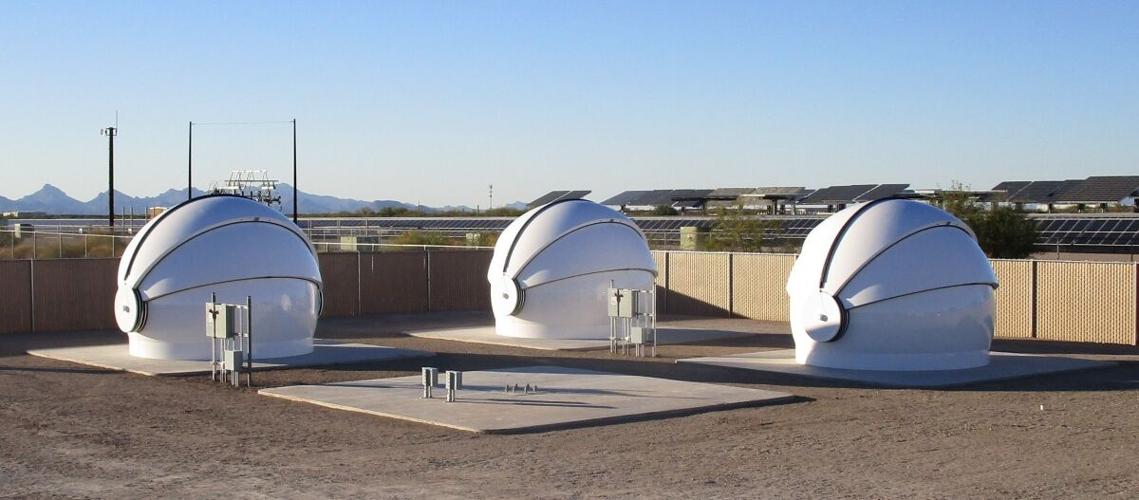

A longtime Tucson space-tech company is testing ground-based optical systems for space security, missile warning and satellite tracking at a new facility at the University of Arizona Tech Park.
The company, Geost, said the site at the park on South Rita Road is ideal to test the new technology, demonstrate products to potential customers, and foster the company’s growth plan near its main campus in Tucson.
“This unique and spacious build to suit UA Tech Park site enables Geost to quickly and efficiently assemble and test our optical collection systems before their deployment to serve critical missions for our customers,” Rich Gray, president and general manager of Geost, said as the company announced the site.
Founded in 2004 by UA optics Ph.D. Anthony Gleckler, Geost specializes in space-based electro-optical sensor systems and has quietly developed and produced such systems for the Air Force, and more recently the Space Force for nearly two decades.
Geost was acquired by the private-equity firm ATL Partners in 2021 and is now part of LightRidge Solutions, formed by ATL in March to encompass Geost and another acquisition, Colorado-based laser-radar sensor maker Ophir Corp. In July, LightRidge acquired Virginia-based Trident Systems, a maker of space electronics for communications and data processing.
Goest makes optical space- and ground-based sensor systems to protect military satellites from space debris and weather damage, warn of missile threats and track satellites and other objects for “space domain awareness.”
In December 2021, Geost was awarded a contract worth up to $32 million by the Space Force to further develop and demonstrate a small space-domain awareness system.
Geost announced in September that it had won a contract to produce eight payloads for missile-tracking satellites that Northrop Grumman is building for the U.S. Space Development Agency’s Tracking Layer satellite constellation.
The space agency’s Tracking Layer satellite system, designed to provide global detection, warning, tracking and targeting of advanced missile threats, is projected to become operational in 2025.
Green-fuel startup gets $20M

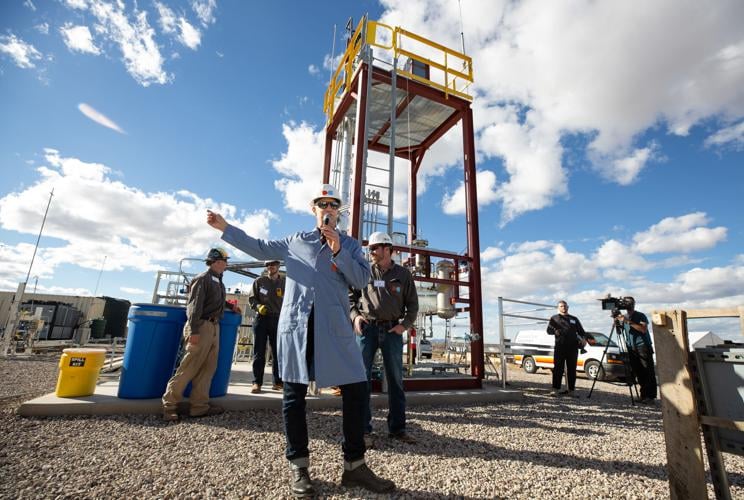
Jason Salfi, co-founder and CEO of Dimensional Energy, talks in front of the Fischer Tropsch reactor, which converts syngas into pure liquid hydrocarbons that can be further refined into fuels like aviation gas, at the University of Arizona Tech Park, 9040 S. Rita Road, in Tucson on Dec. 6, 2022.
Dimensional Energy, a New York-based company that opened a research facility in Tucson last year, recently closed a $20 million Series A funding round to advance its technology to make sustainable hydrocarbon fuels with captured carbon dioxide emissions.
The Ithaca, New York, based startup plans to use some of the proceeds to continue development of its proprietary reactor and catalyst technologies at a field-testing site the company opened in December 2022 at the University of Arizona Science and Technology Park on South Rita Road.
The funding round was led by Envisioning Partners, a prominent Korea-based impact venture capital fund focused on climate investing, with strategic participation from United Airlines’ Sustainable Flight Fund, Microsoft’s Climate Innovation Fund, RockCreek Group’s Smart Aviation Futures fund, DSC Investment, Delek US, New York Ventures, Climate Tech Circle, and continuing support from existing investors, the company said.
Dimensional Energy’s technology combines carbon dioxide and water through a patented, renewable-energy-powered process to create sustainable aviation fuel and replace other fossil-fuel products ranging from plastics to cosmetics.
The company says it plans to use the new funding to build the world’s first advanced power-to-liquid fuels plant, utilizing emissions from the Lafarge Richmond Cement Plant in British Columbia, Canada, in partnership with Svante, a leader in carbon-capture technology.
The company says it also plans to introduce its first consumer and business-to-business products, including “fossil-free” surf wax and a “cruelty-free” fat alternative tailored for vegan food manufacturers.
Along with the new funding, Dimensional Energy CEO Jason Salfi announced the company had filed a Delaware Public Benefit Corporation Charter, the first step in becoming a certified B Corporation, a for-profit type of corporation whose goals include making a positive societal impact.
United Airlines Venture Fund made a follow up investment in Dimensional after signing an agreement to buy 300 million gallons of sustainable aviation fuel from the startup.
Learn how Dimensional Energy, which opened a tech center in Tucson, turns carbon dioxide and water into jet fuel. Video courtesy National Science Foundation.
Raytheon EKV hits mark
A kinetic warhead made by Raytheon in Tucson hit and destroyed an intermediate-range ballistic missile during a recent test of the nation’s Ground-based Midcourse Defense System, a system of large missile interceptors stationed in silos in Alaska and California.
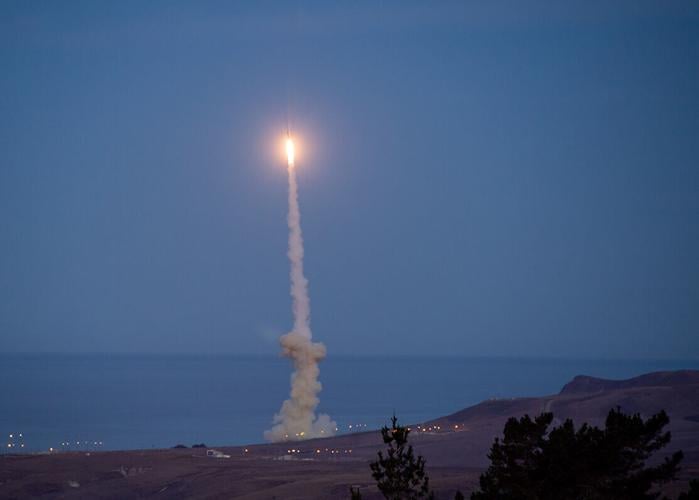
During the test in mid-December, the first flight test of the system since 2019, an upgraded GMD interceptor carrying Raytheon’s Exoatmospheric Kill Vehicle was launched from Vandenberg Space Force Base in California to engage the IRMB target over the Pacific Ocean, the U.S. Missile Defense Agency said.
The test flight was the first using a three-stage interceptor operating in two-stage mode, which means the third stage was commanded not to ignite and allowed earlier release of the kill vehicle, providing closer-range engagements, the MDA said.
The recent test was the GMD program’s 13th successful intercept, and fourth in row, in 21 tries since 1999.

An upgraded Ground Based Interceptor with a Capability Enhanced-II Block 1 Exo-Atmospheric Kill Vehicle (EKV) is launched from Vandenberg Space Force Base, California, during Flight Test Ground-based Midcourse Defense Weapon System-12, or FTG-12, on Dec. 11.
The agency had planned to replace the EKV with a new design after flight-test failures in 2010 and 2013, but dropped that effort due to technical problems in 2019.
The upgraded Raytheon EKV was successful in test flights in 2014, 2017 and 2019, when the MDA paused testing.
Missile-defense critics have cited the EKV’s spotty past intercept record and a failure to present real-world challenges particularly in some early testing.
But Raytheon President Wes Kremer said after the most recent test that “the U.S. ballistic missile defense system is operational, reliable and ready to protect the country,” citing the company’s completion of nearly 50 space intercepts including testing of its Standard Missile as part of the mainly ship-based Aegis Ballistic Missile Defense system.

