


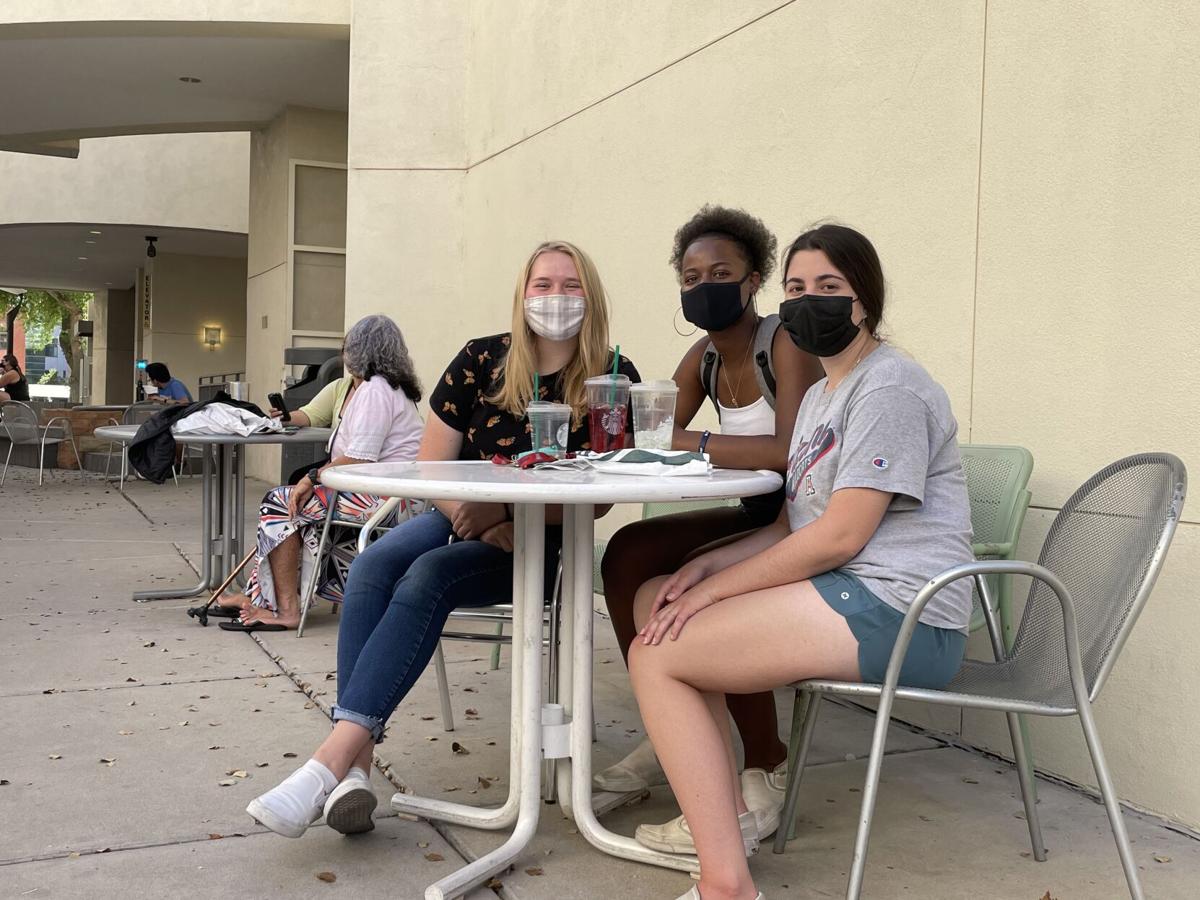
As summer approaches, University of Arizona sophomore Sophie Fragen is left with a paradox.
She wants an internship to get more experience, but all of the internships she wants require experience.
As a film and television major, in-person interactive learning was important to Fragen, but cancellations and transitions to online learning due to the COVID-19 pandemic last summer left Fragen feeling like the situation, “shot (opportunities) in the leg.”
Finding a summer internship, she has discovered, has not been easy.
She is not alone. College student internship openings posted online at the job site Glassdoor plummeted 39% during the pandemic, from about 50,000 in April 2019 to about 30,000 in April 2020. The unemployment rate for those with Bachelor’s degrees was still nearly twice the pre-pandemic rate at 3.7%, according to the U.S. Bureau of Labor Statistics.
Although job searches have not been easy for students, options might be improving, UA student advisers say.
“For everybody, this summer is still more challenging than most, but it’s not as difficult,” said Stephanie Springer, internship director at the UA’s School of Public and Applied Humanities. “It’s not as dire as last summer was because companies have had the opportunity to pivot to figure out what kinds of opportunities they can offer that are still meeting the safety and health conditions that are set forth by public health agencies.”
Career advising appointments have dropped slightly at the UA, according to Megan Forecki, senior coordinator of assessment and research, student engagement and career development.
COVID has caused students and UA officials to think creatively.
Pandemic pivot
Peter Corrigan, associate director of UA Employer and Alumni Connections, said the pandemic required a different approach to helping students secure jobs.
“We had a large employer with like 25 students coming to work for them (both) internships and full time, and they couldn’t do it. They couldn’t bring them on,” Corrigan said. “So what we did was, I got the recruiter to share the information, the students’ information with us. … We offered to set up appointments with them, (and) we pointed them toward resources.”
Career fairs have also changed to fit the circumstances, which had advantages and disadvantages for students, Corrigan said.
“We do the career fairs, we’re going more and more niche, meaning not just a big room, full of all employers, and in a big room full of all students,” Corrigan said.
Although job fairs became virtual, they have not necessarily been easy for students to navigate, according to Corrigan.
“I can tell when students have to make an appointment to see employers, but then they don’t. So they register for the career fair, but then they don’t make appointments, or they make appointments, and then they don’t show up, or the employer, for some reason, they’ll bring two or three colleagues with them, but then one of the colleagues doesn’t show up,” Corrigan said.
Low salary or unpaid internships have been barriers for students with financial need, leading to potential gaps in job experience.
Springer cited the new Summer Impact Awards, which started in 2020, as one of the ways in which the UA internship programs were able to adapt to support students over the summer.
“There’s basically a $2,500 stipend for students who are doing unpaid or underpaid internships, to recognize that there is a burden for those kinds of opportunities,” Springer said. “It helps students make strategic choices about those opportunities, which have a lot of value that students might not have considered otherwise.”
Shift in mindset
As the zeitgeist of the COVID-19 pandemic began to change for employers and coordinators, students were beginning to feel a change in their own thinking, too.
Burke Wood, a sophomore majoring in environmental studies, had concerns about the pressure to find a job after the COVID-19 pandemic subsides.
“Given my field, I have a lot of options, which is nice, but also, knowing that the pandemic has been a bit of an easy way to fall back and be like, OK, I have the time,” Wood said. “So I’m afraid now that it’ll be over within the year, maybe, or like a year from now that that pressure is going to be a lot higher to really figure out what you have to do. Especially because I haven’t really figured that out yet.”
Freshman Twa’Niyah Adams had plans to return to a job at an amusement park she held during her senior year of high school instead of taking an internship. Although Adams was in her first year of college, she felt like she was already behind.
“It made (internships) feel a lot more intimidating and challenging to get to because of the pandemic. I’m a freshman, and there’s already people who have had internships, and I feel like I’m behind because I haven’t had those opportunities. I couldn’t get it before the pandemic and then couldn’t get it while I’m in the pandemic so I’m kind of just here,” Adams said.
Although Adams did not have an internship, she cited the PREMIER program for Eller first-year students as the main place where she learned about online tools that could assist her in her search in the first place such as LinkedIn or Handshake, an app to help connect college students with jobs and internships.
The pressure of searching for jobs during the pandemic drove sophomore Hailey Smith to start thinking more about the UA options available to her.
“I feel kind of like a pressure to start being more motivated to do those types of things,” Smith said. “That pressure motivates me to maybe seek out advice from one of the academic or career counselors here at the U of A, or just job searches on Handshake.”

