

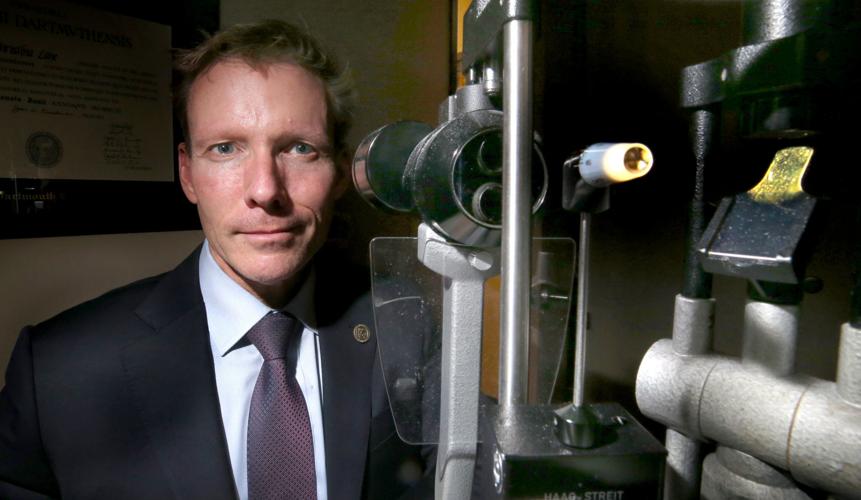
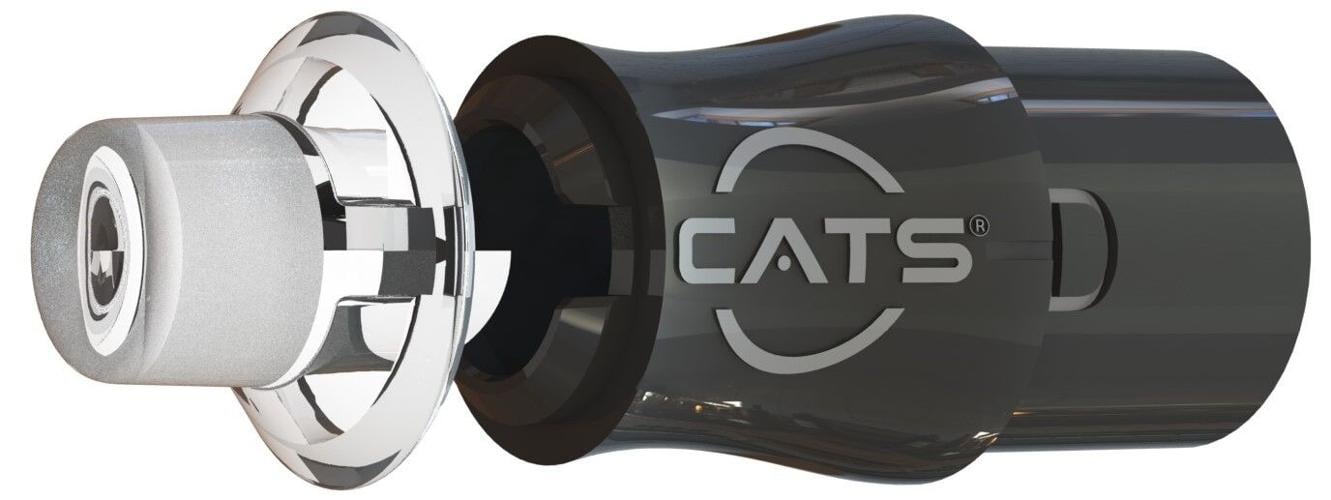

Tucson medical startup CATS Tonometer has won federal clearance to market a disposable version of its device to measure internal eye pressure, with plans to start selling the instrument this fall.
The U.S. Food and Drug Administration approved CATS Tonometer’s disposable version of a prism device that increases the accuracy of a common instrument that measures eye pressure to diagnose diseases such as glaucoma.
The company, founded in 2015 by University of Arizona alumnus Dr. Sean McCafferty, won FDA clearance for a reusable version of its patented prism in 2018.
Market clearance is a form of FDA market approval mainly based on a medical device’s similarity to an already-approved device.
CATS Tonometer has been selling the reusable device through Reichert Technologies under a distribution agreement announced last year.
The recently cleared CATS-D Disposable Prism is designed to deliver improved intraocular pressure measurement accuracy using a sterile, disposable tip replacement for the commonly used pressure-measuring device called a Goldmann applanation tonometer.
A Goldmann tonometer test is often ordered as a follow-up when a noncontact eye-pressure test — the “puff” test used by optometrists and ophthalmologists — raises concerns.
But the Goldmann tests can be highly inaccurate, with error-inducing factors such as variances in corneal thickness and rigidity often leading to misdiagnoses.
Using mathematical models to correct for such error-causing factors, CATS Tonometer designed a tonometer tip surface that can cut the error rate by 50% or more, the company says.
CATS Tonometer’s prism — known as a correcting applanation tonometry surface, or CATS for short — can be quickly adapted to the thousands of Goldmann tonometers already in use.
And since the tip of the device comes into contact with the eye during use, the disposable tips help protect patients and staff from contagious diseases — including COVID-19 — that could be passed on from an unclean or improperly cleaned reusable prism, the company said.
McCafferty, who got his master’s degree in optics from the UA in 2015 and serves as a UA clinical associate professor of ophthalmology, developed the CATS tonometer with several colleagues at the UA, in studies funded by the National Institutes of Health.
He believes the company’s reusable and single-use devices will quickly supplant the 60-year-old Goldmann prism technology and become the new standard of care for eye-pressure measurement.
UA improves in
patents rankings
The University of Arizona ranked No. 28 among the top 100 worldwide universities with the most U.S. patents granted for inventions in 2020, up 11 spots from 2019, according to a list released recently by the National Academy of Inventors and the Intellectual Property Owners Association.
In 2020, a total of 81 patents were issued to the UA and the Arizona Board of Regents for inventions developed at the university, 19 more than the previous year., the school said.
In 2018, the university ranked No. 66, and in 2019 the ranking rose to No. 39.
Besides its world-class research, the UA cited its commitment to technology commercialization since the 2012 creation of Tech Launch Arizona, which helps faculty members to refine and patent their inventions, licenses their intellectual property and encourages local startups based on UA technology.
Aqualung moves
forward with trial
Meanwhile, Tech Launch Arizona startup Aqualung Therapeutics Corp. is planning to move forward with an initial, small-scale human clinical trial of its proposed drug to treat acute respiratory distress syndrome after a successful meeting with the FDA.
The Tucson-based company, founded by UA pulmonary physician-scientist Dr. Joe "Skip" Garcia, now plans to move forward with a “Phase 0” study in the coming months to support an Investigational New Drug application filing with the FDA.
A Phase 0 trial is an exploratory study, usually involving small doses and 10 patients or fewer, used to quickly establish whether an agent will work as desired in humans.
In its meeting with FDA officials, Aqualung said it shared its development plan for its drug candidate, known as ALT-100 mAb, along with “extraordinarily compelling pre-clinical evidence” in animal studies.

