



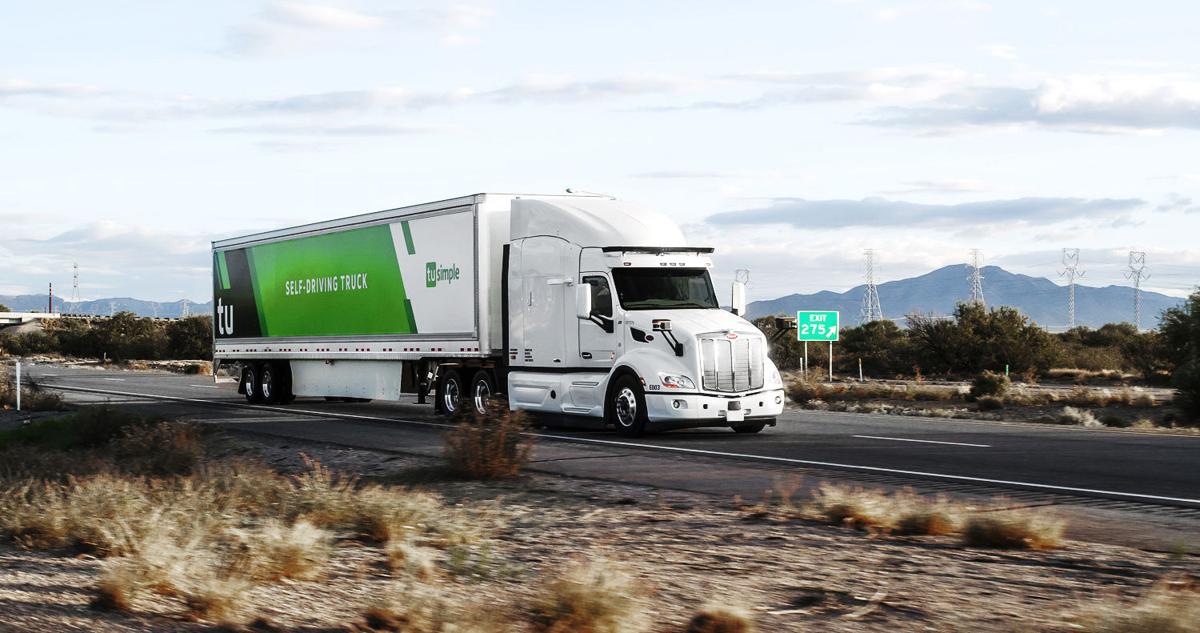
TuSimple Holdings, a developer of self-driving commercial trucks with major operations in Tucson, says it intends to explore options including potential partnerships for its operations in China and the Asian-Pacific region.
TuSimple said in a statement that certain partnerships could enhance shareholder value and that it has no immediate plans to sell off its Asian assets, which include operations in China, Hong Kong and Japan.
“This exploratory process does not currently include any plans for a divestiture or a similar transaction for any of its businesses or subsidiaries,” said the San Diego-based company, which is publicly traded on the Nasdaq Global Select Market.
The announcement comes about a month after TuSimple said that it had signed a National Security Agreement with the U.S. government, agreeing to limit access to certain data and adopt a technology-control plan, and to drop a board member from a Chinese investor group, among other measures.
The security agreement was reached after a probe by the U.S. Committee on Foreign Investment in the United States found no unresolved national security concerns, TuSimple said in filings with the U.S. Securities and Exchange Commission.
TuSimple has a large base of Chinese investors that bankrolled the company early on, including Sun Dream Inc., an affiliate of Chinese internet giant Sina Corp.
As part of the agreement, two board members with Sun Dream agreed not to stand for reelection when their terms expire and Sun Dream won’t nominate replacement candidates or boost its stake in TuSimple.
The company also agreed to appoint a security officer and a security director, establish a government security committee of the board and periodically meet with and report to certain federal monitoring agencies.
TuSimple’s system uses an array of sensors and cameras with artificial intelligence to guide semi-trucks on point-to-point routes mainly on interstate highways.
In December, TuSimple announced it had completed the industry’s first fully driverless test run from Tucson to Phoenix, as it works toward getting regulatory approval to begin regular autonomous runs by the end of 2023.
The company has been testing its system with a driver onboard since 2017 from its southeast Tucson terminal on Old East Vail Road, hauling loads for customers and development partners including UPS, McLane Co. and the U.S. Postal Service.
Automotive News reports that autonomous driving engineers are focusing their efforts on perfecting long-haul freight. Most interstate runs lack anything more complex that slow curves or E-ZPass lanes.

