

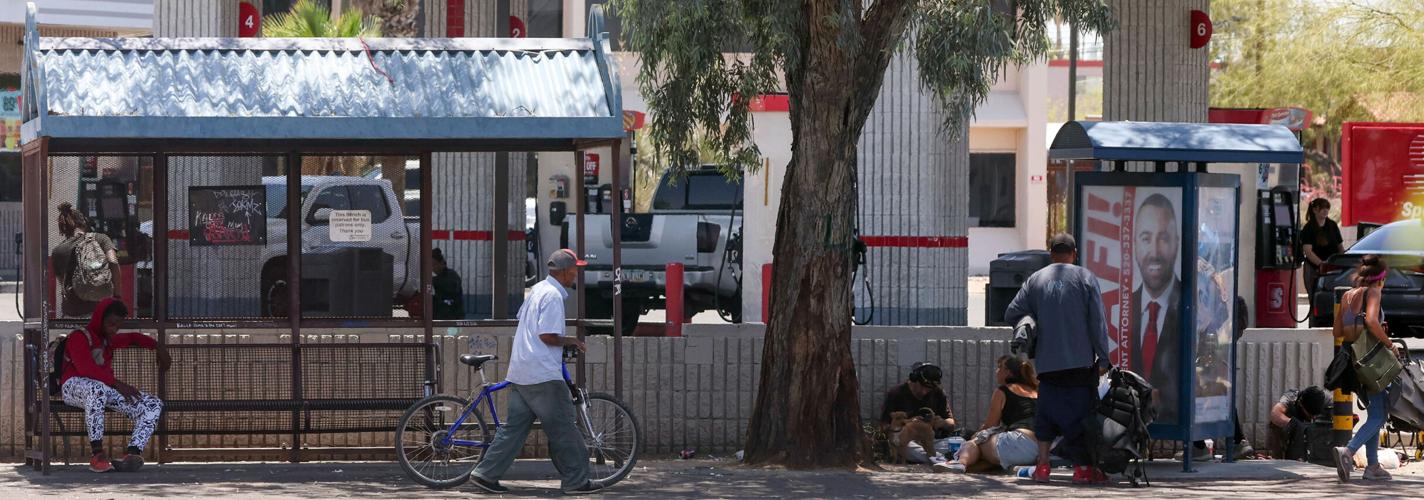


You don’t have to ride the bus to know the stops can be trouble spots.
All you have to do is move around town. You’ll see the occasional crowd of drug users or shopping-cart pushers under the slim shade of a Sun Tran shelter.

Arizona Daily Star columnist Tim Steller
Or lately, all you have to do is watch the news.
You probably know about the killing of Jacob Couch at a streetcar stop downtown. He was attacked by a man wielding a hatchet April 5 and died 12 days later. But there have been other recent cases:
- On March 31, a woman reported being raped by a man she met when he was drinking with a group of drug-using people at a bus stop at Kolb and Speedway.
- On April 28, a 13-year-old girl was waiting at a bus stop near her school, at Broadway and Harrison, when she was attacked by a man who had been talking to himself at the stop.
- On May 12, a woman was exiting a bus, looking at her phone, when a man at the stop accused her of taking his photo and grabbed at the phone. Two other people there intervened, a hatchet fell out of the waistband of one of them, and the original attacker grabbed it and attacked two bystanders with it, resulting in minor injuries.
When I talk to people who ride the bus regularly, they say there are occasional bad situations at a stop — especially, groups of people doing drugs. One rider I accompanied on the northbound Route 18 bus Tuesday, Griselda Puig, told me she rides two buses daily and is fed up with stops where people are smoking fentanyl.

There seems to be more trouble lurking around Tucson bus stops in recent months. That works against the effort by city officials to encourage more people to use transit options like Sun Tran and the Sun Link streetcar.
“You can’t even be around the bus stop,” Puig told me. “When I see the bus is coming, I start walking toward it and covering my nose.”
Riding with his mother and younger brother on the same bus headed up South 6th Avenue, 11-year-old Nathan Martinez told me that on the bus, “I feel safe.” During the school year, he rides the bus home every day from school.
What I wonder about is the people who don’t ride, and the impact of the bus-stop scenes and incidents on them. Local officials have been trying to encourage more people to use transit options like Sun Tran and the Sun Link streetcar. I agree with this push and use the bus occasionally myself, enjoying the convenience of fare-free riding.
But these incidents and the ugly street scenes aren’t encouraging to people on the fence about taking the bus, and ultimately could help end the fare-free experiment by further reducing public support.
Trying to remove loiterers
What got me thinking about this — other than the incidents and scenes I’ve mentioned — is something new to me that I saw over the Memorial Day weekend. Twice at Midtown bus stops, I saw American Guard Services cars parked at bus stops with their yellow lights flashing.
The security guards were apparently ejecting people who had been hanging out at the stops — not physically moving them, but telling them to move on. Sun Tran General Manager Mikel Oglesby and others told me this is nothing new.
“While American Guard Services continue to monitor transit centers and select bus stops, their deployment has remained consistent without an increase in rotation,” Oglesby said in the statement. “The combination of these measures has contributed to a safer environment for both riders and operators.”
These are morally troubling scenes in some ways. Moving people out of a slice of shade in Tucson’s summer sun isn’t something to do lightly.
I spoke with a couple of people hanging out at a shady bus stop at East Speedway and North Alvernon Way Wednesday morning, and one of them said he goes there for the camaraderie.
“Being homeless is lonely,” said Anthony Adams, who uses a wheelchair. “You go to bus stops to meet people.”
Another person there, who gave her name as Angie, said, “Cops run us off from everywhere else.” Of course, you could see why: Another man at the scene was sitting among paraphernalia, using a lighter that looked like a pistol, a meth pipe discarded at his side.
There are some alternatives for people who need to cool off, if they’re not actively using drugs. Tucson has set up six cooling centers, which open Sunday, June 1 and are open from 12 noon to 4 p.m. daily. Pima County also has said people may use its libraries to cool off.
Most importantly, hanging out is not what bus stops are for. They are for people to wait for and catch the bus. And if we want more people to ride the bus, we need to make the bus stops user-friendly, not repelling.
Moving the problem around
Police have caught suspects in all four recent attacks at bus stops. But of course, the arrests haven’t stopped people from congregating at stops. And moving people along often just moves the problem around.
During the May 6 Tucson City Council meeting, Teamsters representative Mike Sanchez cautioned that safety problems aren’t easing.
“Recent events including the murder of Jacob Couch and the disturbing assaults involving young girls at bus stops have highlighted how dire the situation has become,” he said. “Our transit system is in crisis, not just because of the operational challenges, but because safety has taken a back seat.”
At Speedway and Alvernon, Austin Button, manager of Cactus Jack’s Auto, said a rotating crew inhabits the bus stop next to his car lot. The dealership has stopped parking cars near the bus stop after incidents that included people slashing tires, breaking car windows and sleeping in cars.
If something bad happens, and they call 911, the perpetrators have gone by the time police arrive, Button said.
“They bus hop all day,” he said. “They’ll get on the bus and ride to the next stop.”
The City Council has taken preliminary steps to eliminate the free fare program. But the council majority would like to continue with free fares, and regular riders I’ve spoken with consider it a blessing, if a mixed one at times.
People as diverse as Puig, the rider who complained to me about fentanyl smoking at bus stops, and the dealership manager Button, said they wish the city would end the fare-free program.
If we can’t clean up the bus stops, maybe it should.

