



Leave it to the most bombastic politician of our time to ignite free-speech debates in Tucson.
I missed Donald Trump’s visit to the Tucson Convention Center Saturday because I was at the tail end of a week’s vacation, but it’s been impossible to miss the continuing reverberations from the Trump rally.
Among all the anecdotes Tucson has been discussing, the central issue seems to be free speech: What constitutes free speech, who can engage in it when, and what’s appropriate in response to someone speaking out?
The issues get tricky when protesters attend Trump’s rallies, as happened at TCC, then raise their signs and voices in opposition, disrupting him. Is it within their right to do so and does it infringe on attendees’ rights? The answers seem to be contradictory: Yes and yes.
I talked to Paul Bender, a professor of constitutional law at ASU, and he said generally yes, protesters may attend and speak out. If the public is invited to a political rally, then an opponent of the politician is within his First Amendment rights to attend, display signs and even raise his voice.
However, Bender said, if the rally is a private event — as was the case at the Trump rally because the campaign rented out the TCC arena — then Trump’s campaign is within its right to kick out protesters. In fact, Bender said, the protesters begin infringing on the rights of other attendees if they make it impossible for the speaker to be heard.
For my part, I’ve always disliked protesters shouting down speakers. It seems presumptuous for any of us to decide who another person may or may not hear, especially when the speaker is a political candidate. It’s also counter-productive, I believe, in that it generally creates more support, not less, for the person being protested.
I asked Bryan Sanders, the Tucson man who was attacked at the rally, why he attended and protested.
“I wasn’t there to disrupt the rally,” he said. “I was there to disrupt his political policies.”
Of course, he did make a minor disruption by yelling “liar” at Trump. And Trump interrupted his own speech to call Sanders and another protester “disgusting.” But Sanders didn’t do much wrong, if you follow Bender’s interpretation, because when security asked him to leave, he did.
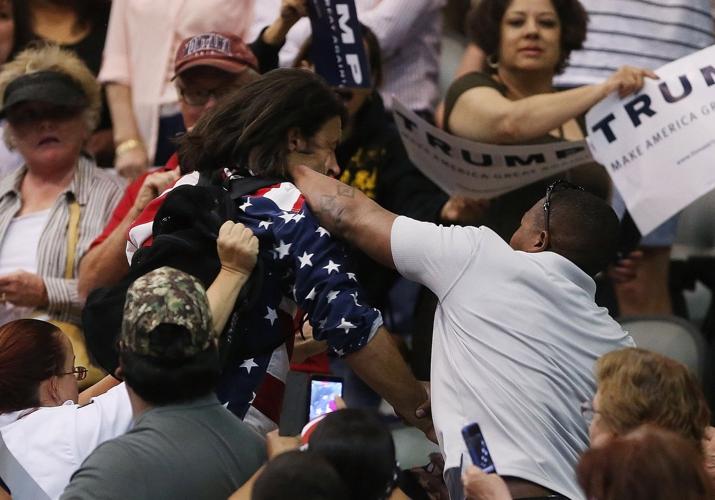
That’s when an obvious violation kicked in. As most of us have seen on video, someone — Davis-Monthan airman Tony Pettway has been charged — ripped the sign from Sanders’ hands, punched him and kicked him on the ground. Absurd justifications have circulated that Sanders did something to provoke Pettway, but the video makes clear, Tucson police reports say, and Sanders asserts, that there was nothing.
“I had no interaction with that guy before he hit me,” Sanders said.
The attack Pettway is accused of obviously crosses the line dramatically into crime. But until then, you can’t argue Pettway did wrong by being there and participating in the rally. Active-duty members of the military may do so, Department of Defense rules say, “as a spectator when not in uniform and when no inference or appearance of official sponsorship, approval, or endorsement can reasonably be drawn.”
That’s only fair. It’s also true of police officers.
On Sunday, Tucson police officer Brandon Tatum posted online a 10-minute description of his experience at the Trump rally. He attended off duty, Tatum said, because he was curious. Most of the monologue consisted of Tatum’s outrage at the behavior of protesters.
“These are the most hateful, evil people I’ve ever seen,” he said of the protesters.
That was eyebrow-raising, coming from a police officer who has presumably seen some pretty bad stuff, but more concerning was his justification of Sanders’ beating, which he saw. Three times, Tatum said that the protester had done something to deserve the beating, though he hadn’t.
“He was asking for that one,” Tatum said. “He assaulted somebody and he lost the battle.”
Tatum was within his First Amendment rights to attend and even talk about his experience, the Tucson Police Department said in a statement, but of course he put his credibility at risk with his comments. He also experienced considerable online fame blowback.
That was the case with Sanders, too, who has been lied about by Trump on national TV — Trump claimed Sanders was a professional agitator who had dragged an American flag or otherwise done something to merit the beating. The online mob has been after him as well.
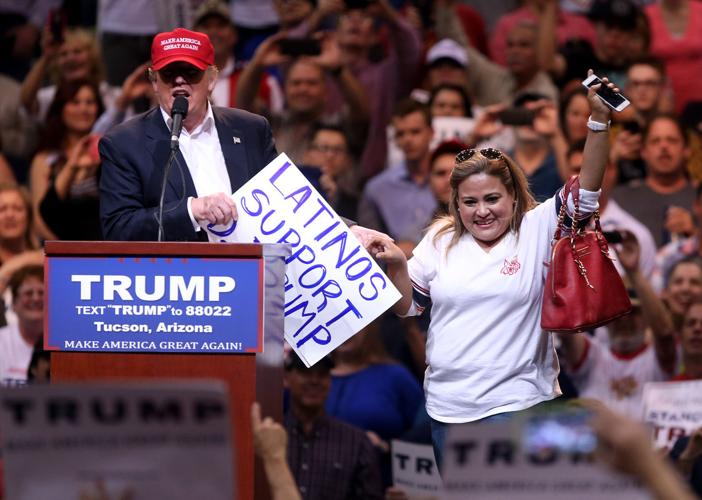
Then there was Betty Rivas, the owner of a Catalina restaurant who was brought up on stage by Trump and was written about by my colleague Joe Ferguson. She’s been harassed online and by phone for acting within her constitutional rights, but supporters have also flooded her restaurant, Sammy’s.
Clearly, exercising our free-speech and free-assembly rights comes with risks, the most common of which is one I’m unfortunately familiar with: Saying something stupid. But attacking people for exercising them is where we really go wrong.
TUSD campaign group
An independent expenditure group has formed to play in this year’s Tucson Unified School District board race. Jim Lovelace, a CPA who was a member of the district’s audit committee till last year, formed the group TUSD KidsFirst with Kathy Campbell, a district parent.
Incumbents Kristel Foster, Cam Juarez and Mark Stegeman are up for re-election, but they say they won’t be advocating for or against specific candidates. That shouldn’t make Juarez and Foster comfortable, though — the group clearly aims to shake up the status quo majority, of which those two are members.
Their main critiques so far have been of increasing spending on administration in a district that is losing enrollment. The founders said in an email they “both believe that reforming TUSD is the single most important issue for improving the economic health of central Tucson.”
A familiar challenger
Four years ago, Mark Napier mounted the first significant challenge in several terms to incumbent Pima County Sheriff Clarence Dupnik. Now, Napier is running again, against Dupnik’s appointed successor, Democrat Chris Nanos. Napier, a Republican who retired from Tucson police as a captain, filed paperwork Monday to run for sheriff.
His platform, he told me, will be much the same as last time: “I just think the people of Pima County need an educated, competent sheriff and need a change at the Pima County Sheriff’s Department.”
District 1 no-shows
A couple of weeks ago I noted that some Republicans were considering mounting a primary challenge to Pima County Supervisor Ally Miller in her run for re-election to her District 1 seat. So far, none has filed, and Miller’s only formal challenger is Brian Bickel, a Democrat, in the general election.

