


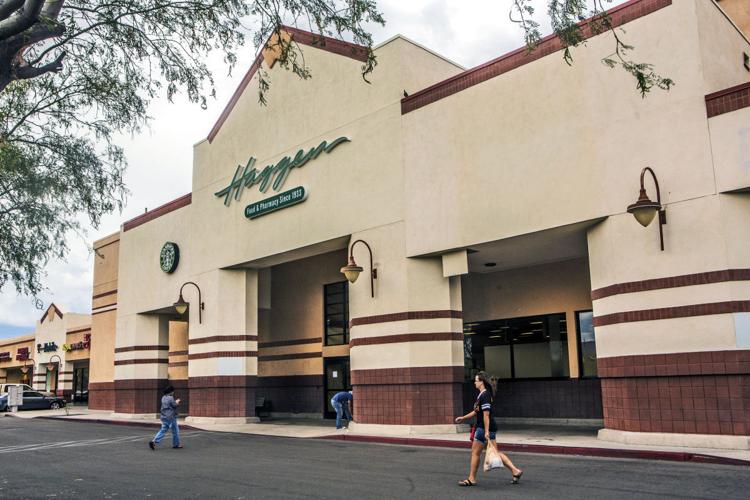


The workers were beaming at a Haggen supermarket on Tucson’s east side Friday afternoon: Word had just come that they would likely be transferred from that store, which is about to close, back to open Safeway stores.
But at a Haggen supermarket on the west side, employees looked dejected: Word had just arrived that their store would close, along with all the existing Haggen stores in Arizona, California and Nevada. The future of these former Albertsons workers was uncertain.
It’s been a rough ride for the 200-or-so employees at all three Tucson Haggen stores since the stores were converted from two Safeways and one Albertsons on May 30. The Federal Trade Commission required Safeway and Albertsons to sell some stores to a third company as a condition of their merger, and the small, Washington-based chain emerged as the winner — the unlucky winner, it turned out.
Haggen quickly proved itself unprepared for this and other markets.
At all three stores I visited Friday, employees marveled at a particular sale item that was advertised prominently in the stores’ circulars once this summer: Cotton-candy-flavored grapes at a price of $4.99 per pound. The idea that those grapes, at that high price, would attract Tucson shoppers symbolized how out of touch Haggen was.
“It was just a jacked-up mess,” veteran employee Wanda Pollard-Phillips said Friday, sitting among a group of workers outside the Broadway/Houghton store. “Who dropped the ball? We lived it and couldn’t figure it out.”
The corporate fiasco has hit Haggen’s employees in Tucson hard. Waves of layoffs followed unexpectedly low sales. Now, how many employees emerge intact may depend on a condition of the merger deal imposed by the FTC: Workers in the newly converted Haggen stores are prohibited from going back to work for Safeway or Albertsons for one year from the day of the merger.
That condition was intended to keep the merged grocery giant from poaching its old workers from the Haggen stores. But of course, that condition was based on the idea that the new Haggen store would not be featuring cotton-candy grapes at $4.99 a pound — in other words, that they’d remain open. Now the companies have asked that the FTC remove it.
The employees at the two former Safeway stores seem safe now — they are members of the United Food and Commercial Workers Local 99, which negotiated the impending returns to Safeway. But the employees at the former Albertsons store are exposed. They have no union representation and are seemingly subject to the whim of big supermarket chains in the midst of an acrimonious disentanglement.
Albertsons has sued Haggen; Haggen has sued Albertsons; and Haggen has filed for bankruptcy protection.
At that former Albertsons store, 1350 N. Silverbell Road, workers blamed their problems on the price increases that took effect when Haggen opened and on the lack of circulars with good specials to bring customers in. Customers at that store walk in with the ads in their hands, they said, but there wasn’t much good in the ads, even if customers did find them.
“Look at the parking lot,” customer Jim Dew told me outside the store Friday morning, waving at acres of empty asphalt. “It’s nothing like what it used to be.”
While neighborhood customers have been losers, they likely will eventually get stores to replace the Haggens. The workers threatened with the loss of their annual wage gains, their seniority and even their jobs are the the ones who really have been suffering.
Before learning of the union deal with Safeway, Haggen employee Jorge Acosta was just plain angry at the situation he and other employees had been put in — worried about whether they’d retain their vacation time, their pensions, their jobs. He’s 44 and had put in 23 years with Safeway before the sale to Haggen happened.
“I don’t have faith in Safeway. I don’t have faith in no grocery store,” he told me.
The thing is, these workers know they’re not in a glamorous job, or one that pays highly. But it’s been a steady job with good benefits, especially at the two union Safeway stores. But that was before they were involuntarily placed on the Haggen “roller coaster,” as cake decorator Yolanda Wallace called it.
“We don’t have the weekends other people have. We don’t have the holidays,” Wallace told me, sitting among the group of co-workers. “Why would I do that for 32 years just to throw it in the garbage?”
That’s the crazy thing about these corporate mega-mergers. They’re made by CEOs, financiers, private equity men and regulators viewing the situation from 40,000 feet, but they affect so many people right here on the ground.
“Even if we do get to go back to Safeway, I want to know what caused all this stress and sleepless nights. I bet I’ve aged 10 years,” Wanda Pollard-Phillips said. “I really want to know what went on here. Who’s to blame?”

