


Leaders of the Tucson Police Department had heard a little about the video. Now, for the first time, they would judge for themselves how grim it was.
As the top brass gathered in a conference room at headquarters, Tucson was, like much of America, protesting the killing of George Floyd. It was June 2020. This body-camera footage could be the tipping point.
The video started. It was nighttime. Three officers strode up to a modest home. A 66-year-old grandmother had called 911 after her 27-year-old grandson became aggressive.
Carlos Adrian Ingram Lopez was naked and high on cocaine when the officers confronted him in the house’s cramped, unlit garage. One officer told him to get on the ground and he did, a flashlight briefly showing him on all fours.
In the darkness on screen, the sound popped out. Ingram Lopez wailed, pleaded, apologized as officers cuffed his hands behind his back.
There was a heaviness in the conference room. The body language around the table was bad, the reluctance to talk telling.
The footage was not done, but the chief and his team didn’t need to see anymore, not right then. They all knew how this ended.
The meeting broke, and the reckoning began.
Well before Floyd’s murder in May 2020, Tucson was among America’s big-city departments to embrace “progressive policing.” Members of the same leadership in that conference room had launched programs to get nonviolent drug dealers and homeless people services, rather than incarcerate them, and new training to teach officers to de-escalate difficult and dangerous situations.
Then-Chief Chris Magnus was a leader within progressive policing who had, as chief in Richmond, California, appeared in uniform at a protest holding a Black Lives Matter sign. Two weeks before watching the Ingram Lopez video for the first time, he reflected on Floyd’s death in a newspaper column.
Progressive police departments, Magnus wrote in the Arizona Daily Star, work hard to prevent such deaths through training, supervision, accountability and transparency. Tucson, he wrote, was “ahead of the curve” in these areas.
Now, Magnus’ department had a death that involved not just rapid escalation to force but also – like Floyd – a person telling officers “I can’t breathe” as they held him face down.
An Associated Press reconstruction of what followed, based on text messages and internal investigative files, shows how a department’s attempts to limit force don’t always filter down to the street, and how internal culture can shape what a department tells the public.
“We were sitting here going — when George Floyd broke — thinking, man, that can never happen here,” Chad Kasmar, the No. 2 under Magnus who took over when the chief left in 2021 to lead U.S. Customs and Border Protection, told AP of this Democratic-leaning city of 542,000 people. “And what we hadn’t recognized is we had a very similar incident that people were going to connect.”
Cascade of force
In the early morning of April 21, 2020, police came to the house of Ingram Lopez’s grandmother after she reported that her grandson was naked, under the influence of drugs and acting erratically.
Ingram Lopez had struggled with substance abuse, was unemployed and hadn’t gotten much sleep in his last days. Inside the home, he was hallucinating. His grandmother tried to leave, but he blocked and pushed her. Frightened, she called 911.
A dispatcher told responding officers Ingram Lopez had a domestic violence arrest warrant. Two days earlier, the mother of his young daughter reported that he pushed her in the chest during a dispute over her laptop. Ingram Lopez was staying with his grandmother because the woman had kicked him out.
None of the first officers to arrive discussed a plan — a basic best practice that would later be emphasized in the department’s training. Aside from telling Ingram Lopez to relax, they did little to calm the encounter, even when he soon started cooperating.
Officers cuffed Ingram Lopez’s hands behind his back and kept him for 12 minutes on his stomach, a position known as prone restraint that can dangerously restrict breathing. During the handcuffing, two of them put knees on his back, while a third held his legs, according to internal interviews of the officers. The officers would later be found to have violated several departmental policies, including for their use of force.
WARNING: RAW, GRAPHIC VIDEO. Body-camera video of Tucson Police officers trying to restrain Carlos Ingram-Lopez, 27, on April 21, 2020. Ingram-Lopez died in policy custody. Video by Tucson Police Department
One who believed Ingram Lopez remained a danger didn’t turn him from his stomach onto his side so his airway could remain clear. Officers ignored Ingram Lopez’s complaint that he couldn’t breathe and his 21 pleas for water.
Due to concerns about an emerging virus called COVID-19, officers placed a spit sock over Ingram Lopez’s face. Blankets draped over his head and naked torso made it harder to monitor breathing. One of the officers had previously worked as an EMT but had not requested paramedics.
Ingram Lopez was dying, yet nearly two minutes passed from when he made his last sound to when officers turned him off his stomach at the request of an arriving supervisor.
The supervisor pulled up the spit mask, and he and another officer started CPR. Within about half an hour, Ingram Lopez was pronounced dead. In an autopsy, a medical examiner concluded Ingram Lopez died from “sudden cardiac arrest in the setting of acute cocaine intoxication and physical restraint” and that his enlarged heart was a contributing condition.
He was one of more than 1,000 people who died over a decade after police subdued them using force that is not supposed to be lethal, an investigation led by The Associated Press found. In hundreds of those encounters, officers violated long-established safety practices. The investigation was done in collaboration with The Howard Center for Investigative Journalism programs at Arizona State University and the University of Maryland, and FRONTLINE (PBS).
In Tucson, Ingram Lopez’s grandmother blamed herself, family would tell an officer investigating the death. “She should have just taken a beating” is how family members summarized her anguish.
Jolting as it was, the video raised a deeper question: Why did it take nearly eight weeks for the department’s leaders to see it?
‘No force was used’
The department immediately opened an internal affairs investigation into Ingram Lopez’s death — a standard practice to determine whether officers broke any rules.
A series of texts the AP obtained under a public records act request shows how the internal affairs commander responsible for that investigation downplayed the full range of failures. The text conversation was between Lt. Jennifer Pegnato, the commander who was investigating the death, and her boss, Assistant Chief Michael Silva.
In the overnight hours after the encounter, Pegnato reported to Silva that investigators found white powder at the grandmother’s house, that Ingram Lopez had been acting bizarrely, and that a few minutes had passed between when he was detained and when a supervising sergeant arrived.
She also referred to the officers’ body-worn camera video. Based on her initial assessment, the officers could have rolled him from his stomach to his side sooner.
“But,” she wrote, “no force was used.”
The next day, Silva texted to check on interviews of the officers, who had worked for the department between 18 months and five years.
“Nothing earth shattering thus far,” Pegnato replied.
She texted again a bit later. “I think this is a case of several young inexperienced officers,” she continued. “They will likely need some additional training. Some poor tactics were utilized and no one really had a plan.”
Silva then asked Pegnato if she wanted to bring any investigators from her staff to an initial briefing for the brass.
The two sergeants helping Pegnato with the investigation were split. Like her, one of them believed no force had been used — but the video shocked the other sergeant, who considered it among the worst he had seen, records show.
“I’ll cover it,” Pegnato wrote Silva of the meeting. “I think I’m well versed. And hoping with just me I can help keep it brief. :)”
The pandemic was unfolding, and people were scattered, so Pegnato scheduled a remote meeting on the Microsoft collaboration platform Teams for two days after Ingram Lopez’s death.
During the meeting, Pegnato didn’t show the video. She later said Teams was new to her and that posed challenges. She would recount that she thought she described some of what she saw on the video, and said a lot could have gone better.
Seven weeks later, on June 15, the leadership finally saw for itself.
The internal affairs investigator who was shocked by the video but wasn’t invited to the first meeting made sure to go this time, even though it was his typical day off. Several attendees recalled how the bosses’ faces showed that they hadn’t previously understood the gravity of the encounter.
They described Chief Magnus as displeased, disappointed and appalled. Magnus did not grant an interview request.
Department leaders understood immediately that people would see parallels between Ingram Lopez and Floyd. And that the public would suspect a cover-up, since the public hadn’t yet been told and the officers were back on duty within three days.
“It was a heavy meeting where everything’s flooding against you,” then-Deputy Chief Kasmar recalled.
Stepping to the microphones
The department wasn’t ready to go public.
Magnus would later say they waited to reveal the death until after Ingram Lopez’s family could watch the video. But eight days after leadership saw the video, local news media broke the story of the death.
The next day, June 24, Magnus addressed the public.
Stepping to news conference microphones, flanked by the mayor and a sign language interpreter, Magnus removed the mask covering his face. He began by saying he and others at the department were troubled and were committed to accountability and transparency.
Magnus then summarized the encounter. Ingram Lopez faced domestic violence allegations, had been restrained face down for about 12 minutes and went into cardiac arrest. He was on cocaine and had a preexisting heart condition. Although Ingram Lopez started out acting erratically, he soon became compliant.
Magnus said the three officers didn’t have malicious intent but had violated department policy and would have been fired had they not already quit.
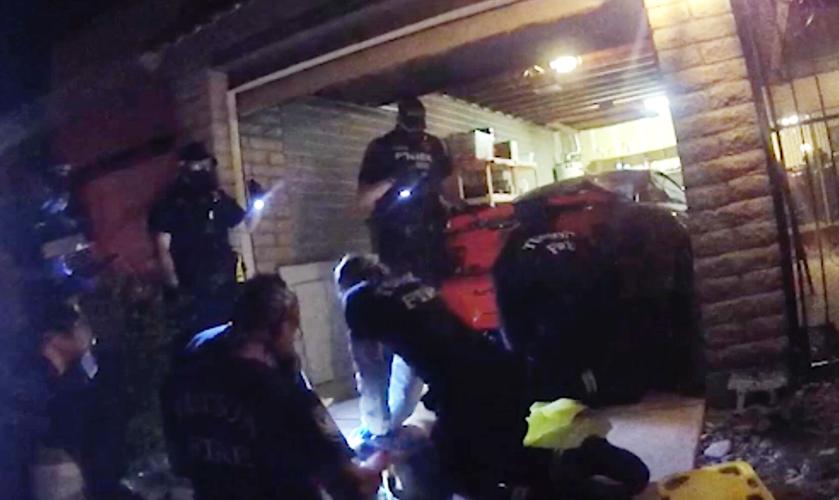
The video began on a large screen and ended 22 minutes later, with officers and firefighters trying to revive Ingram Lopez.
“This is now the 18th time I’ve watched it,” Magnus said, “and it frankly never gets any easier.”
Magnus then acknowledged he and other top managers should have watched the video sooner. The public should have been notified earlier, too, but he didn’t think there had been a calculated cover-up.

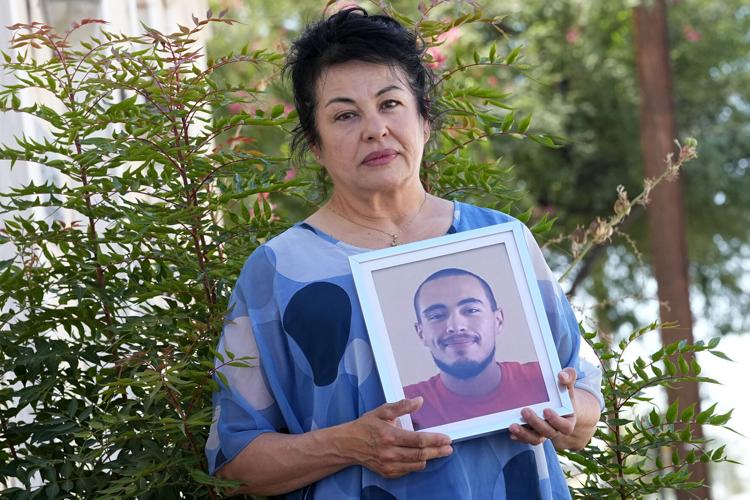
Irene Alvarado holds a photo of her son, Damien Alvarado, outside her attorneys’ office in Tucson.
“I realize that, given the times we are in, any mistakes of this kind are viewed with great suspicion,” Magnus said.
Even as he promised transparency during the news conference, Magnus didn’t disclose something else: Just a month before Ingram Lopez’s death, another Hispanic man died after Tucson officers restrained him.
Damien Alvarado ran from a car crash in March 2020. A man and his son who had witnessed the immediate aftermath of the wreck spotted the 29-year-old in a bush behind a church. The man and an officer who had just arrived had grabbed Alvarado’s legs as he tried to climb over a cinderblock wall.
The officer brought him to the ground and punched Alvarado, whose hands, the officer said, were moving toward his gun. More officers arrived. Alvarado resisted handcuffs and threatened them. Police shocked him several times with a Taser and used two devices to restrain his legs.
During the four minutes they held him down, an officer put a knee on Alvarado’s back. Both officers and paramedics put a spit mask over his face. When Alvarado complained he couldn’t breathe, one officer profanely told Alvarado to shut his mouth.
Paramedics were preparing to leave but were called back when his breathing became labored, then stopped. Officers began CPR, and paramedics brought him to a hospital, where he was pronounced dead.
Alvarado’s mother, Irene, remembers Damien as a skilled carpenter with a zest for life. Like Ingram Lopez, Alvarado left behind a young child. “He didn’t deserve to die,” Irene Alvarado said in an interview as she wept.
The Pima County Medical Examiner’s Office concluded the death was an accident caused by “cardiac arrest in the setting of acute methamphetamine intoxication and restraint.” All officers were cleared for their use of force, but two were disciplined for foul language.
Two weeks after Magnus’ news conference and more than three months after Alvarado’s death, the department revealed the encounter to the public — through a news release.
Changing the culture
At the news conference, Magnus had offered to resign. The city manager declined the next day, citing his community policing efforts and talent for changing the department’s culture.
Those efforts would be tested, as the Ingram Lopez death galvanized protesters.
Still deputy chief, Kasmar reviewed the department’s internal investigation and leveled a withering critique. Pegnato should have realized the officers’ failures far exceeded “re-training opportunities,” Kasmar wrote, and she failed to grasp the city’s legal liability when the officers kept holding Ingram Lopez down despite his medical distress.
Kasmar also criticized the department’s executive leadership team, which he said should have asked to see the video. AP sought to speak with Silva, but he did not respond to interview requests. Pegnato, whose last name is now Pegnato Moss, declined to be interviewed.
Police leaders undertook a new kind of accountability called a sentinel event review board, a public investigation typically used in the hospital and airline industries to learn from mistakes. Departments tend to avoid them because the findings can become fodder in wrongful death lawsuits.
In the end, the review board offered dozens of recommendations. Months after the inquiry, the department detailed changes it made.

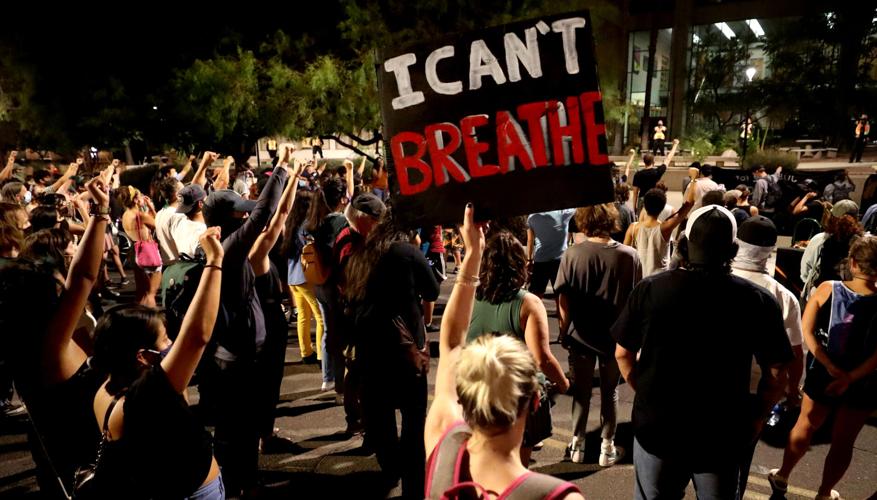
Hundreds gather outside Tucson, Ariz., Tucson Police headquarters shortly after a vigil for Carlos “Adrian” Ingram Lopez, June 25, 2020.
In response to the lack of planning and rapid escalation with Ingram Lopez, the department gave sworn officers new training in November 2020. There were also trainings on recognizing medical distress, calling EMS and monitoring breathing – courses that are continuing today, according to Kasmar.
Parallel reforms required quicker action. Two chiefs and the chief of police now review body-worn camera footage within two days of a death, and footage must be made public within three days. All restraint deaths get the same level of review as officer-involved shootings.
Other changes included dispatching the fire department with police on narcotics calls to administer aid quickly. The department discontinued use of spit socks, and each new internal affairs staffer would get a training program and a mentor sergeant.
Michael Scott, a criminal justice professor at Arizona State University and former police chief in Florida, helped conduct the Tucson review board’s investigation. He’s long pushed departments to adopt these kinds of boards to build transparency and trust.
“Doing nothing, changing nothing is not really an option,” Scott said in an interview.
The department takes learning from critical incidents like Ingram Lopez’s death seriously, Kasmar said. The question becomes how well officers embrace those lessons.
“Culture,” he said, “eats policy for breakfast.”
Tucson has picked most of its chiefs from within and Kasmar is a third-generation Tucsonan “raising a fourth.” Kasmar attended his hometown’s University of Arizona, earning a fine arts degree. The year after he joined in 2000, people rioted after the school lost the men’s college basketball title game. Officers fired beanbags and wooden dowels at them, striking 40 people, including a student who lost an eye.
Kasmar worked his way up, including stints as a patrol officer and commander of internal affairs. Now in charge, Kasmar believes change can come, even if slowly. Getting the department’s 1,200 people to follow along takes time, he said – and persistence.
“Across this country we have these, you know, expectations for these immediate shifts in culture,” Kasmar said. “But what we don’t have any grace for is the fact that human beings in general are difficult or resistant to change.”
Looking within
Under Kasmar, the department has paid an anthropologist to examine its training and culture. Some review board members were concerned systemic racism might have influenced officers’ responses with both Latino men.
Victor Braitberg, a University of Arizona cultural anthropologist, began working as a private consultant for the department in January 2021, conducting a yearlong examination. He has since done other paid work for the department.

The screenshot from a Tucson police body cam video taken in April 2020, shows paramedics performing CPR on Carlos “Adrian” Ingram-Lopez, who died after repeatedly telling officers he could not breathe.
Braitberg said officers earnestly believed that racism and bias were not a problem in their ranks. He also found a division between officers and leadership on the role bias was perceived to play in the two deaths. The rank and file didn’t feel the brass had their back.
That view began to change, Braitberg said, with Kasmar, whose approach included running with recruits and checking in with detectives. Braitberg said he thinks the department’s culture is improving and that officers and leadership are more aligned.
Kasmar said his department’s not perfect and has been working to rebuild trust.
“I think we’re doing everything in our power to be a transparent police department and set a tone for other organizations in the country to follow,” he said.
One indicator of cultural change in the department, he said, was that for the first time in five years, the agency began the year with a handful more officers than it had in the previous year – a reversal of a trend after the deaths of Floyd and Ingram Lopez. He pointed to a program that helps officers deal with trauma and recognize “it’s OK to be human – it’s OK to show emotion,” Kasmar said.
Hard skeptics question whether Tucson police can change. Paul Gattone, an attorney representing Alvarado’s family, said officers see civilians as a potential threat rather than people who need their protection. “They are a product of what we’ve allowed the police to become,” Gattone said.
Tucson is fighting the Alvarado lawsuit, arguing that officers acted reasonably. On the other hand, the city paid $2.9 million to settle legal claims over Ingram Lopez’s death.

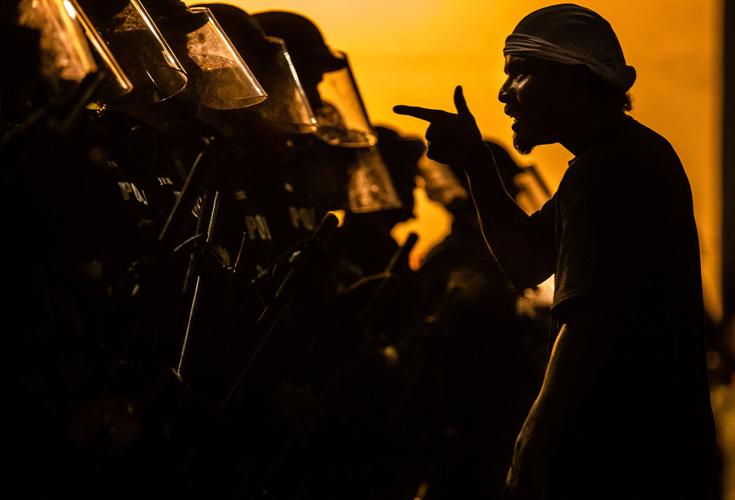
A protester confronts a Tucson police riot line line near the department's headquarters downtown during a protest like many across the country soon after the death of George Floyd in Minneapolis. The Associated Press used text messages and internal investigative files to reconstruct what followed after two similar police-linked deaths in Tucson about the same time as Floyd's in-custody death.
It’s not only the police department’s culture that would have to change to improve police-community relations, according to Caroline Isaacs, a longtime Tucson activist with Just Communities Arizona.
Internal reforms can be hard because criminal justice often presents itself as adversarial, and there’s not great communication between those in the system.
“It’s always us against them,” she said. “There’s so little dialogue on both sides, and that creates no room for — you know – accountability.”
Photos: Vigil for Carlos Adrian Ingram Lopez, who died in police custody
Carlos "Adrian" Ingram Lopez
Updated
Family members stand together among a crowd of several hundred, part of a vigil for Carlos "Adrian" Ingram Lopez, June 25, 2020, Tucson, Ariz., who died in Tucson Police custody two months ago.
Carlos "Adrian" Ingram Lopez
Updated
Members of the crowd bring candles to a memorial stand at El Tiradito shrine, part of a vigil for Carlos "Adrian" Ingram Lopez, June 25, 2020, Tucson, Ariz., who died in Tucson Police custody more than two months ago.
Carlos "Adrian" Ingram Lopez
Updated
Tucson, Ariz., mayor Regina Romero stands in the crowd of several hundred at a vigil, June 25, 2020, for Carlos "Adrian" Ingram Lopez, who died in Tucson Police custody.
Carlos "Adrian" Ingram Lopez
Updated
Hundreds of protestors chant outside Tucson, Ariz., Police headquarters shortly after a vigil for Carlos "Adrian" Ingram Lopez, June 25, 2020, who died in police custody more than two months ago.
Carlos "Adrian" Ingram Lopez
Updated
A protestors walks up to a line of Tucson, Ariz., police as several hundred gather outside TPD headquarters, June 25, 2020, after a vigil for Carlos "Adrian" Ingram Lopez, who died in police custody.
Carlos "Adrian" Ingram Lopez
Updated
One of the hundreds of protesters takes a seat outside Tucson, Ariz., Police headquarters as they gather after a vigil for Carlos "Adrian" Ingram Lopez, June 25, 2020, who died in police custody.
Carlos "Adrian" Ingram Lopez
Updated
Hundreds gather outside Tucson, Ariz., Police headquarters shortly after a vigil for Carlos "Adrian" Ingram Lopez, June 25, 2020.
Carlos "Adrian" Ingram Lopez
Updated
A protestor confronts a Tucson, Ariz., Police officer on a barricade at Church Avenue and Cushing Street shortly after a vigil for Carlos "Adrian" Ingram Lopez, June 25, 2020.
Carlos "Adrian" Ingram Lopez
Updated
Members of the crowd line up to place candles at a memorial stand for Carlos "Adrian" Ingram Lopez at a vigil in El Tiradito, Tucson, Ariz., June 25, 2020. Lopez died in Tucson Police custody two months ago.
Carlos "Adrian" Ingram Lopez
Updated
Hundreds gather outside Tucson, Ariz., Police headquarters shortly after a vigil for Carlos "Adrian" Ingram Lopez, June 25, 2020, who died in police custody more than two months ago.
Mayor, chief seek to reel in city board often at odds with Tucson cops' discipline
UpdatedTucson Mayor Regina Romero is pushing for a review of the city charter and for immediate training for members of a civilian board that handles appeals by police officers who’ve been disciplined or fired after several “unacceptable” decisions the board has made to rehire officers that were terminated for excessive force or domestic violence.
The five-member Civil Service Commission is operated under the city charter. They are each appointed by the mayor and council to six-year terms and must be appointed based on their political affiliation. Currently, there are only four members. The primary duty is to review appeals of discipline by city employees, including police officers, and decide if the punishment meted out by city leaders is appropriate.
In September, the commission reinstated Officer Alfred Anaya, who was terminated in 2019 after he fired six rounds into a car though he could not clearly see inside because of its deeply tinted windows. During the department’s internal probe, he told investigators he did not believe the suspect in the car posed an immediate lethal threat after the car crashed and came to a stop until he saw someone moving inside. Anaya admitted to investigators that he had no idea if the backseat of the car was occupied.
After a nearly two-hour executive session at the end of Anaya’s four day-hearing, the commission spent 21 minutes deliberating before voting to reinstate Anaya to the force with full back pay.
After the decision, Tucson Police Chief Chris Magnus issued a statement saying he believed the decision undermined his duty to hold officers accountable for violating department policies.
Anaya’s reinstatement is the most recent in a series of decisions by the commission, including ordering five other officers to be rehired who had been fired for matters like domestic violence, excessive force and dishonesty.
“They’re going based off emotion”
Magnus has said multiple times that he will not be putting officers who are dishonest or commit crimes back on patrol because they pose an unacceptable risk to the community when it comes to handling complaints or investigations.
Magnus says he thinks the commission members are well-intentioned. But, he says, their job is not to substitute their own judgment when it comes to department rules, regulations and policies.
“It’s a problem. I don’t think there should be three more chiefs of the Tucson Police Department,” Magnus said, referencing the three commission members who must be present during an appeal hearing. “It is not within their scope of responsibility to substitute their judgment about what the rules and regulations and policies of the police department should be.”
In the case of Anaya and the other reinstated officers, the commission overruled the department’s policy regarding presumptive termination for certain offenses and said that the punishment was too severe.
Magnus and Romero both say this is not the commission’s job.
“It’s unacceptable to reinstate an employee — it doesn’t matter if it’s in the Police Department or other departments — that is not following protocol or that has a domestic violence incidence on record,” Romero told the Star on Thursday. “These policies are to help the community not have police officers use excessive force, and if someone does, they have to be terminated. That’s what we expect.”
Romero said Magnus has been working hard over the last five years to make important changes to the department’s rules and regulations involving use of force. It’s an issue many Tucsonans, like people in communities across the U.S., are concerned about.
“Our Civil Service Commission seems to be disconnected from what the goals and vision that the mayor and council have established in the last year with the (Carlos Adrian) Ingram-Lopez and (Damien) Alvarado cases,” Romero said, citing recent in-custody deaths here. “The mayor and council are very clear about not accepting excessive force. We’re very clear about being transparent and holding officers accountable for their actions.”
Ingram-Lopez, 27, and Alvarado, 29, both died this year while being restrained and in custody of Tucson police.
Romero said that in the months following, she and Magnus have had conversations about how to best align the commission with what it’s supposed to be doing, which is determining if there was just cause for the punishment.
There’s a list of actions that can lead to discipline and termination, in the city code and civil service rules. Fireable infractions includes infractions such as dishonesty, violation of department rules and regulations and conduct that would cause “the city or the department to question an employee’s reliability, judgment and trustworthiness in carrying out assigned responsibilities.”
“They’re supposed to be looking at facts and seeing if policies, rules or procedures were violated. If they were, they have to take action and agree with the department decision,” Romero said. “They can only ratify the decision made by the department based upon the facts. Unfortunately, that’s not happening. They’re going based off emotion and non-facts.”
Because the commission was created by the city charter, a list of ordinances and codes for the city would have to be changed to alter the commission’s role, which Romero said has been done before. But it is not easy.
“For now, we put together a task force or committee to review the charter. I think there’s some good government changes that need to pass,” Romero said. “I believe that one of conversations we’ve had as a community and mayor and council is that we revamp and reimagine our committees that oversee our police department and the city of Tucson.”
Magnus and Romero have both suggested the use of an administrative law judge to conduct judicial reviews of police disciplinary appeals based solely on the facts.
But the process to change the charter is slow. Romero says interim steps will be taken to make sure the commission does not continue to run astray of its duties.
“Part of that revamping ... is either training or retraining the current commissioners that are there and making sure that they’re aware of implicit bias and excessive use of force and these things that could potentially help them while we find a longer term solution,” Romero said.
What that training will look like for commission members is unclear.
Public safety “hangs in the balance”
A 135-page document relating to appeal hearings that contains information about the city charter, law enforcement discipline statutes, procedures and duties on appeals and more is provided to help guide commission members, according to documents obtained by the Star through a public-records request. There’s also a 69-page rules and regulations document that’s available online. It’s unclear if commissioners receive any formal training beyond being asked to read these documents.
In addition to the guides, commissioners also have access to their own legal counsel, which is hired and paid by the city. “They need outside counsel, and they can’t be represented by someone within the City Attorney’s Office,” said Donna Aversa, the commission’s legal counsel. “The city provides me as a resource to give them legal advice. Under open-meeting law, they have to say why they are going into executive session and for the commission, it’s always legal advice.”
Aversa said she was unable to speak further on the issue.
Over the past 15 years, there have been 19 members of the commission, with most serving only one six-year term, according to a list provided by a city. Several members were approved for a second term but resigned before it was over.
The Star also requested the résumés and other application material for current commission members Thomas Palomares, Paul Fimbres, Rebecca Montaño and Carol West.
The city provided materials for Palomares, Fimbres and Montaño. They city said it was unable to locate materials for West’s 2014 appointment, as they’d been destroyed per the City Clerk’s Office documentation schedule. The city’s list shows that West, a former city councilwoman, was appointed in March 2019.
Palomares, the commission chair, was recommended for appointment in October 2018 by former Councilwoman Shirley Scott, to fill a vacant Republican seat. The commission is meant to be made up of two Republicans, two Democrats and one member of a third party, but Palomares is currently the commission’s only Republican member. He works as a strategic manager specializing in client engagement, relationship management and business development, according to his résumé. He has a bachelor’s degree in political science and criminal justice and a master’s in business administration. He has served on the commission since December 2018.
Fimbres, one of two Democrats on the commission, was recommended for the position in June 2017 by former chairman Max Parks, who served from 2014 to 2019. Fimbres was appointed a month later, with Parks’ recommendation letter saying that Fimbres “has a deep understanding of policy and administrative directives and their application.” The former Raytheon employee said that with the knowledge he gained from being a 34-year member of the defense industry, he believes he “can contribute an understanding to the questions that arise and are brought to the Civil Service Commission,” according to his application.
Montaño, a Democrat who has served since March 2017, applied to the commission the month before and was recommended for the appointment by Romero. Montaño spent 35 years working as an educator, climbing the ranks from teacher up to deputy superintendent at the Tucson Unified School District. Montaño’s application said her résumé listed a “variety of skills” she’d be able to utilize on the commission, and that she has previously served on boards that involve employment issues. Montaño said she also had experiences at the national and state level that involved development, implementation and accountability.
Magnus said that one of his biggest responsibilities as chief is to create policy for the department, which includes rules, regulations, expectations and training. Because of that and other factors, the vetting process to become chief is extremely extensive.
He said he doesn’t believe commission members have undergone the necessary training or vetting process to be making their own judgments on policy issues, which has happened multiple times over the past several years.
“I don’t think it’s really an overstatement to say that when we’re talking about this, public safety literally hangs in the balance here,” Magnus said. “To have the Civil Service Commission members, regardless of their intentionality, substituting their judgment for the expectations we have associated with public safety is a recipe for disaster.”
“Problematic and concerning”
Commission members should undergo new training before they hear any more appeals, Magnus said.
“The public has some pretty significant concerns about how cops use force and make decisions on a range of things. What kind of chaos are we creating when this kind of confusion is sowed over what’s allowed?” he said. “These folks need to understand that just because information is presented to them by an advocate representing an employee, it does not mean it’s either relevant or even deserves any kind of consideration whatsoever.”
The rules for hearings are much different than a criminal case, with no objections and no rules about what can and cannot be presented in the case. Many times, attorneys for officers accused of excessive force will point to the county attorney’s decision to not file criminal charges as a reason why the punishment is too severe.
The justification statute to file criminal charges is based on a completely different standard and has nothing to do with if an officer violated a department policy, Magnus said.
Still, the comparison continues to come up in hearings and even more problematic, in the letters the County Attorney’s Office issues when they decline to file charges, Magnus said.
On Dec. 1, David Berkman, the chief criminal deputy county attorney, said in a second review of a use-of-force allegation against Officer Colin Klingler that the “justification statutes and TPD’s use-of-force and justification policies are basically the same.”
“This is patently false,” said Assistant Chief Mike Silva, the city’s former legal adviser for TPD who worked as a prosecutor and in private practice before joining TPD.
Klingler’s case will be appearing before the commission sometime in 2021, having been rescheduled twice already. Klingler was fired earlier this year for a February incident in which he was accused of using excessive force, failing to render medical aid, “callous disregard for an injured person” and “deliberate indifference” toward the injured man’s personal property.
On Feb. 13, Officer Crystal Martinez, who resigned during the investigation, conducted a traffic stop after observing a man on a bicycle make a traffic violation, according to the Police Department’s executive review of the incident.
The man, who had two outstanding felony warrants, fled but was detained a short distance away, after which Klingler arrived to assist in the arrest.
The man was not complying with Martinez’s commands to give her his hands and rolled onto his stomach, pulling his hands under his chest. Klingler approached the man over his right shoulder and delivered four to five elbow strikes to the man’s head and face.
Klingler told the man to put his hands behind his back before delivering four more strikes to the man’s head. The man screamed, then Klingler struck him three more times. The man stopped talking and screaming and his “body stops moving and his breathing is labored,” the review said.
At that point, the man appeared to be unconscious with his body “completely limp,” but Klingler moved to the other side of his body and delivered a knee strike to the head, several more elbow strikes and then transitioned to “hammer fist strikes” to the man’s head and face, while Martinez put him in handcuffs.
The man remained limp as officers shined a flashlight in his face to see if he was conscious, the review said.
“He might need meds; I rocked him,” said Klingler before he was seen in body camera footage smiling and laughing.
Paramedics arrived, but the man, who had regained consciousness, refused treatment and was taken to jail. When he arrived, he was medically rejected for booking and was sent to a hospital. An exam revealed fractures to his face and head, some of which required surgery to repair, the review said.
The review noted that Klingler and Martinez lived together and were involved in a romantic relationship at the time of the incident. During his interview with investigators, Klingler had no recollection of how many times he hit the man. The review found that while some of the initial strikes were proportional to the suspect’s actions, the final seven were not and that Klingler’s “lack of recollection and inability to articulate his justification ... is problematic and concerning.”
The review found that Klingler’s actions fell into the “serious misconduct” category of the department’s discipline guide, for which the corresponding discipline is presumptive termination.
“Substituting their judgment for mine”
In the case of Anaya, one commission member said that because the suspect whom he fired upon was “a very dangerous person,” the use of force was justified. Magnus says he is concerned similar logic will be applied in Klingler’s hearing before the commission.
In June, Daniel Oates, a former police chief, wrote an opinion piece for the New York Times about why it’s so hard to fire cops who break the rules.
“The arguments are always the same: The chief’s investigation was shoddy; the chief had a vendetta against this particular cop; other cops did this before and weren’t fired; the alleged misconduct really wasn’t that bad,” Oates wrote. “Too often, (decision-makers) feel the pressure to ‘split the baby’ in their decisions. Perhaps the cop is docked pay or promoted; otherwise he’s back on patrol.”
Oates’ words echo a situation that has played out in Tucson a half-dozen times in recent years.
“These are dedicated, conscientious people who haven’t been given training on the scope of their job,” Magnus said, adding that the solution isn’t clear-cut.
Magnus says the commission needs to undergo training, be held to a greater standard of accountability and have a process for transparency where a summary of hearings and their decisions are presented to the mayor and council, similar to other city boards.
Magnus also said he’d like to see a selection process with greater scrutiny, but he wonders if the commission will ever attract diverse members representative of the community when hearings are held on weekdays during business hours, eliminating most people who have a full-time job.
“They’re really dealing with critical issues particular as they relate to public safety” Magnus said. “It seems very unfair that as a department, and frankly me specifically as the chief, I am held responsible for the idea that when you have a bad police officer, they shouldn’t be working here. I don’t have control over that. I have a commission substituting their judgment for mine.”

