



Location, location, location.
That's how you go from a few hundred souls hunkered down near the river to a metropolis of 1 million and counting.
We came for the protection. We came for the climate. And we came for the money to be made off of each other.
But in the beginning, we came for the water.
Written records show humans living in what we now call Tucson 4,000 years ago.
They killed small game, fished in the sometimes-flowing Santa Cruz River and farmed.
"It was an agrarian group living at the base of 'A' Mountain," says Jim Turner, historian with the Arizona Historical Society. "They were the earliest known tobacco farmers in North America. And they grew the earliest corn in North America."
After them came the Hohokam, here from about A.D. 300 to the early 15th century.
"The Hohokam essentially became extinct," says retired anthropologist Bernard "Bunny" Fontana, who blames their disappearance on the very thing that drew them here.
"They became overly dependent on water," says Fontana. "They built an irrigation civilization based on rainwater. If you get enough years when that doesn't happen, everything goes to pot."
Next to inhabit this valley were what Fontana refers to simply as the O'odham, who claim the Hohokam as ancestors. Perhaps they learned from those who came before them — for "Hohokam" is an O'odham word for "all used up."
Unlike the Hohokam, the O'odham "were able to get by living very lightly on the land," Fontana says. "It was very light horticulture — and they never had huge villages the way the Hohokam did. They kept the population densities very low."
The dangers of going outside
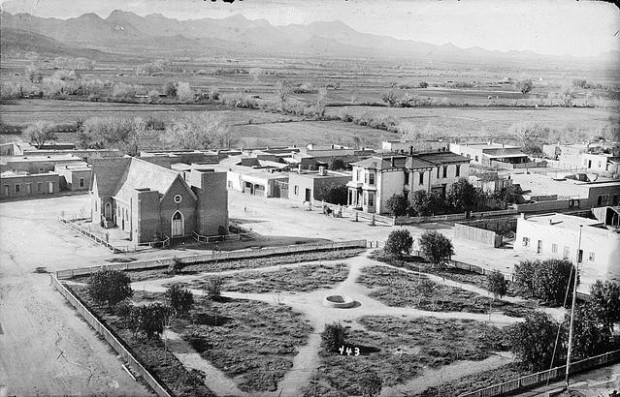
By the time Col. Don Hugo O'Conor and his party chose Tucson as a Spanish presidio in 1775, O'odham settlements dotted the banks of the Santa Cruz. The presidio's adobe walls soon rose east of the river, offering protection against marauding Apaches — Plains Indians who had drifted south into Arizona some 200 years earlier.
So feared were the Apaches that people worked the fields with armed guards standing by. Women who went out for water were also guarded.
"People lived inside those walls for 80 years," says Turner.
It was during this time that Tucson went from Spanish rule to Mexican rule after Mexico won its independence from Spain in 1821. By then, most of the soldiers and non-Indians living here were probably mestizo — a mixture of Spanish and Indian, says Fred McAninch, a member of Los Descendientes del Presidio de Tucson.
During Mexican rule, the government all but abandoned Tucson, says McAninch. "Sources of revenue were cut off. The missionaries who had played such an important part were expelled."
Tucson's fate hung in the balance. "Tucson would not exist as a city today were it not for the people who lived in the military colony, and the farmers who lived at the foot of 'A' Mountain. But the mestizo and the Spaniards stayed here and fought it out and hung on. A lot of them starved."
An influx of young men
During this time, Tucson's first Anglos — fur trappers headed for the Gila River — passed through in 1826, writes John Bret-Harte in "Tucson, Portrait of a Desert Pueblo."
The Mormon Battalion raised the American flag here on Dec. 17, 1846, but the battalion quickly struck camp and left, writes Bret-Harte. It wasn't until 1854 that Tucson became part of the United States with the signing of the Gadsden Purchase. And two more years drifted by before American troops rode in to replace Mexican troops.
Yet Anglos made their presence known as cowboys, ranchers and merchants. Then, as now, some came from California, more after 1849.
"It was backwash from the California Gold Rush," says Turner of the Historical Society. "Ninety percent were young men ages 18 to 26."
And following the miners were the men who "mined" the miners, selling them everything from pies to ammunition.
The last supply stop till Yuma
In 1857, the stagecoach came to Tucson, part of the route between San Antonio and San Diego, writes C.L. Sonnichsen in "Tucson: The Life and Times of an American City."
Squatting in the middle of a major east-west route, Tucson became an important supply station between El Paso and Yuma. "People stopped here for water, meat, hay," says Turner. "We were the last 'gas' and water until you hit Yuma."
Writes Sonnichsen: "The Anglo storekeepers and freighters prospered. The mining industry began to be important. Indian agencies and military posts had to be supplied."
And the first health-seekers began to flock here. Among them: a tubercular Sam Hughes, who arrived in 1858.
Following local custom, he married into a prominent Mexican family, taking Atanacia Santa Cruz as his bride in 1862. "These Yankee men made good marriages; they were not carpetbaggers," says Turner.
The same year Sam and Atanacia tied the knot, Confederate troops briefly raised the flag in Tucson, until a Union victory in April of 1862 at Picacho Pass sent the Rebs scattering. Not that peace was totally restored. Tucson's defense industry was aimed at one enemy: the Apache. By the mid-1860s, writes Bret-Harte, Arizona had 14 permanent Army posts.
For Tucson, this meant increased security as well as trade, both from the Army and from Indians seeking peace.
"The ripple effect of federal money, coupled with the wealth made and spent by miners and ranchers for whom Tucson was a natural market … drew population like a magnet," writes Bret-Harte.
Commerce spikes with railroad
In 1870, Tucson was the territorial capital, with 3,224 people. Never mind, writes Sonnichsen, that its Capitol building was "a series of adobe rooms with dirt floors and mud roofs on Ochoa Street, just off Stone Avenue."
For it was the railroad, not politics, that thrust Tucson from village to town to city. With the arrival of the iron horse in 1880 came a way of delivering goods that no longer depended on oxen-drawn wagons.
"When the railroad came in, prices dropped by 75 percent in one day," says Turner. Tucson's old-time freighters — who had hailed the railroad's coming — were forced out of business.
Suddenly, everything from lumber to bathtubs to Anglo women started arriving with some regularity. "The railroad allowed outside capital to pour into Tucson and Southern Arizona," says Tom Sheridan, author of "Los Tucsonenses, The Mexican Community in Tucson, 1854-1941." "Mexican entrepreneurs couldn't compete with companies like Southern Pacific and Phelps Dodge."
Adobe dwellings were supplanted by wooden Victorian houses. Marriages between Anglos and those of Mexican descent became more and more a rarity. "Our community did not mix as much," says historian and author Patricia Preciado Martin. "The people who had the power changed drastically."
And with it came discrimination, fostering groups such as Alianza, founded in 1894 to combat unfair practices in the workplace, housing and politics.
Phoenix surges ahead for good
Meanwhile, tourists were discovering Tucson. "By the 1890s, the wealthy were coming out here in their own Pullman cars," says Turner.
Those seeking the "cure" for everything from tuberculosis to arthritis headed to the sanatoriums springing up in Tucson, fast becoming a health mecca. "Palm Springs wasn't built yet and Phoenix was 20 miles from the train station," says Turner.
In 1920, Pima County had 34,680 people — unimaginable just a few decades earlier. But the census showed Phoenix pulling ahead of greater Tucson for the first time.
Cotton and water did it, says Turner. "During World War I, the Germans blockaded Egypt. You couldn't get any cotton, which was used for everything from clothing to tires."
A boom in cotton farming ensued in the Phoenix area. That, coupled with water from the new Roosevelt Dam, put Phoenix ahead in the population game, no doubt for good.
Never mind. Tucson still had the state's university — maligned though it was at its 1891 opening by those who pined for the territorial insane asylum awarded to Phoenix.
The university, says Turner, "served as an intellectual arts base. People wanted to live in a university town."
Like the rest of the nation, Tucson boomed in the 1920s, adding its first "skyscrapers" to the Downtown landscape — the Pioneer Hotel and the Consolidated National Bank. Famed aviator Charles Lindbergh flew in to dedicate Davis-Monthan Field, then the nation's largest municipally owned airport.
When the Great Depression settled in during the 1930s, Tucson did its share of suffering. But it also got its share of federal relief money.
Six buildings on campus were built with New Deal money, says Turner. So were other projects, ranging from Colossal Cave to Himmel Pool to the road and bridges meandering up Sabino Canyon.
WWII veterans decide to stay
Then came World War II. Davis-Monthan went from sleepy airfield to major training base. Thousands of soldiers poured into town. Jobs for thousands more opened up south of town at the Consolidated Vultee Aircraft plant, where B-24 Liberators were modified.
In 1940, Pima County's population was just under 73,000. By 1946, it ballooned to just under 100,000. Births also doubled in those years, with 1946 recording 2,800 newborn Tucsonans.
The baby boom had arrived — much of it created by veterans who decided to stay and make Tucson their home. "All those soldiers found out we weren't all sand dunes," says Turner, who also credits Arizona Sen. Ernest McFarland with pushing through the GI Bill letting veterans matriculate at the UA.
At last, warnings about growth
By the end of the '40s, the Arizona Daily Star was predicting at least 320,000 in greater Tucson by 1970. That wasn't far off; Between 1950 and 1970, the county's population zoomed from 141,200 to 351,700.
The joke was we were doing each other's laundry. In reality, we worked in mining, construction, tourism and defense, particularly after Hughes Aircraft came to town in 1951.
Inside city limits, the jump was even more dramatic, from 45,500 in 1950 to 263,000 in 1970. Much of that can be explained in one word: annexation.
In 1950, Tucson covered less than 10 square miles. By the late '50s it had spread to more than 70 square miles.
Don Hummel, mayor from 1955 to 1961, gets credit for much of the acquisition, including 23 miles on the North and East sides. When he took office, Tucson covered about 14 square miles, stretching no farther than Speedway to the north, Country Club Road to the east.
Though residents fought him so bitterly he once appeared before them in a suit of armor, when it was over, they were living within city limits. Hummel also was credited with helping to get the Central Arizona Project extended to Tucson, thus ending its sole dependency on groundwater.
A decade after Hummel, Mayor Lew Murphy began his 16-year reign. Though his vow to annex the valley from "mountain to mountain" never happened, he did annex almost 63 square miles and more than 120,000 residents.
It was during this expansion, in December 1978, that we marked another milestone: Pima County's population hit the half-million mark. It was also during the 1970s that the first warnings began to reverberate against the constant drumbeat that growth was good for Tucson.
"Rapid growth here tied to crime jump," cautioned a 1973 Tucson Citizen headline.
"Denser traffic confronting city planners," headlined a 1976 Star story.
A 1973 survey reported in the Star found that Tucsonans were concerned about traffic, dirty air, bad streets, government, planning and zoning, and overpopulation. The same problems vex us today as we reach the million mark — a milestone we would not have hit, says Turner, without air conditioning and swimming pools.
Cool air. Cool water. Both hard to come by in the desert.
Water no longer flows in the Santa Cruz. And someday it may no longer flow from a tapped-out Colorado River.
"Oh, sure. One day we'll run out of water," says anthropologist Fontana. "Water is a finite resource. It's not a question of if, but when."
And then it could be our turn to become the people who vanish — the people whose home became "all used up."

