




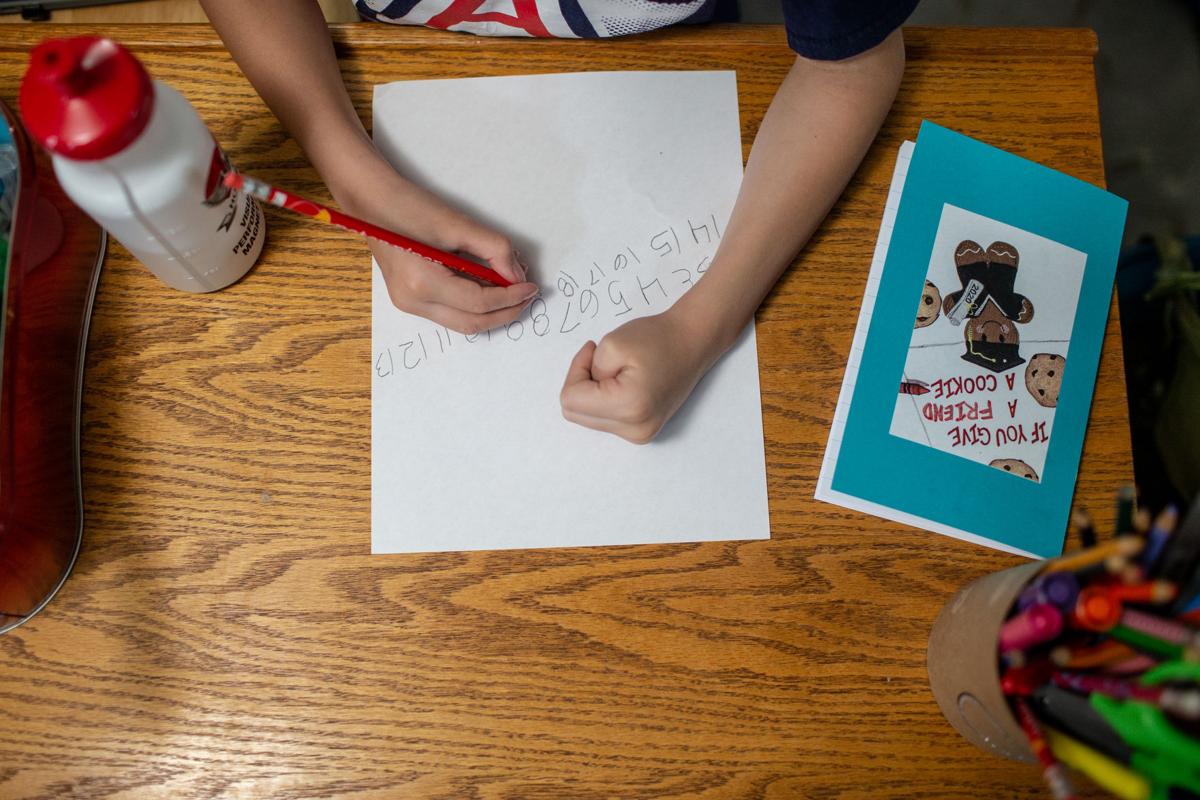
Stephanie Castillo-Leon will not be sending her children into school for standardized testing this year.
“We made the decision to keep them home as a safest option,” she says. “It doesn’t really make sense to send them back, even if it’s just for a day or two, to get that exposure. If we weren’t worried about the exposure then they would have gone back to school.”
The Tucson Unified School District mom has a first grader and a fourth grader, and her older child has standardized AzMerit tests in April in both math and English. Arizona is requiring the test to be taken in person, even if the child has been exclusively remote learning for the past year and despite federal permission to postpone the tests or give them online.
Castillo-Leon is not alone in refusing to send her child to school for in-person testing. Many parents have expressed concern about remote learners going on campus to test, said Tucson Unified Superintendent Gabriel Trujillo during a March 9 board meeting. The idea was not popular with parents who attended a virtual parent forum hosted by the district.
“If you’re a parent and you are keeping your child remote and you do not want your child coming onto campus, that decision is going to be respected, and there will be no negative consequences academically or anything placed in your student’s academic history or file,” Trujillo said.
Mari Katherine Scruggs, a teacher at Rincon Vista Middle School, creates the best-possible learning experience for her students as she navigates both remote and in-person instruction during the coronavirus pandemic of 2020-2021. Video by: Mamta Popat / Arizona Daily Star
Rachael Eggebeen teaches eighth grade social studies at Apollo Middle School in Sunnyside, so her students have to take three standardized tests this year, in English, math and science. And like many educators, Eggebeen says she thinks the standardized testing should be canceled this year.
“All of the stress of living in a pandemic, of remote learning, of disruptions to life, compounded by students who have lost lots of things — they’ve lost opportunities. They’ve lost family members and friends. Some of them have had to move. All of that, plus the idea of now we’re going to give you this high stakes test,” she says.
While standardized testing is required nationwide, the U.S. Department of Education has said states can postpone it until the fall and administer it remotely. But Arizona has decided to require that the testing happen this school year and that it occur in person.
“I know the scores are going to go down”
In a typical year, AzMerit test scores have an impact at both the school level and for individual teachers and students.
Test scores usually affect schools’ A-F letter grade in the state’s accountability system. That can affect funding and enrollment. The state is pausing the grades for schools this year. The scores also typically factor into teachers’ performance pay, which is also being paused by the state for a year.
A student’s scores can be a factor in whether they get into honors classes. And third graders need to get a certain score in English to move on to fourth grade, which still stands this year.
Students take the AzMerit in English and math in third through eighth grades and in 10th, and a standardized science test in fifth, eighth and 11th. The third grade English test is especially important because of Arizona’s Move On When Reading law, which says that third graders who don’t meet the standards on the test need to demonstrate “sufficient progress toward reading” on an alternative reading assessment in order to move onto the fourth grade.
Although third graders who do not meet the standards will be retained despite the pandemic, kids who do not take the test at all are not retained, which could be another incentive for parents to opt out of testing.
Gov. Doug Ducey issued an executive order in February that called for the results of this year’s AzMerit tests to be used to combat learning loss, as statewide assessments are meant to offer a temperature check on how students are doing academically.
Rodney McGee, who teaches middle school math at Anza Trail in the Sahuarita School District, has mixed feelings on the testing. He says it’s a lot of pressure on the kids who have not been in the classroom, but he also thinks what the tests reveal could be important.
“I know the scores are going to go down because even the kids that are there every day — it’s not the best situation in the world,” he said. “My feeling is that scores are going to be bad, but we need to find out how much damage has been done.”
McGee teaches hybrid in-person learning. With classes of up to 30 students, he sees half his class in person on staggered days of the week.
Sahuarita schools could open full time in April. That could mean 30 kids in one class for McGee. If the online students also come in for the standardized tests, “that’s going to make for a really full classroom,” he says.
A potential influx of students
Normally school districts are required to test at least 95% of their student body.
This year the Arizona Department of Education is applying for a waiver from the federal government to be exempt from this requirement, which they expect to be granted. Nonetheless, schools are expected to make a good-faith effort at getting students in to test.
Across Tucson, school districts have between about 14% and 58% of their students in remote learning exclusively — but that could change Monday when all elementary schools in the area will be open for full-time, in-person school, under an executive order Ducey issued requiring in-person classes across the state no later than March 22.
Bringing a remote student to test in person could mean trying to bring an estimated additional 27,000 children onto school district campuses across Tucson during a six-week window.
“When we’re talking about almost 50% of the district being in remote instruction, there’s no really feasible way that our schools in mass are going to be able to test 95% of their test populations that they have at their schools when we’re probably going to have a lot of parents that for safety reasons will probably not have their kids coming onto campus to take AzMerit,” Trujillo said.
Sunnyside, Tucson’s second-largest school district with about 15,000 students, was bringing in remote students in February for the AZELLA, a standardized test for English Language Learners to test their proficiency. It was sort of a test run for AzMerit but on a much smaller scale, said Superintendent Steve Holmes.
“I feel like we have systems to bring students back for purposes of just testing — we saw that happen with AZELLA,” he said. “Of course this scale is of greater concern, just to try to manage that. And so it’s going to really mean that we have to be thoughtful about extending that testing window for those students that are not in school, over a two to three week period of time.”
With about 58% of the Sunnyside student body still learning remotely, that could amount to about 5,000 students across the eight grades that get tested, who may not have set foot on campus all year.
The State Board of Education approved the extension of the testing window by two weeks, for a six-week window.
Last year, testing was canceled as schools first closed and the pandemic began to spread. If Castillo-Leon, the TUSD mom, did send her fourth grader in to test, it would not only be his first time setting foot on campus in a year and being around a large group of kids, it would also be his first standardized test.
“This is a global pandemic, and they’re sort of learning how to do school while doing school virtually, and so I really don’t feel like the standardized test would be able to capture what they’ve experienced the last year,” she said. “I almost feel like it’s kind of setting your kids up to fail.”
Janelle Edmonds, a teacher at Marana High School, creates the best-possible learning experience for her students as she navigates both remote and in-person instruction during the coronavirus pandemic of 2020-2021. Video by: Mamta Popat / Arizona Daily Star

