





A bill aiming to limit shared governance, like the University of Arizona’s Faculty Senate, is making headway in the statehouse.
HB 2735, proposed by Republicans Travis Grantham of Gilbert and David Livingston of Peoria, recently passed the House 31-28. It is now headed to the Arizona Senate.
The proposed law would require the Arizona Board of Regents and university presidents to “consult” rather than “share responsibility” with faculty regarding educational and personnel matters.
This is all happening in the backdrop of the UA’s $177 million deficit, which many in the Faculty Senate blame on UA President Robert C. Robbins and his senior leadership team.
According to Ted Downing, a longtime research professor at the UA who also served as a state legislator and helped get the original shared governance law passed, Grantham’s bill “puts all power in the president.”
“The power to set up programs, hire and fire faculty, really all power,” Downing said. “This is a wrecking ball to the whole concept of how we govern and operate as a university.”
Is it in state law?
Proponents of shared governance point to the fact that it is technically, they say, written into Arizona state law.
“Shared responsibility” became a state law in 1992 with the passage of ARS 15-1601B, which stated that “the faculty members of the universities, through their elected faculty representatives, shall share responsibility for academic and education activities and matters related to faculty personnel.”
But, according to Grantham, that law doesn’t technically have the phrase “shared governance” in it.
“There is no shared governance,” he said in an interview with the Arizona Daily Star. “That’s not in state law.”
He says faculty members at the UA “took control” of the university.
Inspiration behind the bill
Grantham told the Star the bill was inspired by the “massive financial cliff” that’s threatening to “bankrupt the university system.”
Any criticism from faculty members — and there’s been a lot — is “wrong,” he said.
“Nothing in the bill takes away their ability to participate in decision-making processes,” he said. “They’re making stuff up.”
According to Grantham, the faculty members are “the most left of the left” who are “grabbing and clinging to power.”
“They should be smarter than that; they’re supposed to be professors,” he said. “They don’t even understand the legislation, which is kind of disappointing, so I guess I would encourage them to maybe take a civics class.”
Downing took offense at Grantham’s comments.
“He’s blaming the faculty for something we have nothing to do with,” he fired back. “In fact, it is to the contrary. We brought up issues about the hundreds of millions of dollars being spent to support out-of-state students.”
Overspending on merit financial aid for out-of-state students is one of the things UA senior leadership have blamed the financial crisis on.
Downing says Grantham’s bill aims to “remove the legs from the stool that accountability at this university stands on.”
As for who caused the financial crisis?
“I don’t really know,” Grantham said. “And I don’t care.”
Then, after briefly blaming what was going on as “another tactic of the left,” the representative said maybe it was “everybody’s fault.”
“The organization has to be run top down,” he said. “The job of the president is to make decisions, and sometimes you got to make tough ones.”
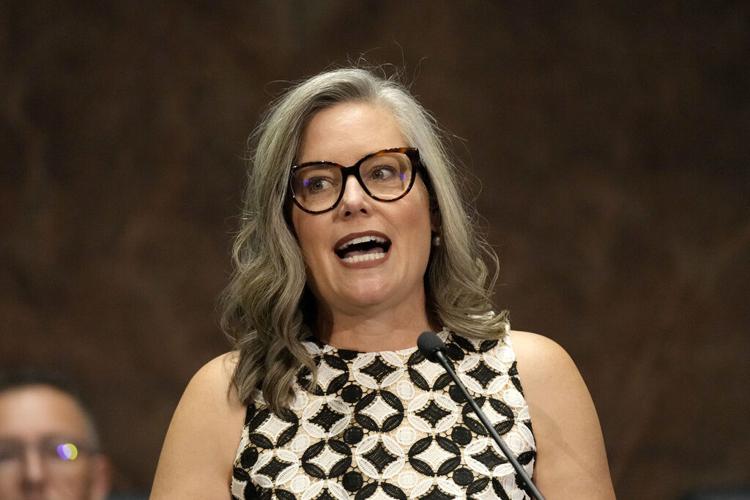
Grantham also claimed Democratic Gov. Katie Hobbs was in support of the bill.
“She voiced her support and agreed with what was in this bill,” he said.
Hobbs directly contradicted Grantham’s statements just a day after Grantham spoke with the Star.
“I haven’t had a chance to look at his bill,” she told reporters.
Will the bill become law?
Hobbs, who exercises her veto power regularly with the Republican-controlled Legislature, hasn’t come out with an official stance on the bill.
Mark Stegeman, a professor at the UA Eller College of Management and the parliamentarian for the Faculty Senate, said he’s worried about potential amendments making the bill more palatable to lawmakers.
“My assumption has been that the current bill has very little chance of becoming law because it has obvious problems,” he told the Star. “One thing that could happen which concerns me is that the bill could be amended in a way that made it less unreasonable.”
Though he rarely takes positions as parliamentarian, Stegeman said he would make an exception if this bill gains more traction.
“I would certainly do what I could personally to block a bill that materially reduced the role of faculty governance,” he said. “I would not hesitate to take a position against that and explain clearly why I think that’s a bad idea.”

