



The University of Arizona is operating in a $177 million deficit and faces layoffs and across-the-board budget cuts of 5% to possibly 15%, according to a new report released by interim Chief Financial Officer John Arnold.
Sixty-one of the 81 units within the university — that’s 75% of them — overspent in fiscal year 2024, according to Arnold. Just 20 units reported spending within their budgets this year.
“It’s fixable and we’ve caught it in time to give us the time to fix it,” Arnold said in an interview Monday with the Arizona Daily Star. “The university is not currently in financial danger, but as I said the other day, the cost trajectory is dangerous.”
To help combat this, there will be a 5% budget reduction planning assumption for fiscal year 2025, said Arnold, who also serves as executive director of the Arizona Board of Regents. Each unit will have to present how they would operate if 5%, 10% and 15% of their budgets were cut. The UA will then decide how much to fund each unit.

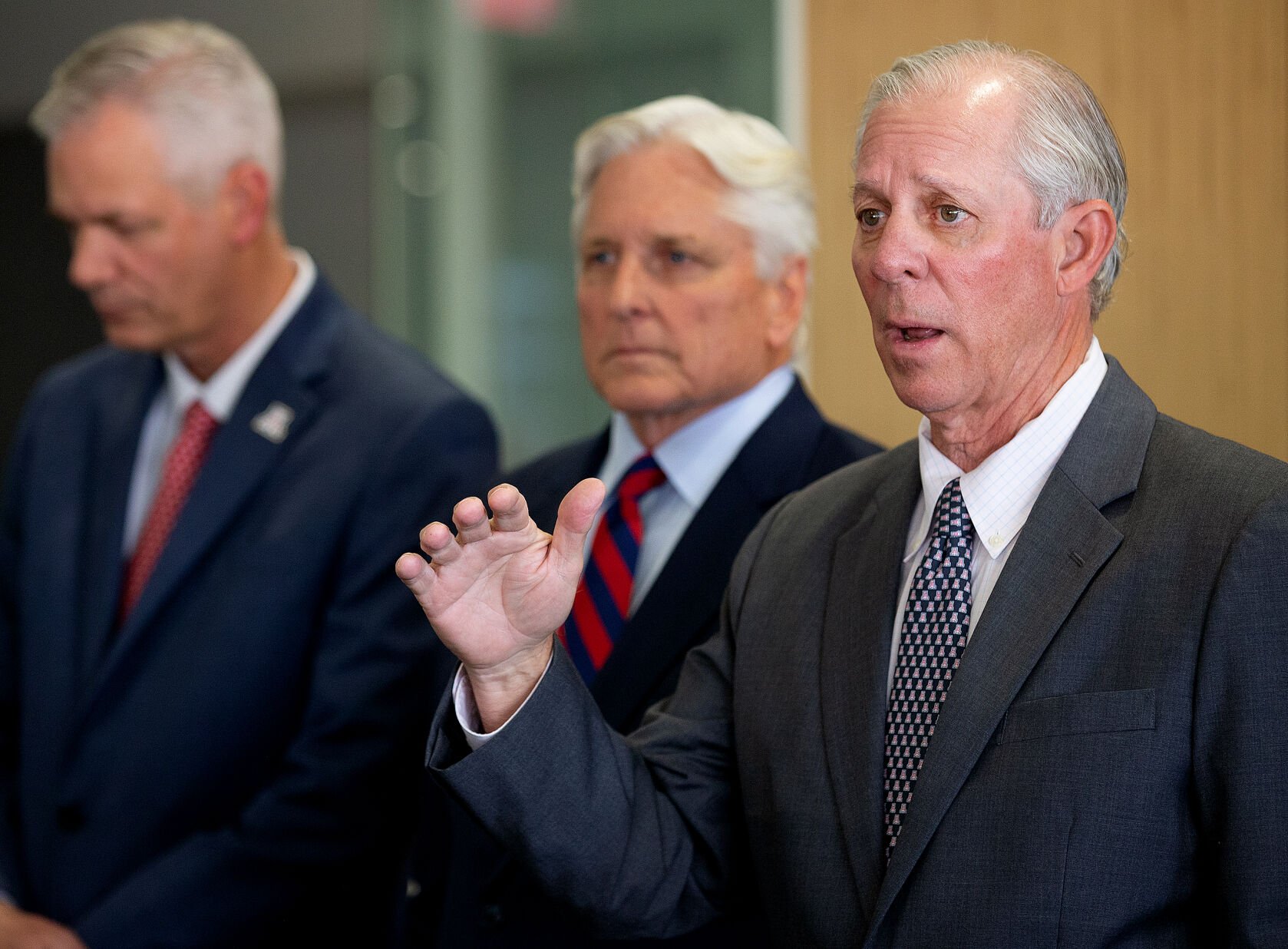
University of Arizona Interim Chief Financial Officer John Arnold presents a financial action plan Monday to faculty leadership.
The budget drafting process for fiscal year 2025 will take place from Feb. 1 through April 15.
“We’re going to have to go through that exercise of deciding what the university wants, and then funding it appropriately,” Arnold said.
In a presentation to university leadership and ABOR Monday, Arnold cited over investing in strategic plan initiatives, unit-level investment in scholarship and students and institutional-funded research as reasons why the UA was in its financial situation.
He stated that external factors included inflation, the COVID-19 pandemic and the shift in revenue from athletics, something university administrators say is being felt by almost all peer universities.
UA President Robert C. Robbins’ strategic plan initiatives, Arnold said, have cost the university “about $150 million” in the last five years.
In fiscal year 2023, the university started within a beginning balance of $845 million in cash. By the end of the year, it had spent down $140 million of that.
According to Arnold, last year $61 million was overspent by “colleges and divisions,” $32 million was loaned to athletics, and $15 million was overspent on the university’s strategic plan; $26 million went to “unallocated leases/utilities/institutional costs,” $35 million went to the rare “27th payroll,” which happens “about every 11 years,” according to Arnold; and $18 million went to the deferred payroll tax from the COVID-era CARES act.
The acquisition of the online, former Ashford University into the University of Arizona Global Campus, which has been unpopular among faculty, actually netted the university a positive $47 million for fiscal year 2023.
In one year, the university went from $845 million in cash reserves to $705 million.
And, according to the forecast for the current fiscal year of 2024, it will end up with $510 million in cash on hand, having spent another $195 million.
According to the forecast in Arnold’s presentation, colleges and divisions are projected to overspend by $116 million, athletics by $32 million, and “unallocated leases/utilities/institutional costs” by $24 million. Additionally, the strategic plan will overspend by $3 million and UAGC will cost the university $2 million. Arnold chose to add a 10% “contingency” in the forecast to be conservative, which totaled $18 million.
By the June 30 end of this fiscal year, the university is expected to have a projected 70 days of cash on hand. The ABOR guideline calls for about double that.
The interim CFO did note, however, that he felt hopeful the UA will have more cash on hand than the projected amount, as the hiring freeze and other initial responses to the financial crisis have worked to slow the spending of cash.
Arnold stated that, though there will be cuts and changes across the board, the university is committed to not doing any of the following: Reducing need-based financial aid for Arizona resident students, reducing need and merit-based aid for any current or accepted students throughout their time at the UA, eliminating tuition guarantees for any current or accepted students, reducing retirement benefits or instituting furloughs.
There will be layoffs, however, he said.

The University of Arizona is committed to not reducing need-based financial aid for Arizona resident students, reducing need and merit-based aid for any current or accepted students throughout their time at the UA, nor eliminating tuition guarantees for any current or accepted students, officials said Monday.
“People ask me all the time, ‘where did the money go,’ “ Arnold said. “It went to students through excessive discounting, wanting to retain and recruit faculty and staff largely though salary, and it went to athletics. Those are the big three.”
Athletics
The issue of athletics has long been at the forefront of the university’s financial crisis.
In a December faculty meeting, Robbins confirmed the UA had loaned its athletic department more than $86 million in recent years. He said there would be layoffs and serious cuts made to the department.
But at ABOR’s special Dec. 13 meeting, Robbins didn’t share anything about his plan for athletics, and noted how “vexing” of an issue it has been for him.
This includes centralizing administrative functions, resetting the budget and starting from zero, installing hard caps on spending, enhancing revenue outcomes and setting long-term goals. The university will be “engaging a global professional services firm to review athletics finances and operations.”
He said that “the whole athletic model is just flipped upside down over the last four or five years,” causing the university to lose significant money from its department.
According to Arnold’s plan, the university will “modernize athletic operations from the ground up.” In his presentation to UA leadership, Arnold said that there had been “no sustainable growth in athletics” in six or seven years.
With the help of a consulting firm, which ABOR has volunteered to pay for, the UA will try to answer questions that Arnold has asked in multiple presentations: “What do we want out of the athletics department?”
UAGC
The UA also plans to hire a consultant to help with its acquisition of UAGC, Arnold said. ABOR will also pay for that firm.
In fiscal year 2023, the year it was officially acquired, UAGC brought in $47 million to the university. In fiscal year 2024, it is projected to lose $2.4 million, though Arnold projects that by the end of fiscal year 2025, its cash impact will be an estimated $3.1 million.
“There’s a lot of overlap between what the standalone university provides and what UAGC provides,” Arnold said. “So we need to bring those together and create those efficiencies as quickly as we can.”
Financial aid
Since first announcing the university’s financial crisis in November, Robbins has continuously blamed financial aid and merit scholarship programs as one of the core reasons the UA has struggled.
According to Robbins, the university loses money on every student it admits with a high school GPA over a 3.75 because of how much merit money it gives.
“As part of the university’s strategic plan, they wanted to increase the merit level of the student body, and so they began spending more on merit aid at the same time the higher education market was softening,” Arnold explained in the interview. “We were both trying to increase the merit level of the student body as well as maintaining growth in the student body, and so that led to excessive discounting.”
In fiscal year 2018, the university gave out $189 million in financial aid. That has jumped to a projected $362 million in aid for fiscal year 2024. Arnold said the UA will rein in the amount given, though financial aid to in-state students and currently admitted and enrolled students will remain the same.
Despite the growth in financial aid, the net tuition revenue per student that the UA receives has remained stagnant, according to the presentation.
In fiscal year 2018, the university was receiving an average of $12,183 per student. That amount has grown less than $100 in six years — in fiscal year 2024, the forecasted net tuition revenue is $12,259.
Centralization
“There is a lack of unified structure on campus,” Arnold said. “The university operates in a very decentralized model and it doesn’t have the robust reporting, neither up to central (administration) or down from central (administration) out to the units to really support that kind of operating model.”
Arnold echoed previous statements from Robbins and ABOR about a lack of unified structure. He cited the business/finance office, facilities management, human resources, information technology, marketing and communications and the university’s advancement office as units that will be assessed for centralization.
Facilities will be centralized immediately, according to the presentation, and human resources and information technology will be centralized by March 4.
“You have all these units that are out there making decisions, they’re really on their own without an understanding of how those decisions are affecting the greater (university),” Arnold said.
He stated that he hopes to save costs and cut bureaucracy in the university.
Administration costs
Arnold said Robbins asked him to “attack” the financial crisis “through the lens of administration first.”
According to the presentation, to reduce administrative costs the UA will “right size” vice president/vice provost and associate/assistant vice president positions.
By doing so, Arnold hopes the university will “improve transparency, budget management and communications.”
He added that the UA will be working with Huron Consulting to review its administrative structure, and that leadership has already begun the process of reviewing bureaucratic positions that will be cut. That consulting firm will also be paid for by ABOR.
“We’re going to reduce administration by restructuring and then outright reducing,” Arnold said. “The guiding principle behind all of this will be cost savings, less bureaucracy and improved outcomes.”
Revenue streams
The university has a “revenue problem,” Arnold said.
He said the UA must consider a new financial aid model, summer and winter revenue options and auxiliary revenue opportunities in order to find ways to bring more money in.
“I think there were expectations of revenue growth that just did not materialize,” Arnold noted.
He added that there is a “tremendous asset base here at the university, and we need to make sure we’re maximizing the use of those assets.”
To do so, the UA will also be taking part in a “space utilization study,” some of which is already done, Arnold said. The study will allow the university to consolidate its office spaces.
Changing budgeting models
The UA has had three budgeting models in the last 10 years, which is a problem, Arnold said. The university has switched from the incremental model, to Responsibility Centered Management (RCM), to Activity Informed Budgeting (AIB). None of these models have been very popular.
Arnold hopes to implement a new budget model by Jan 1, 2026.
There has been a “slow separation” over the last 10 years “between cost reality and how we’re allocating resources across campus,” according to Arnold. A lot of that has to do, he said, with the past budgeting models used by the university.
Next steps
Arnold, in his interim role, has been working on the financial crisis at the UA for about six weeks.
In Gov. Katie Hobbs’ letter to ABOR Thursday, she stated she was concerned about a potential conflict of interest in Arnold’s UA appointment because of his position as executive director of ABOR.
“I think it’s in everybody’s best interest that we have a permanent chief financial officer as quickly as possible,” Arnold said. “We will be working to resolve that situation, I think, as quickly as makes sense.”
Arnold said the UA’s budget units can band together to right the financial issues faced by the university.
“This is not an isolated problem, it is a campus-wide problem,” he said. “We need to think about it as a university-wide problem, and we’re only going to be able to solve it through university-wide solution sets.”
Get your morning recap of today's local news and read the full stories here: tucne.ws/morning

