


The city activated a new “Toucan” pedestrian and bicycle signal Thursday at the crossing near the University of Arizona, where three students were struck and killed last year.
The improved crossing on North Euclid Avenue at East Second Street is part of a broader effort to improve pedestrian safety near campus.
The signal is in response to public outcry after the Oct. 30 deaths of students Sophia Akimi Troetel, 21; Josiah Patrick Santos, 22; and 21-year-old Katya Rosaura Castillo-Mendoza.They were struck while crossing Euclid in a marked crosswalk on the night before Halloween.
The driver, Louis John Artal, then a 19-year-old student, surrendered to police hours after the crash and was arrested on suspicion of manslaughter. He has pleaded not guilty and is set to go on trial Nov. 3.
The deaths sparked widespread grief and outrage across Tucson, with students and residents demanding immediate safety improvements at the intersection long known for heavy foot traffic and fast-moving vehicles.
The crossing system is more advanced than the HAWK (High-intensity Activated CrossWalk) signals at nearly 90 intersections citywide.

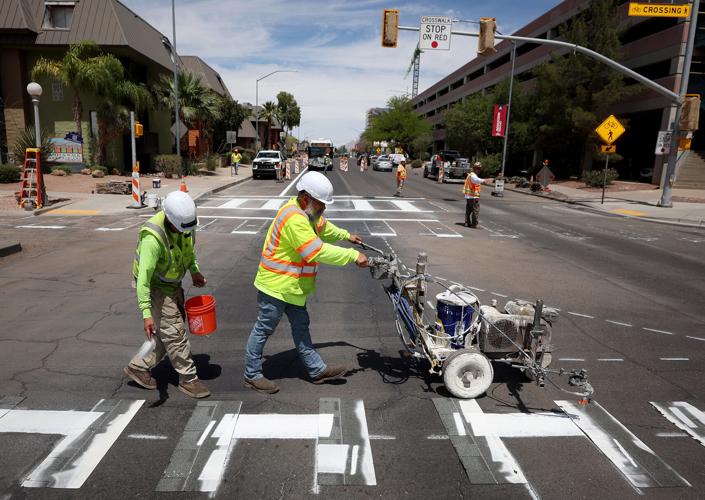
Crews from Pavement, Marking and Ink, paint the crosswalk Thursday at North Euclid Avenue at East Second Street Thursday. The city has installed a new “Toucan” pedestrian and bicycle signal at the intersection following public outcry after an Oct. 30 crash killed three University of Arizona students crossing there.
“This one is called a Toucan traffic signal,” said Lindsey Salcido, a Tucson Department of Transportation & Mobility spokesperson. “It essentially means two can cross — cyclists and pedestrians — at the same time, together during a dedicated signal phase.”
Unlike standard HAWK signals, which are designed for pedestrian crossings only, the Toucan signal accommodates both bikes and foot traffic simultaneously, a key distinction for an area heavily used by students.
“It provides improved safety for pedestrians and cyclists, especially because of the location,” Salcido said. “There is a lot of pedestrian traffic and a lot of people riding bicycles.”
The system, part of Tucson’s broader bicycle and pedestrian crossing program, is activated by a push button that stops traffic when needed. Once activated, drivers get a red light and are required to stop while pedestrians get the go-ahead to cross, creating a controlled crossing environment.
The Toucan signal, city officials said, is one of the most effective tools available for improving safety at complex crossings like Euclid and Second.
As part of the project, city officials installed north and south signal crossings to manage pedestrian traffic flow.
The design also allows more space for people moving through the intersection, addressing congestion that often builds during peak class times

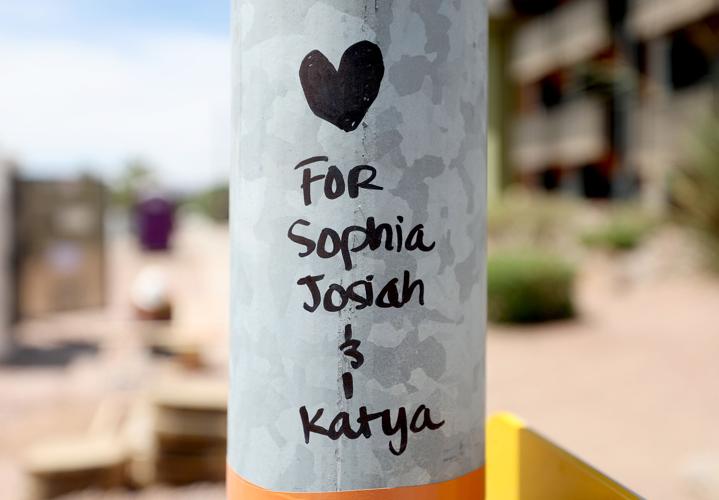
The names of three University of Arizona students — Sophia Akimi Troetel, 21, Josiah Patrick Santos, 22, and Katya Rosaura Castillo-Mendoza, 21 — are written on a pole at the intersection where the trio was struck and killed while crossing North Euclid Avenue near campus last year.
“It can be a little scary walking across this crosswalk because sometimes people can’t stop in time or swerve to try and get out of the way, or stop in the middle of the crosswalk,” said Alyssa Hernandez, who lives near the intersection and regularly crosses the street there.
Hernandez said she walks the area daily and often in the morning when traffic is at its busiest. She said crossing the road can be unpredictable.
For some pedestrians, the memory of last year’s crash still shapes how they move through the intersection.
“My friends and I use this crosswalk, sometimes even at night,” said resident Trent Miles. “Knowing what happened last year, we are kind of afraid every time we cross the street.”
The UA area project is part of the city’s larger plan to install HAWK systems at four intersections across Tucson: East Prince and North Los Altos, East Fort Lowell and North Geronimo Avenue, East Speedway and North Second Avenue, and East Speedway and North Belvedere Avenue.
City officials say the goal is to reduce crashes and increase driver awareness in high-risk areas, especially near the university, where foot and bike traffic remain constant day and night.

