



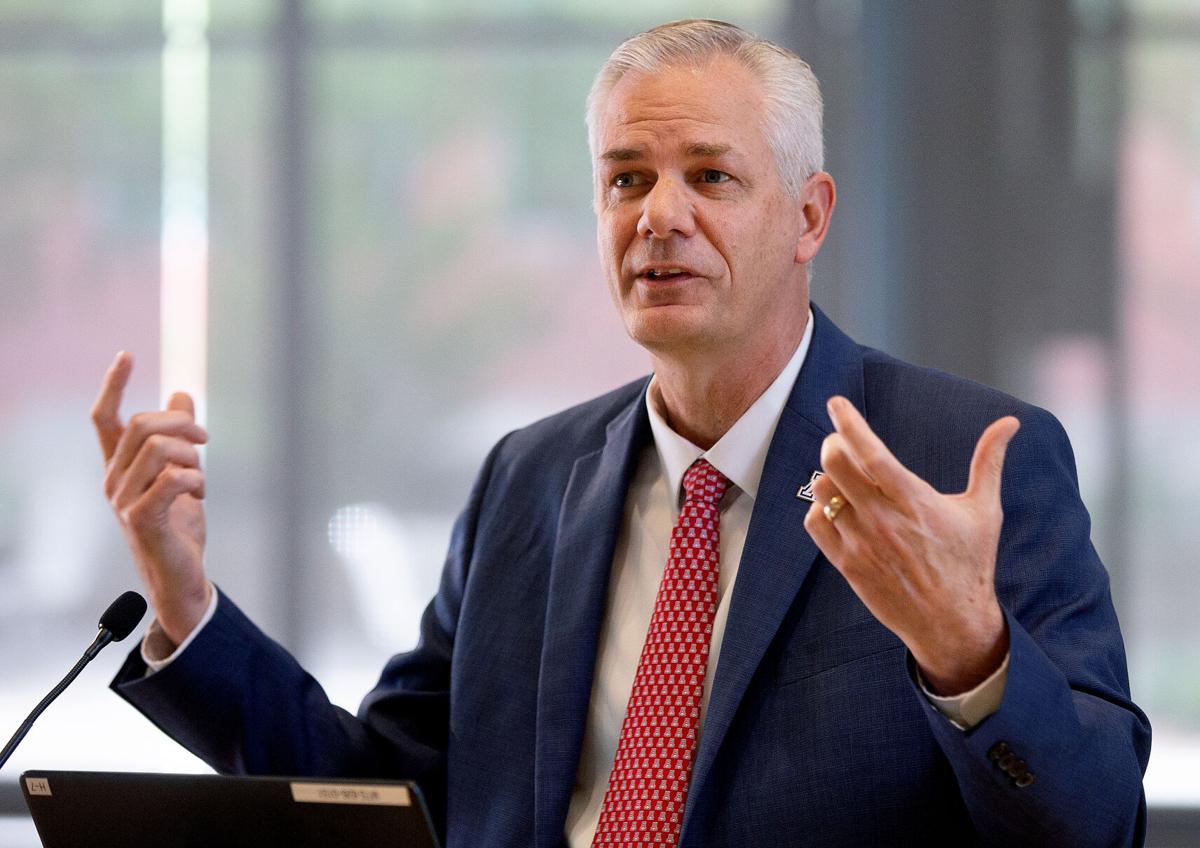
After an initial round of budget cuts and spending measures, the University of Arizona’s deficit has shrunk from $177 million to $162 million, says interim Chief Financial Officer John Arnold.
Arnold gave an update on the “good news” for UA’s finances to the Arizona Board of Regents’ University Governance and Operations committee on Thursday.
The UA’s current cash balance is $748 million, or $157 million less than it was last year at this time.
Arnold and Interim Provost Ron Marx are about 90% done with their funding meetings with individual colleges and units, meaning a baseline UA budget will be ready by the end of April.
“That will allow our colleges to really develop their staffing models for next fall and make staffing decisions that need to be made,” Arnold told the regents. “I don’t want the board to anticipate a wholescale structural change in April. We’re just not prepared for that, nor have we had time to delve into that.”
That’s important, because about 70% of the university’s expenses are “personnel-related.”
“I think we need to be aware that you can bite around the edges only so much before difficult decisions have to be made,” Regent Lyndel Manson said. “They will be made. And I know the university will not make them rashly; they will be made with careful and thoughtful considerations for individuals involved.”
Layoffs have begun. There have been over a dozen so far, and “they’ll continue to occur,” Arnold said.
“I don’t anticipate a single day when we announce hundreds of layoffs,” he added. “This will take place over time and (be) more piecemeal.”
In Arnold’s unit, he said, there have been “about 10 individuals” that have left.
“It’s been a mix of terminations, retirements and voluntary separations and it’s at all levels,” he said. “I’ve had two associate vice presidents and a vice president that have left that I’m not replacing. We did a reorganization, and we no longer need those positions.”
Layoffs aren’t just affecting vice presidents, however. Arnold noted that “we are separating from some custodial staff” and that “everything from high-end paid individuals to very low-end paid individuals” will be impacted.
So far, he said, a lot of the separations have been “voluntary,” which he believes isn’t necessarily a good thing.
“I worry that if you limit it to voluntary separations, you’re letting employees dictate structure,” he said. “As we get through spring and have a better understanding of where we’re at in June, we’ll have to do a look back and see what we’ve accomplished through voluntary (departures).”
Arnold also noted that given the “employment structure” of the UA, layoffs are complicated. At the university, there are nine classes of employees, each with different separation rules in terms of “process and notification” of termination.
That isn’t the case in Tempe, Arizona State University President Michael Crow chimed in. ASU has “fully implemented” Arizona’s at-will employment laws, meaning they can let go of employees more freely.
In response to this, Regent Manson asked if the UA could change its structure, possibly to match that of ASU. It’s unclear if that’s something that will be considered by Arnold and the UA’s senior leadership team.
Outside consultant Ernst & Young will have reports on the athletics department and the UA Global Campus by the end of May, as well.
“I had a really good update meeting with them yesterday and they are really into it and identifying a number of opportunities” for athletics, Arnold said.
UAGC, which has faced scrutiny from faculty, the media and Gov. Katie Hobbs, has broken even. Arnold said it had a net positive of “$100,000 or something.”
Additionally, the process of establishing a new financial aid model is underway. Arnold said he is working with the Strategic Planning and Budget Advisory Committee, a form of shared governance, on the process.
“Hopefully we’ll have something in place for early May that we can start marketing for students that will be enrolling next year,” he said.
Human Resources is in the process of being centralized, as “a lot of the overspending at the UA is driven through HR decisions,” Arnold said.
“By July 1, we’ll be able to put in place a staffing model for the UA that is backed up by a budget, and then we’ll be able to monitor and control that staffing model so that the departments and colleges won’t be able to go out and hire people without us knowing about it,” he said.
Get your morning recap of today's local news and read the full stories here: tucne.ws/morning

