



Since Placido dos Santos had the backyard pool removed from his midtown Tucson house seven years ago, he’s watched his water and electricity bills plummet.

Tucson utilities are joining in a public campaign to give information to people who want to remove their pools, and help those who want to keep them better understand what it costs to do so.
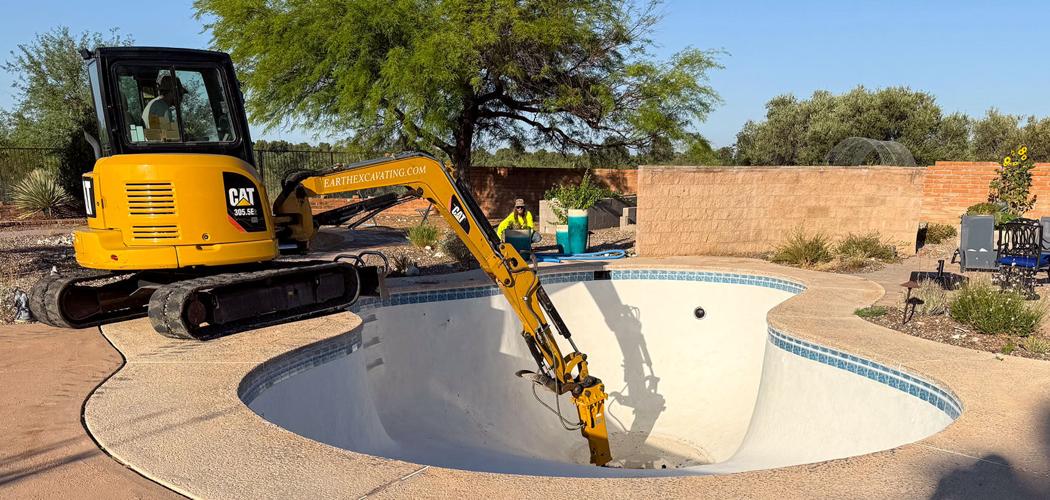
Now, Catalina Foothills homeowner Chrtine Mullins expects to see huge savings in those same costs after she bid her backyard pool farewell a month ago as it was demolished, then removed. She’s also saying goodbye to all the extra hours she said it took and the costs she incurred to keep the pool maintained.
Dos Santos and Mullins are the kinds of pool owners that four Tucson-area water utilities hope to reach in the coming months. The utilities, including Tucson Water, held a free public workshop Saturday and will hold a second one on Aug. 2 to explain how people who want to remove their pools can do that and how people can better understand the costs of pools they swim in at home.
The utilities have also combined to launch a website — poolremovalhelp.org — explaining many of the facts and issues about pools and pool removal in detail.
The Tucson area has plenty of private pools today — more than 59,000, or 18.7% of all residential parcels in Pima County, says longtime Tucson water researcher Gary Woodard. He cited December 2024 statistics he got from the Pima County Assessor’s Office.
And they use plenty of water — an average of about 30,000 gallons a year. That’s almost half the average Tucson Water household’s annual water consumption, according to a news release announcing the pool removal workshops.
“We’ve had questions from customers for years about what to do with swimming pools they no longer want,” said Candice Rupprecht, Tucson Water’s water conservation manager “We are excited to offer this website that helps users understand the true cost of pool ownership based on local data and make informed decisions about owning, maintaining, and removing backyard pools.”
In general, various studies on outdoor water use and on pool removals suggest there are a lot of homeowners with older pools who wish they didn’t have them, said Woodard, who helped organize the workshop and designed the pool removal website.

Placido dos Santos had the backyard pool removed from his midtown Tucson house seven years ago.
A 2017 random sample survey of 300 pool owners in the Tucson Water service area found 1 in 6, or 17%, were considering removing their pool, Woodard said.
But surveys also suggest that a lot of homeowners interested in removing their pools lack information to figure out how to do it, he said.
“When you go driving around, empty pools, they are everywhere you go,” said Chris Kent, co-owner of AZ Pool Busters, one of at least 10 Tucson businesses that do pool removals. “On Google Earth, of if you fly around, you see tons of them. They are either black or empty.
“(And) they are dangerous. We have some people who can’t even go in their backyard, because if you fall in one, you can bust your head open,” said Kent, whose company removed Mullins’ and dos Santos’ pools.
A pool was ‘the last thing on my mind’

Placido dos Santos says since he removed the pool from his backyard seven years ago, he’s enjoyed significantly lower electricity and water bills.
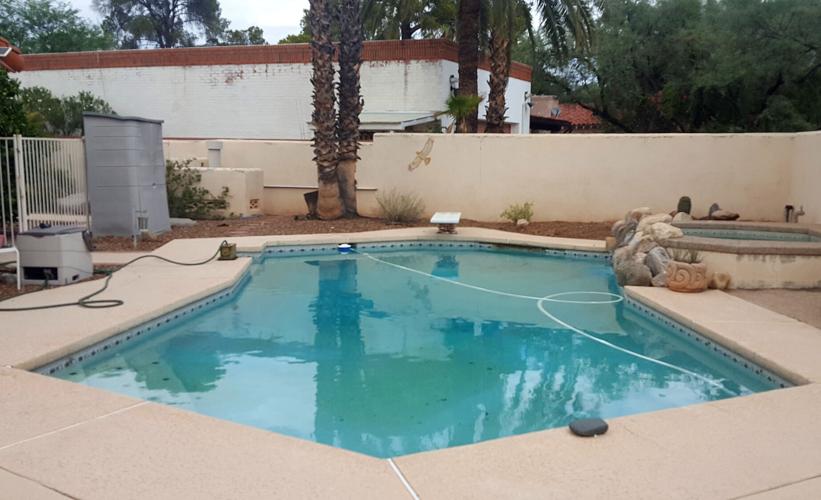
Dos Santos and Mullins had their pools removed seven years apart, but they had other things in common. Neither had really wanted the pools that came with houses that they bought — dos Santos in 2000 and Mullins in 2020. Both of their pools were large, with Mullins’ pool containing a diving board and a slide and going down 9 feet deep.
They also work or have worked for water agencies. Mullins is a software engineer for Phoenix’s Salt River Project, which sells water and electricity to farmers and urban dwellers in that area.
Dos Santos retired in April after working 30 years for the Central Arizona Project, the Arizona Department of Water Resources and the Arizona Department of Environmental Quality and as an independent consultant. At ADEQ, he was border environmental manager, at ADWR he directed the agency’s since-closed Santa Cruz County area office and for CAP, he was a planning analyst.
Getting a pool was “the last thing on my mind” when dos Santos purchased his home in the San Clemente neighborhood near El Con Mall, he recalled.
“I bought the house anyway. It had everything I wanted. It was old. It was historic. It was in my price range. It was close to my mother. It needed to be attractive, and it was not a fixer-upper.
As for the pool, “I looked outside and it was pretty,” he said. “It was part of my landscaping.”
Mullins recalled that when she bought her house near River and Craycroft roads, “the pool didn’t matter to me.
“I bought the house because of the location. The backyard is very private and very large. I like the neighborhood. I didn’t really care about the pool. I really didn’t think about getting rid of the pool or keeping the pool.”
‘A total waste of water’
One reason Mullins and dos Santos wanted to get rid of their pools is that neither one used it much.
Mullins said she’s not a swimmer and would use her pool about “once a summer,” when her family was visiting.
Dos Santos said he would go into his pool six times a year, at most.
Their disenchantment with their pools sprung in part from the large and increasing amount of time they had to spend maintaining it.
“What evolved in my own mind was that because I was spending all this time cleaning it, getting all the dirt out and taking leaves out, filling it with water, adding chemicals, taking water quality tests, and doing repairs; I came to look at the pool and hated it,” Dos Santos said.
“So I made up my mind; I wanted to get rid of it. I even thought about selling my house.”
Over time, not only did pool maintenance become increasingly tedious, but as a nature lover, “I especially disliked having to remove dead lizards from the bottom of the pool and the skimmer,” he said.
For Mullins, “Come springtime; I like to call it the season of what’s dead in my pool today. I’d wake up every morning and I would fish something dead out. Seventy percent of the time, it’s a lizard, 20% of time it’s a mouse and 10% it’s a bunny or some other type of creature.”
Also, because her pool was built in the 1970s, it lacked modern features such as an autoflush device that automatically fills a pool with water, she said. So during the summer, every morning she had to go out to the pool to fill it with enough water to replace what had evaporated the day before, she said.
“You really pay attention to an hour of water filling the pool every day,” said Mullins, adding she felt guilty “all the time” about the water use. “If you are water conscious, which you should be in the desert, it’s like throwing away water.
“It’s like turning on your hose for an hour for no apparent reason — a total waste of water.” she said.
“I think, honestly, pools are fantastic for families and kids who swim every day. It’s a wonderful thing for keeping kids active, for being outside in summer to cool down,” Mullins said. “For someone like me, I live alone. I do not swim. It’s not worth it.
The other thing about having a pool is that it’s very expensive, she said.
When she plugged her various pool-related expenses into a calculator, it was costing her about $3,500 a year to maintain the pool, in between adding chemicals, paying for water and electricity.
And when she had to refill her pool with water each year, her water bill that month would rise to $900, compared to a normal summertime water bill of $400 to $500, she said. Part of the reason for the hefty increase is that her bills would increase more per gallon used as the water use rose, under Tucson Water’s increasing water block rate structure.
Removing the pool cost her $10,000, but she’ll pay that back through saving on energy, water and other maintenance costs in three years, she said.
As for Dos Santos’ water costs, he found that once his pool was gone, his summertime water use dropped about 62% and his wintertime water use fell by about 60%. Between lower water and sewer bills — which are based on wintertime water use — his annual water costs fell by $160.
His electricity use and bills fell by half after the pool was removed. That came on top of an earlier, dramatic cut in his energy use and costs when he installed an energy-efficient pump for the pool.
Over two years, Dos Santos calculated his “cost per dip,” which he said was about $250. Eventually, an entire swim season would pass without him going in.
“When the pool reached 25 years old, it needed re-plastering and was being invaded by roots from a mesquite tree that had reached the water by creeping under the concrete deck around the pool. I considered having a total pool rehab, and was quoted estimates of $7K to $12K,” dos Santos wrote in an account of his pool saga on the poolremovalhelp.org website.
“After owning the pool for 18 years, I came to realize that a pool is a hole in the ground that you throw water, money, energy and time into,” dos Santos wrote. “By 2018, I wanted it gone so I could use my yard for other things that seemed more gratifying and environmentally appropriate for the Arizona desert.”
It cost him about $5,000 to have the pool removed, another $500 to take out a wall so the pool removal equipment could get into his backyard and $1,000 more to have a drip irrigation system installed He paid it all back through savings on his water, electricity and maintenance costs in two and one-half years, he said.
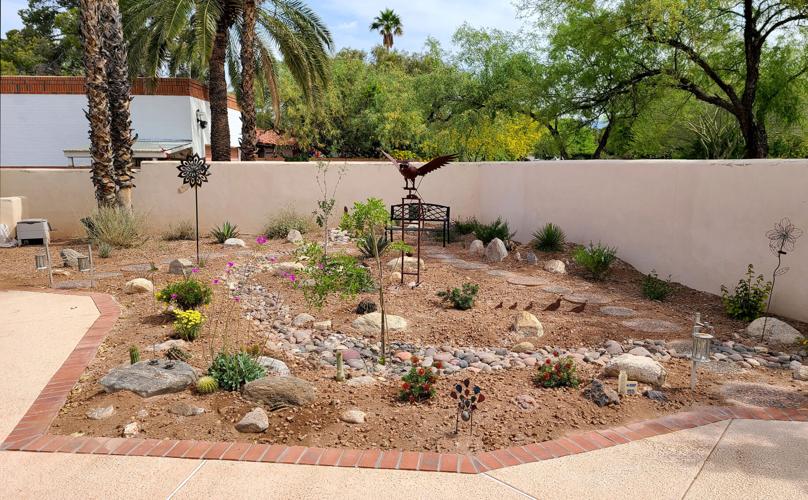
Since 2018, he’s had a new xeriscaped backyard installed, including a Texas mountain laurel and a Southern live oak tree, five shrub varieties and a small saguaro, a golden barrel and a fishhook barrel cactus, a night-blooming cereus and several agaves and yuccas.
Now, “every time I walk into my backyard, I’m happier. I got birds. i see lizards running around instead of drowning in the bottom of the pool. I see flowers. I installed a shade canopy. Now, it’s a pleasure to sit down and look at my landscaping rather than looking at my pool which I really hated.”
Debating a rebate
Dos Santos spent eight years on the city of Tucson’s Citizens Water Advisory Committee, leaving in 2022. While on the committee, he advocated for the city to set up a rebate program for swimming pools like those it has for low-flow toilets, low-water use washing machines and rainwaater harvesting equipment such as cissterns and roof gutters, he said — only to be told that the rebates would be subsidizing the wealthy since so many pools are owned by upper-class households.
He disagrees, saying he believes plenty of middle-class families would take advantage of a pool rebate if offered.
“I think there are a lot of people rather than eliminate a pool, they just keep pouring money into them and don’y use them,” he said. “I think there’s a lot of people just like me. We are trying to make our livings the best we can on fixed incomes and pensions and just a small rebate of $1,000 would be enough to make people seriously look at getting rid of pools.”
But Mullins doesn’t agree, saying that any rebate would have to be huge, probably larger than the city would ever want to pay, to induce people to take on a pool removal job costing $7,500 or more.
“If you want to remove a pool you are going to do it. if there was a financial incentive I would take it, but I would remove it anyway.”

