


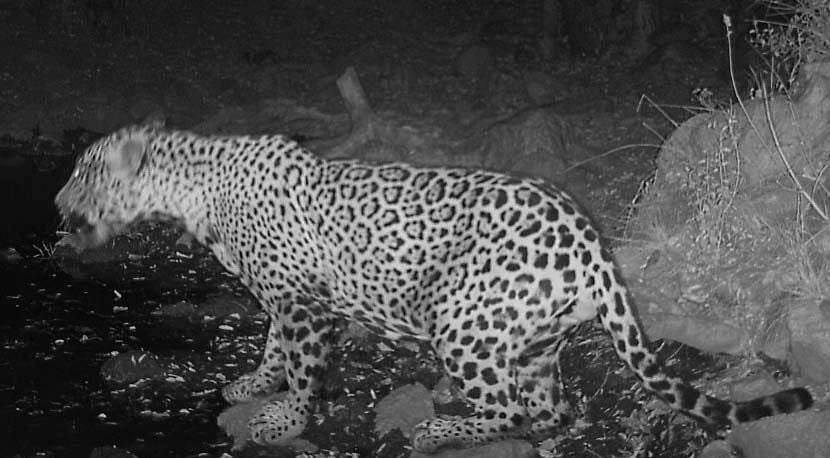

Apparently, Arizona’s newest jaguar isn’t camera shy.
The Tucson-based conservation group Sky Island Alliance on Tuesday released a new image of the spotted cat, this time from one of its motion-activated cameras in the Whetstone Mountains, 60 miles southeast of Tucson.
The photo was captured on Nov. 23, just a little under a month before the same animal wandered past a trail camera in the Huachuca Mountains, roughly 30 miles away, on Dec. 20.
That camera belonged to Vail wildlife videographer Jason Miller, who introduced the new jaguar to the world when he released the footage on his YouTube channel on Jan. 3.
“We’re happy to see this cat moving around and hopefully thriving,” said Louise Misztal, executive director of Sky Island Alliance. “It’s wonderful to see how much the Southern Arizona community cares about these cats. We’re glad to share this good news.”
The jaguar appears to be a young male, Misztal said, though the Arizona Game and Fish Department has not been able to determine that conclusively based on the images of the animal collected so far.
She said her organization’s wildlife camera network also picked up a jaguar in the Whetstones in May, but that picture was too blurry to positively identify the cat based on the distinctive rosette patterns on its pelt.
The two images represent the first confirmed jaguar sightings in the Whetstones since 2011, when the jaguar that came to be known as El Jefe was first spotted in Arizona.
El Jefe famously spent the next several years in the Santa Rita Mountains, just south of Tucson, before disappearing in 2015 and reappearing on trail camera footage from central Sonora, Mexico, in 2021.
Misztal said it took until now to release this new image because of the time involved in recovering and sifting through all the images the group collects in the field. She said Sky Island Alliance operates more than 70 trail cameras along the corridor linking the Whetstones and the Huachucas as part of its advocacy work on behalf of some 55 isolated mountain ranges across Southern Arizona, New Mexico and Sonora.
These recent jaguar sightings demonstrate the need to protect not just the so-called sky islands themselves but the “connective tissue” between them on both sides of the border, she said.
“We know the western flank of the Huachuca Mountains and the San Rafael Valley provide one of the last open corridors for the northernmost population of jaguars to move between habitat in the U.S. and Mexico,” Misztal said. “To recover these cats in the U.S., it’s vital that we protect this pathway.”
The jaguar in the photo unveiled on Tuesday is the eighth individual to be identified in the U.S. Southwest since 1996.
There could be even more footage of this newest cat still out there, waiting to be released.
A remote camera or cameras operated by U.S. Customs and Border Protection captured images of a jaguar at least twice last spring in the Huachuca Mountains southwest of Sierra Vista, but those images were too blurry to identify the cat.
Last month, Aletris Neils from the Tucson-based nonprofit group Conservation CATalyst said the jaguar that Jason Miller recorded in the Huachucas had also been caught multiple times on other people’s cameras starting in March of last year.
It’s unclear if she was referring to Sky Island Alliance’s photos. Neils could not be reached for comment.
Misztal said her group has shared its jaguar photos with its conservation partners in Mexico to see if the same cat has been recorded there before, but no matches have been found yet.
As luck would have it, the footage recorded by Miller and the images captured by Sky Island Alliance both show the jaguar from the same angle.
“We’re hoping someone gets (a picture of) the other side,” Misztal said. “It helps to have both sides.”
Vail videographer Jason Miller captured this clip in the Huachuca Mountains in late 2023. The same jaguar was caught on camera again in Arizona in June and July.

