

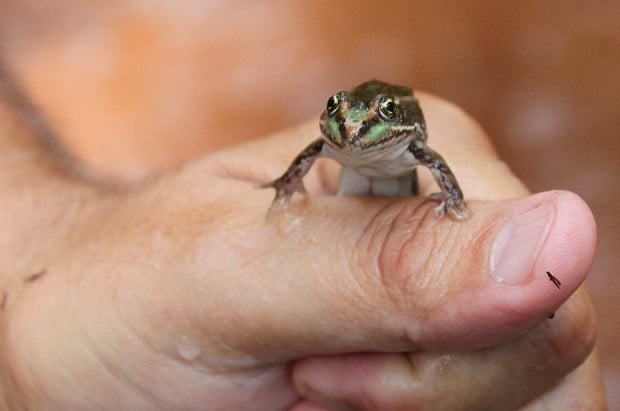

Native frogs will be reintroduced into Southern Arizona ponds on federal lands.
Abandoned mines will be filled in or gated to keep people from falling into them.
A new federal fire ecologist will bring better science to help manage landscapes in Saguaro National Park and other national parks in Arizona to prevent wildfires from wreaking ecological harm.
And native seeds will be gathered from the land and stored to be used to rehabilitate burned areas after a fire.
These projects, slated for Saguaro National Park and other Arizona-based national parks and monuments, will be financed this year and in the future through a new infusion of $10.3 million in federal cash, the Interior Department announced Wednesday in Tucson.
The announcement by Assistant Interior Secretary Shannon Estenoz came at a news conference amid the rolling, saguaro-dotted hillsides of Saguaro National Park’s east unit.
“The impacts of the climate crisis could not be more evident here and across the state,” Estenoz said. “We have harsher heat waves, more intensive wildfire seasons and drought conditions. Investing in our landscapes and expanding nature-based solutions are critical to maintaining land for future generations.
“Nature is our best ally for fighting against climate change. Now, we have new, transformational resources for locally led, partnership-driven projects,” Estenoz said.

Saguaro National Park East
This is the third year of federal outlays for such ecological restoration projects. They’re funded by the Bipartisan Infrastructure Act enacted in 2021. So far, more than $15.7 million has been spent or obligated to be spent through fiscal year 2023-24 by Interior in Arizona for these programs, she said.
Exactly how much will be spent on projects affecting Saguaro Park and other national parks and monuments in Arizona couldn’t be determined Wednesday. That’s in part because many specific programs will split fixed dollar amounts among several parks, including some in New Mexico and other states besides Arizona.
But one effort of particular significance, park service officials said, will funnel money into a program that is trying to eradicate invasive, non-native bullfrogs from various water bodies and to reintroduce native, imperiled frogs and snakes into Saguaro Park and other parks and monuments.
Bullfrogs can wreak havoc on native frog populations either by spreading a fungal disease or by direct predation, said Andy Hubbard, program manager of the park service’s Sonoran Desert Network. It’s one of 32 such Park Service wildlife monitoring programs nationwide.
After extensive bullfrog eradication programs have been carried out at parks and monuments across the Southwest, only two of nine such park units — Tuzigoot National Monument in central Arizona and Gila Cliff Dwellings National Monument in southwest New Mexico — are still considered to have heavy bullfrog infestations, the park service says. Saguaro National Park and Montezuma Castle National Monument in central Arizona’s Verde River Valley have small bullfrog infestations.
“They are not currently there. (But) there are still bullfrogs in the watershed. We want to develop early detection and rapid response protocols,” to keep them from reinfesting these parks and monuments, Hubbard said.
In Saguaro Park and elsewhere in the region, park service officials hope to start reintroduction efforts as soon as this fall to bring back Chiricahua leopard frogs and Northern Mexican and narrow-headed garter snakes, all protected by the U.S. government as threatened species, he said.
The park service has received about $842,000 for this work for fiscal years 2022-23 and 2023-24 and expects to get another $154,000 for fiscal year 2024-25, Hubbard said. Most of that money has been turned over to conservation groups, universities and the U.S. Geological Survey, who are already working on these problems, he said.
Also due for reintroduction is the lowland leopard frog, a species that’s not listed but is known to be declining.
It has disappeared from Saguaro Park where it used to occur, except for a federal research center at the end of East Broadway, Hubbard said. Also planned for reintroduction is the Arizona toad, which could be federally protected in the future, along with the Mexican spadefoot and Woodhouse’s toads.
“We know we commonly had these species in the past. We are optimistic that we will be able to reintroduce sustainable populations in these sites,” Hubbard said.
The fire ecologist will arrive in this region within the next month, park service officials said. The ecologist will serve a total of eight national parks and monuments, including Saguaro Park and all in Southeast Arizona except for Organ Pipe National Monument.
“We are really thankful for the opportunity to get that position. It helps with science-based, risk-informed decision making on how we manage these landscapes,” said John Thornburg, a federal interagency fire management officer for the park service and the U.S. Forest Service in Tucson.
“The fire ecologist is really the bridge to science,” Thornburg said. “We want to make sure in our decision making on how we manage fires, including prescribed burning and managing wildfire, that we are using the best available science.”
The abandoned mine mitigation program will involve putting gates on top of abandoned mines and filling in vertical mine shafts with waste rock, said Beth Hudick, Saguaro Park’s interpretation, education and outreach manager. The program is being financed in many parks and monuments, with Saguaro Park specifically planned to receive $181,000 for the program.
Saguaro Park will also benefit from a $994,000 program, spread over three states, to collect and store native seeds for future rehabilitation efforts following wildfires, Hudick said.
“It can enhance the resiliency of vegetation communities that are vulnerable to wildfires,” she said.
Emerging science helps researchers find rare aquatic species and what threatens them

