




Both visitor centers at Saguaro National Park will be closed on Mondays “until further notice,” as the impacts ripple out from the Trump administration’s sweeping cuts to the federal workforce.
The 92,000-acre park bracketing Tucson announced the closures in a social media post on Thursday but provided no additional details.
A park spokeswoman directed media inquiries to the park service’s Intermountain regional office and its national Office of Communications, neither of which immediately responded to questions about staff cuts and closures.

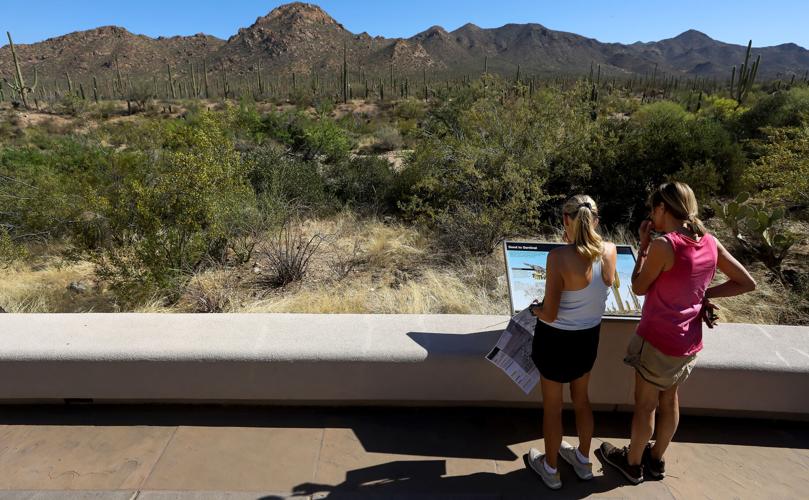
Visitors read an information board at the Red Hills Visitor Center at Saguaro National Park West. The park has announced it will close its visitor centers on Mondays amid federal budget cuts.
Park advocates said the reduction in visitor center hours at Saguaro is almost certainly the result of the administration’s staff cuts, and more disruptions are sure to follow at park sites nationwide.
“What we can say for sure is that more than a thousand national park staff have been arbitrarily fired since Friday (Feb. 14). We do not have any reason to believe that this is the last of the cuts, either,” said Kyle Groetzinger, associate director of communications for the National Parks Conservation Association, an independent, nonpartisan group that supports the park system.
The organization could not pinpoint how many federal workers have been fired at Saguaro or the 20 other park service sites in Arizona, but Groetzinger said most if not all of those fired so far nationwide have been probationary staff members who were working toward permanent jobs with the park service, either as recent hires or after transferring from other government jobs or agencies.
According to the NPCA, some of those employees were notified in a letter that said they were being dismissed because of poor performance, despite receiving glowing performance reviews in the recent past.
“These letters are not coming from their direct supervisors. They’re coming from higher up,” through a process directed by the federal Office of Personnel Management, said Sanober Mirza, Arizona program manager for NPCA.
Mirza said the cuts at Arizona parks have come in almost every department, including maintenance, resource management, education and fee collection. One of Arizona’s parks lost a bilingual staff member, an especially important skill to have in this part of the country, Mirza said. “There’s no rhyme or reason to it. It’s really hurting our park staffs and our communities.”
Saguaro operates the Rincon Mountain Visitor Center on the east side of the park and the Red Hills Visitor Center on the west side. The decision to close those facilities on Mondays comes just before the start of the park’s busiest month and in the midst of a surge in visitation over the past five years.
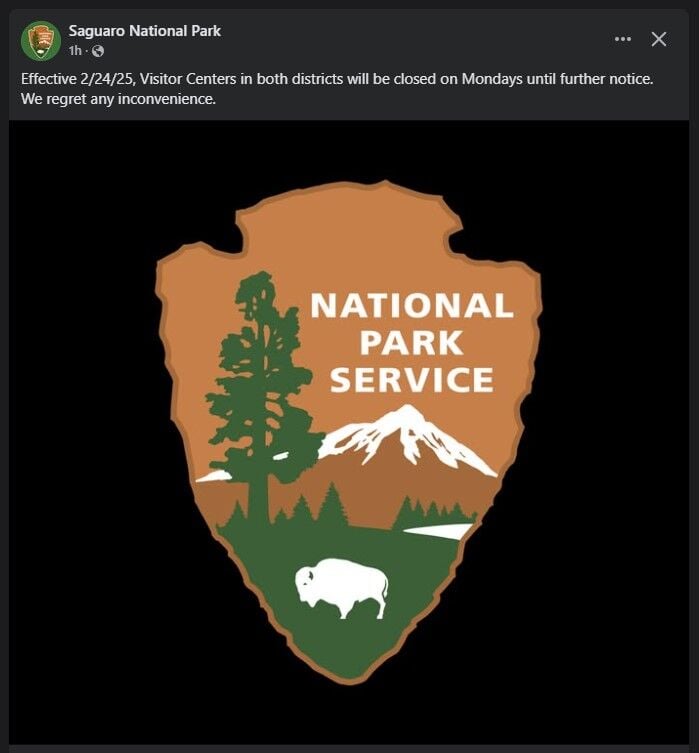
Saguaro National Park announced in a Facebook post on Feb. 20 that its visitor centers will be closed on Mondays “until further notice.”
Preliminary totals for 2024 show just over 946,000 recreational visits to the park, with more than 155,000 of them coming in March.
In 2023, Saguaro topped 1 million recreational visits for the third time since 2019 and just the third time ever. The seven busiest years in the park’s 92-year history have all come since 2017.
The same trend has been playing out at other parks nationwide, leading to congested roads and parking lots, long lines at fee stations and, at a few sites, the implementation of reservation systems just for park entry.
“We haven’t had sufficient staff for a while, and this makes it even more difficult for our parks,” Mirza said. “I think we can expect more of what Saguaro just did across Arizona park units.”
A visitor center isn’t just a place to buy a park pass or pick up souvenirs, either. It’s where tourists often get up-to-date information about road conditions, emergency closures and weather warnings, which can be crucial in Arizona, especially during the summer, Mirza said.
And the impacts could be even more severe at smaller park service sites, where losing even a single employee would significantly reduce the size of the overall workforce.
On Wednesday, the Las Vegas Review-Journal newspaper reported that Great Basin National Park lost about 20% of its total staff when five probationary workers were fired, forcing the park on the Nevada-Utah border to stop taking tour reservations for Lehman Caves, its most popular attraction.
Aside from the obvious human toll and the potential risk to the nation’s most treasured places, there is also a strong economic argument to be made against taking a chainsaw to the park service, Mirza said.

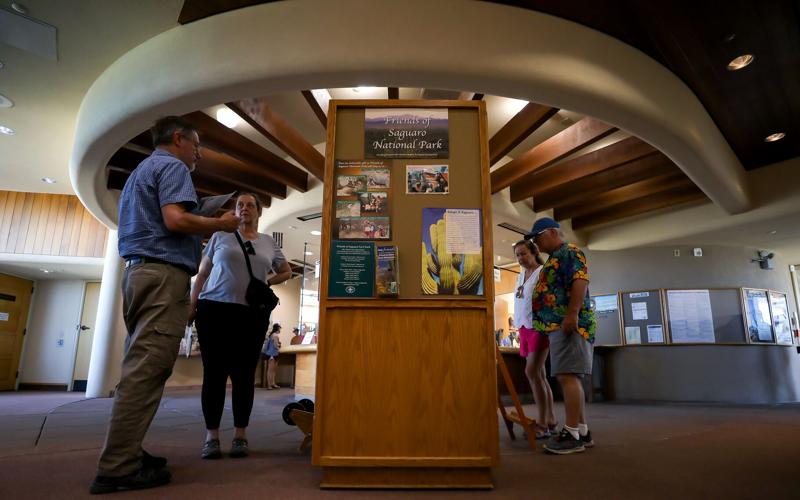
Visitors read information posted on a bulletin board inside the Red Hills Visitor Center at Saguaro National Park West in 2022.
According to the NPCA, the park service makes up less than one-fifteenth of 1% of the federal budget but delivers a $15 boost to the nation’s economy for every dollar invested. In 2023 alone, national parks supported 415,000 jobs in local communities and contributed $55.6 billion to the national economy.
The park service’s own data for that year shows that 325.5 million visitors spent $26.4 billion in communities near national parks.
In Arizona, Mirza said, that economic boost to gateway communities was about $1.2 billion, including $74.5 million in local spending from visitors to Saguaro National Park.
Ultimately, Mirza and Groetzinger expect these cuts to prove wildly unpopular in the court of public opinion. Poll after poll have shown national parks to be a very popular and unifying idea among Americans across the political spectrum, and that seems especially true in Arizona.
“Our license plates say ‘The Grand Canyon State’ on them,” Mirza said. “These are Arizona’s parks. These parks are part of the state’s identity.”

