


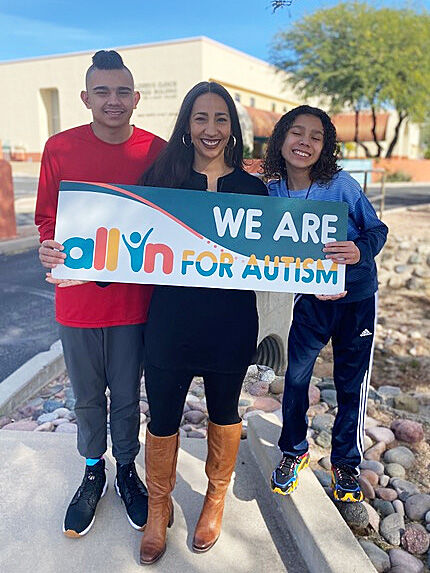
It’s a local fundraiser and celebration of more than 75 million people globally who have autism spectrum disorder: The All In for Autism Drive-In Movie benefit will honor World Autism Acceptance Day at 6 p.m. on Saturday, April 2, at Cactus Carpool Cinema, 6201 S. Wilmot Road.
“We want to flood the city with great stories of autism and everything that is happening in our community to support children and adults with autism and their families,” said Brie Seward, executive director of the Autism Society of Southern Arizona. “We want to have conversations and spread awareness and understanding about autism so that people feel less alone and feel like they are being heard. Hopefully this will create change in the areas where we still need to break through and we can have a more inclusive society.”
Inclusion is increasingly important: In March 2020, the prevalence of autism was estimated at one in 44 births nationwide and one in 40 in Arizona by the Centers for Disease Control and Prevention. The developmental disorders are 3.4 times more likely to be identified in boys than girls, and the Arizona Developmental Disabilities Surveillance Program identified the disorders in 2.5% of 8-year-old children in one Arizona area. Arizona is one of 11 sites nationwide on the Autism and Developmental Disabilities Monitoring Network.
“The new statistics show that the service needs of individuals with autism should increase. This will guide future research and inform policies related to health care and education for autistic individuals,” Seward said. “These numbers also show that there will be students with autism in every classroom, at every team sport and in social settings. Autism is prevalent in our community, and it is vital to understand how autism affects those we interact with and how we can better support them.”
The Autism Society of Southern Arizona has facilitated that support since 2014. Throughout the COVID-19 pandemic, it has offered virtual programming including classes, support groups, workshops and other activities. The nonprofit also provides Parent Trainings, adult social clubs, teen meet-ups, Parent Peer Support Groups and social skills classes.
Additional programming includes Autism Friendly Communities, which provides training to law enforcement, businesses, schools and other organizations on how to better support autistic individuals.
Gathering in-person for the All In for Autism event is another important outreach, according to Seward.
“We wanted to bring the key pieces that everyone loves back with this fundraiser: We wanted a community presence and a manageable, intimate affair where people feel connected. We think this will bring a lot of joy and touch a lot of people,” said Seward.
Volunteer Ashley Brock agrees that the fundraiser is an excellent opportunity for the entire community.
“I think this is an opportunity to raise awareness and educate the general population about our neuro-diverse kiddos. It also gives these families a time to celebrate their kiddos’ differences and feel a sense of community within their uniquely atypical children,” said Brock, M. Ed., a board-certified behavior analyst and licensed behavior analyst for Hopebridge Autism Therapy Centers.
Brock is excited to help counter the isolation that many families felt even before the pandemic.
“The isolation is often both emotional and physical, and we can offer a sense of belonging that is very healing,” she said.
The event also offers an Autism Resource Guide comprised of provider contacts with resource information about education, respite care, health care, therapies, sports and recreation, and much more.
These resources are key because they can help with diagnosis and interventions.
“The earlier the intervention, the greater the growth; parents are often amazed at the growth that happens quickly with interventions. It is so important for people to be aware of what is out there and explore different opportunities for interventions and therapies,” said Brock.
She emphasized that many children who have been diagnosed with autism spectrum disorder are extremely intelligent and may create “beautiful houses or worlds of their own” hallmarked by repetitive actions or behaviors. Making “windows” in the “houses” with Applied Behavior Analysis therapies can facilitate behavior reduction and skill acquisition with communication goals, social goals and adaptive living goals.
“Applied Behavior Analysis allows them to build skills and social interactions and to communicate with others. They don’t have to move out of their ‘houses’: We help them to build on to those houses, to include more people inside and to ensure more exposure and enrichment. It will lead to great outcomes as they grow and mature,” Brock said.

