


About one-third of the $800 million projected to come from Tucson’s Prop. 414 would go toward boosting staffing across city departments, with the majority earmarked for police and fire.
The measure going to Tucson voters in March, dubbed “Safe & Vibrant City,” would add a half-cent to the city’s sales tax over the next 10 years, according to the city. The current sales tax rate in the city is 8.7%.
The proposition is split into five categories, but the second-largest slice of the pie — “Enhanced Emergency Response” — would get about 23% of the total funding. Most of that would be dedicated to first-responder staffing, marking the first time the city has asked voters to approve using a sales tax to hire workers, the city has said.
Clayton Black, president of the Tucson Fire Fighters Association and a 20-year department veteran, says there is a need to address staffing in the department as well as for police.
“We’ve upped our call load by 60% in the last 15 years and we’re down at least 5-7% in our responding personnel already ... Our people cannot continue on this pace,” Black said.

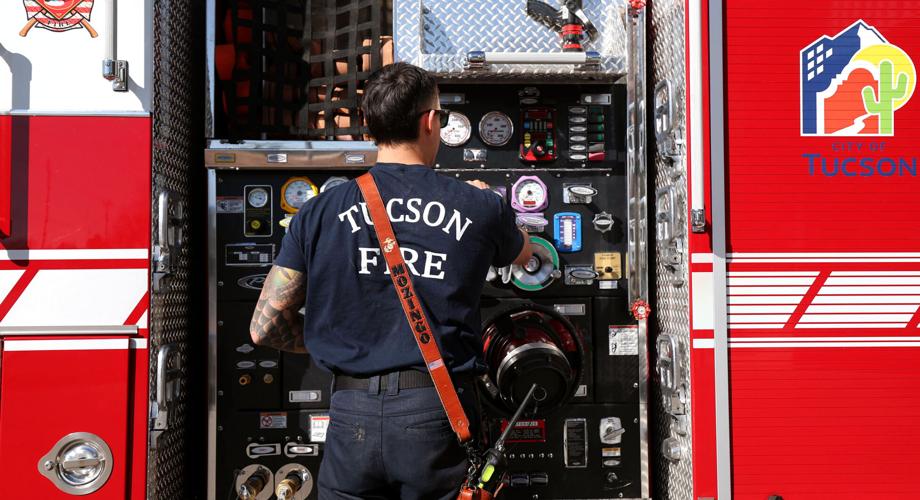
Randy Mozingo, a firefighter at Tucson Fire Station No. 5 cleans a department vehicle during a recent shift. Tucson voters will decide in March whether to approve Proposition 414. The ballot measure would raise about $800 million by adding a half-cent to the city’s sales tax over the next 10 years, with a good portion earmarked for hiring more firefighters and police officers.
“We’re burning our guys out, we’re running way too many calls,” he said. “We’re hovering around a nine-minute response time, where it’s supposed to be five minutes. So, it’s a danger to the public at the level that we’re at now.”
Statistically speaking, if a truck runs at least 3,000 calls per year, it’s in “crisis mode,” Black said. Fourteen suppression trucks and 11 medic trucks, “almost 70%” of the department’s fleet, hit that mark last year, he said.
The department says it currently has 645 “authorized commissioned personnel” and no vacant positions. However, the number should be about 740 to 750 firefighters for a city the size of Tucson. Prop. 414 says it would boost TFD staffing to 712.
Darrell Hussman, president of the Tucson Police Officers Association and a 12-year veteran, shared similar concerns about current staffing levels.
“We’re severely understaffed, we’re at a critical level right now ... over 200 officers or commanders or people in our department can retire right now,” Hussman said. “You’re talking a massive amount of officers could leave today, and the city would be crippled. And that’s why this tax is so important.”
The police department currently employs 768 sworn police officers, with an additional 51 staffers who are currently in field training or in the academy. There are also 24 vacant officer positions.
Additionally, the department employs 147 community service officers, who generally handle matters in which a police officer is not needed. There are also 17 non-commissioned criminal investigators — along with 15 vacancies — who work alongside detectives
Black and Hussman both pointed to the department’s struggle with adequate pay for staff. Although Prop. 414 does not allocate money for pay raises, the boost in staffing would make the department more effective and help raise morale, both said.
“Why would somebody come here, when you could start at Oro Valley for $5 dollar an hour more, starting pay?” Black said. “With it, it’s still going to be tough, but we’d start moving in a forward motion ... it (would) give our guys a little hope, a little more ‘hey, just hang on a little bit longer, relief’s coming.’”
“Without it (passing), I think it’s going to be detrimental to our department,” Black said. “We’ve been stretched so thin, for so long, that this right now is either a huge win for us — that we know relief is coming — or it’s going to really demoralize our department.”
“Without this thing passing, I’m concerned for the future of the police department, and I’m concerned for the community, because we desperately need public safety to be out there. It’s what the community members deserve,” Hussman said Wednesday. We’re at a critical impasse.”
Of the $18 million each year the proposition would generate in the “Enhanced Emergency Response” category, all but $370,000 would be used to increase staffing across city departments.

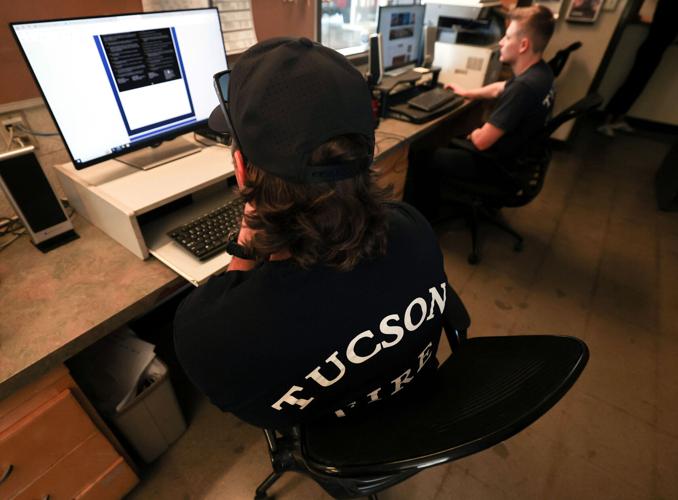
Capt. Casey Johnson, left, works on a computer next to co-worker Austin Anspach at Tucson fire Station 5, 2835 E. Grant Road.
Tucson Fire would spend about $7 million a year on 67 more workers. TPD would use about $8 million for 40 police officers and 40 community service positions, though the staffing numbers could vary.
About $1.5 million per year would go toward hiring 10 more 911 and 311 operators apiece. Also, the police department’s Community Safety Awareness and Response Center (CSARC) unit, which as previously reported is able to tap into any officer’s body-worn camera, view nearly 1,000 cameras placed across the city and send up a drone to a crime scene — would add 10 “specially trained staff” at a cost of $1.37 million annually.
There’s plenty of opposition to using sales tax money for hiring as well as some of the items being funded.
Josh Jacobsen, one of the steering leaders of the Tucson Crime Free Coalition, acknowledges the irony of the group’s opposition to Prop. 414, given that it advocates for “adequate staffing and resources for law enforcement.” The opposition is unrelated to the need for more officers, he said.
“We completely recognize that, and that’s why we say we don’t have a problem with a lot of these expenditures . . . (but) the Mayor and Council have underfunded public safety for so long, now they’re having to make a decision on the budget, and we think that they need to deliver on core responsibilities before they come back and ask citizens for a higher tax rate,” Jacobsen said. “There’s better ways to go about doing this ... This allows for additional staffing for police officers. Well, that’s fantastic, but we can’t even fill the positions that we have now.”
For the grassroots No Prop. 414 Tucson coalition, investments in this category for TFD along with more 311 and 911 operators are “likely necessary,” said April Putney, the coalition’s representative. But she questioned spending more on high-tech police surveillance and said she worried it could be abused and that it could potentially replace more traditional policing.
“Well, historically speaking, surveillance has been used by federal agencies like the CIA and FBI against activists and organizers fighting for civil rights... And so, in this era where we’re worried about what’s going on in terms of the current Trump administration,” Putney said, sharing a 2002 ACLU report saying video surveillance has not been effective. “Our rights to free speech may be put in jeopardy by increased surveillance, (by) other agencies that might come into play here in Tucson, specifically (the Department of Homeland Security) and Border Patrol, who are involved in carrying out the mass deportation threats.

