

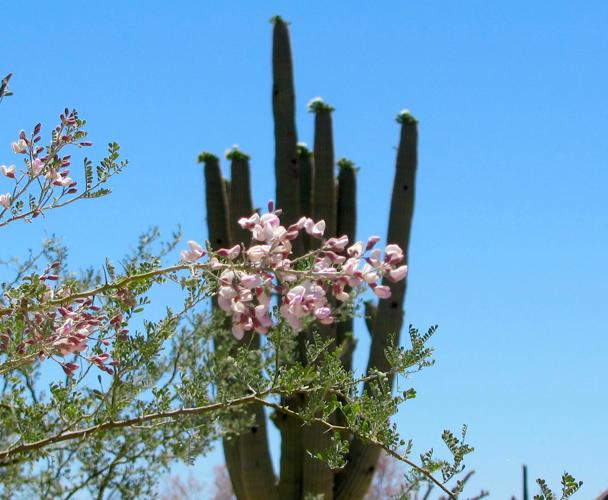
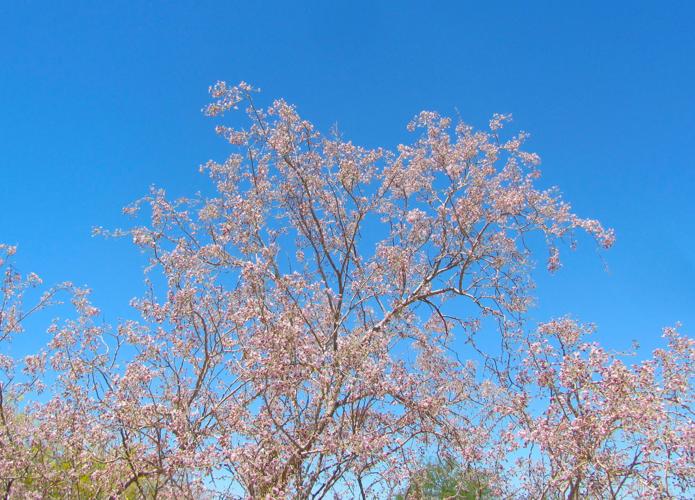
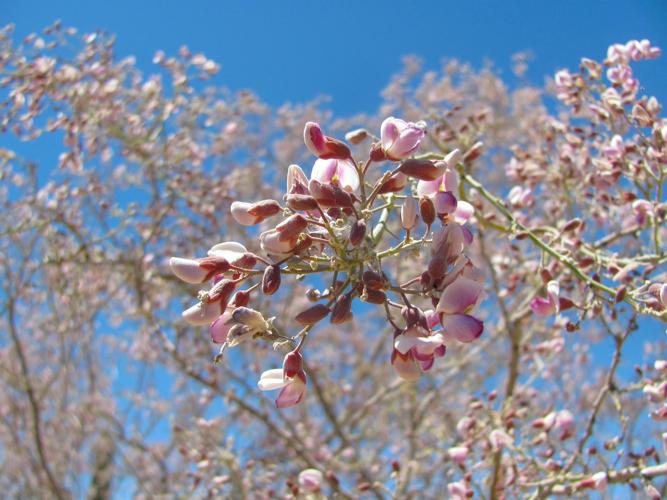
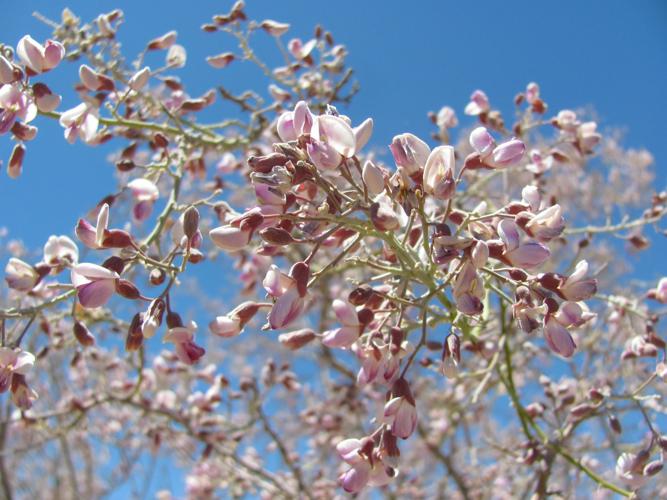

Ironwood trees: Call them senior citizens of the desert.
Mature ironwoods around Tucson make the oldest saguaros look like mere youngsters by comparison.
“Estimates show some (ironwood) trees to be 800 years old, and it is likely that they live even longer,” says the “Desert Ironwood Primer,” a publication by the Arizona-Sonora Desert Museum in collaboration with the U.S. Department of the Interior and Pima County.
Many of the venerable ironwoods, which are blooming this month around the Tucson area, outlive saguaros that can reach “only” 150 to 200 years of age. They also outlast Douglas fir trees that can live more than 500 years in the Catalina Mountains north of Tucson.
Creosote bushes are sometimes considered the oldest desert plants, but they are clones stemming from a single root system with each stem enduring for perhaps 100 to 150 years.
SECRET TO LONG LIFE
The secret to ironwood longevity? “Drought tolerance,” said John Wiens, nursery horticulturist at the Desert Museum west of Tucson.
“They have a remarkable ability to withstand drought,” Wiens said. “First, by losing leaves and twigs during light droughts. Second, by selectively losing complete branches during prolonged drought, while maintaining health in the others. And lastly, during the most severe droughts, they have the ability to ‘die-back’ completely to the soil level, and re-sprout from a healthy base when conditions improve.
“We’ve seen trees with signs of complete trunk die-back that has occurred several times.”
WHERE they GROW
“The range of the desert ironwood goes from around Lake Havasu, Arizona, at the north, south to near the Sonora-Sinaloa border and around La Paz in Baja California Sur, Mexico, as well as southeastern California,” Wiens said.
The Desert Ironwood Primer notes that the range of the ironwood, a hardy legume tree, “closely matches the boundaries of the Sonoran Desert, the only place in the world where it occurs.”
A USEFUL TREE
Ironwood trees serve as “nurse plants” for saguaros and other cacti — providing safe sites for seed dispersal and protection of seedlings from extreme cold.
“The relationship between succulent cacti and ironwoods is especially well documented,” according to the Ironwood Primer. “Studies show that without the protective cover of desert legumes, the distributional ranges of saguaro, organ pipe and senita cactus would retreat many miles to more southern, frost-free areas. On freezing nights, the canopies of ironwood … make the critical difference for vulnerable seedlings.”
The trees have been used as a food source as their seeds are edible raw or toasted, Wiens said. He added that parts of trees have been used in medicines, household tools and ceremonies.
The dense, hard wood also serves as material for a wide variety of wood carvings.
“The most well-known contemporary cultural use of ironwood is by the Seri and Mexican carvers of coastal Sonora,” says the Ironwood Primer. “The Seri began to carve elegant, abstract renderings of native animals in the 1960s.” Such carvings grace many homes in the Tucson area.
BLOOM VARIES
Ironwoods bloom profusely in the spring, with their blossoms lending a purple hue to the landscape.
But the period of blooming varies from year to year.
“We take phenological data on plants in the vicinity of the Desert Museum,” Wiens said. “Here, the average for full bloom in desert ironwoods is from around May 7 through the end of May. However, in 1986 and 1989 we had blooms beginning the third week in April. In 1982, it peaked in June. Last year, it began the last week in April and was finished by the third week in May.
“It is amazing how variable it is. Some years, like 1987 and 2011, due to drought or deep freezes, we have not had a bloom out here,” Wiens said.
SEE IRONWOODS
Ironwoods are found in many areas around Tucson, including parts of the Tucson Mountains and the grounds of the Desert Museum at 2021 N. Kinney Road.
Many of the trees also grow at Ironwood Forest National Monument northwest of Tucson.

