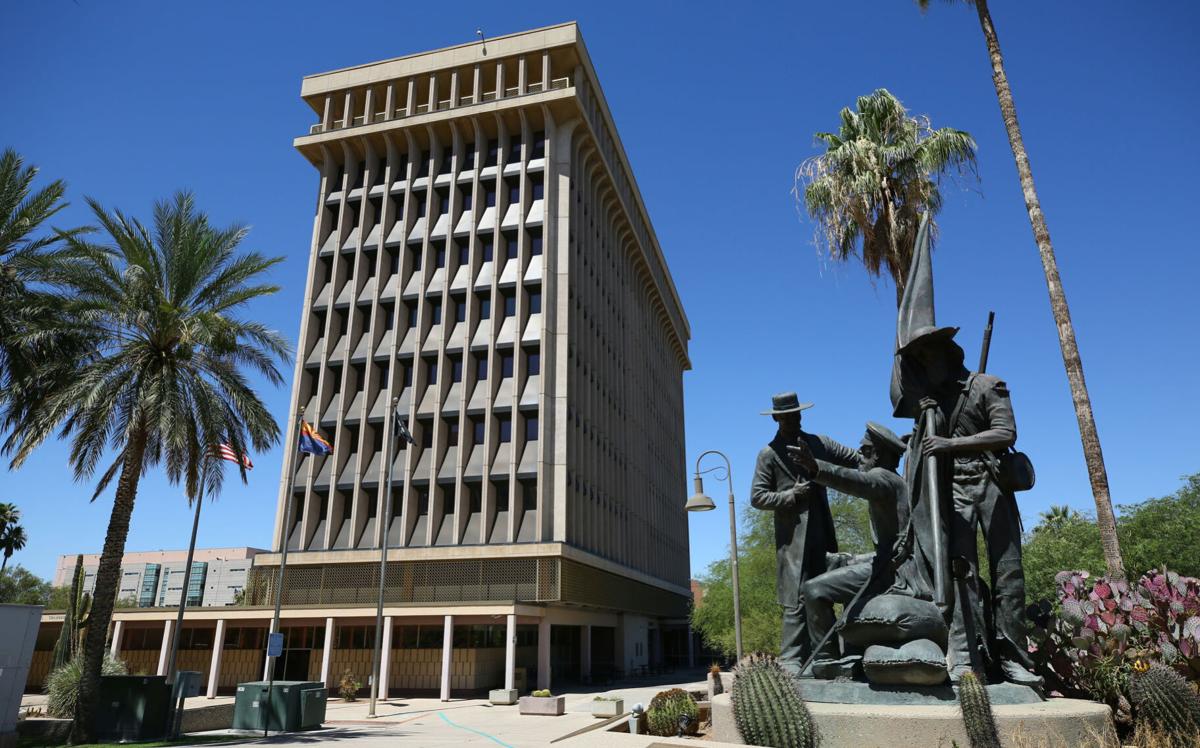
The city of Tucson has officially approved a pay raise for its lowest-paid city workers, taking the last step Tuesday to increase its minimum wage to $15 an hour.
The new minimum wage affects more than 2,000 city employees, over half of its workforce, and will go into effect immediately.
Democrats Introduce Bill to Raise Minimum Wage to $15 by 2025. The Raise the Wage Act of 2021 was introduced on Tuesday. If passed, it would gradually increase the federal minimum wage over five years to reach $15. The Raise the Wage Act is a critical step toward lifting hardworking people out of poverty, .., House Labor Chair Robert Scott, via statement. ... addressing income inequality, and building back a better economy where everyone can succeed, House Labor Chair Robert Scott, via statement. The bill also proposes "phasing out subminimum wages for tipped workers, youth workers and workers with disabilities ...". ... and making sure the value of minimum wage doesn't decrease over time by tying it to inflation. According to the Economic Policy Institute, 32 million Americans would see their wages increased by the Act. In the richest country in the history of the world, if you work 40 hours a week, you should not be living in poverty. , Incoming Senate Budget Chair Bernie Sanders, via statement. Minimum wage must be a living wage, enabling people to live with dignity, Incoming Senate Budget Chair Bernie Sanders, via statement. The federal minimum wage has not been increased in over 10 years
This includes approximately 170 city workers who currently make less than $15 an hour, as well as compression adjustments for many workers making over that amount.
“It’s not only the right thing to do, but it’s the smart thing to do from a managerial perspective as we address ongoing retention concerns throughout the organization,” said Tucson Mayor Regina Romero. “It’s the right thing to do for our workers and their families to make sure that they have living wages, and it is the right thing to do for our city and economy.”
Proposition 206, a statewide ballot measure passed by voters in 2016, boosted Arizona’s minimum wage from $8.05 an hour to $10 in 2017, followed by increases to $10.50 in 2018, $11 in 2019 and $12 in 2020.
The city’s decision to increase pay for its workers comes as Congress continues to debate a federal $15 minimum wage by 2025.
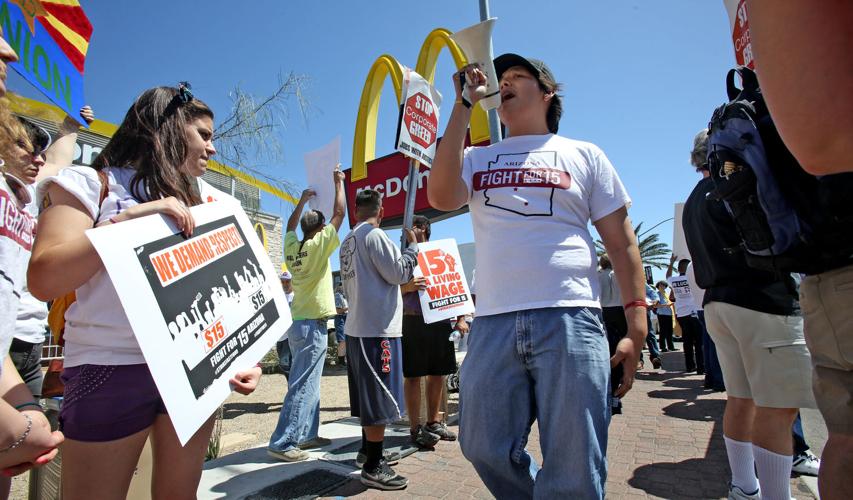
McDonald's employee Luis Frias, 22, uses a bullhorn while chanting in front of the fast-food restaurant on 1711 E Speedway during a protest involving the fast food industry and other businesses that offer low wages. The protest was part of a nationwide push for higher wages. Proclaiming social injustice, protesters wanted an increase in the minimum wage asking for $15 an hour and criticizing such businesses as McDonald's, Wendy's, Burger King and other low wage industries.
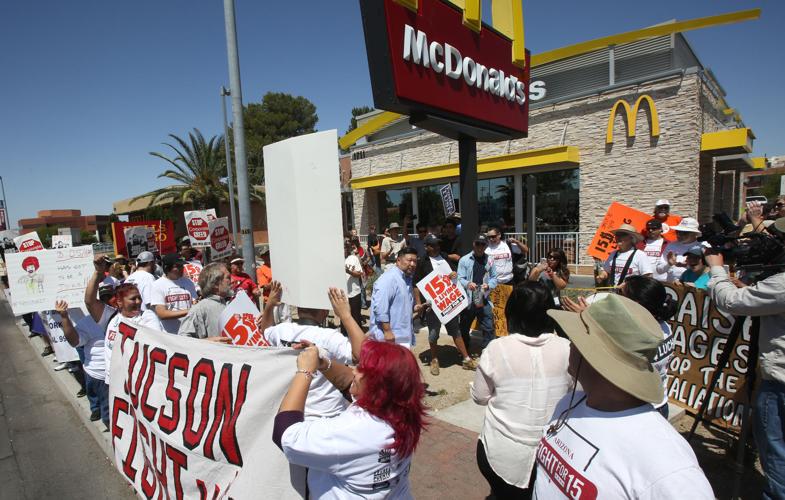
Nearly a hundred protesters stand in front of the McDonald's restaurant on 1711 E Speedway which was part of a nationwide protest involving the fast food industry and other businesses that offer low wages. The group marched from the McDonald's to Old Main at the University of Arizona where a rally was held featuring adjunct faculty and teaching students.
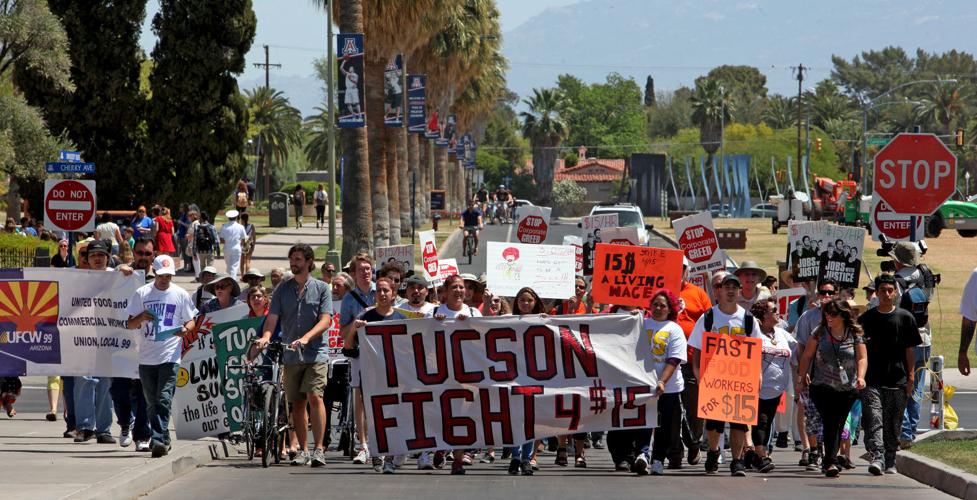
Marchers walk along the University of Arizona Mall during a nationwide protest involving the fast food industry and other businesses that offer low wages. The group marched from the McDonald's at Speedway and Campbell to Old Main at the University of Arizona where a rally was held featuring adjunct faculty and teaching students. Tenured and non-tenured graduate students workers, community members and others demand that schools put more money towards instructors and students.
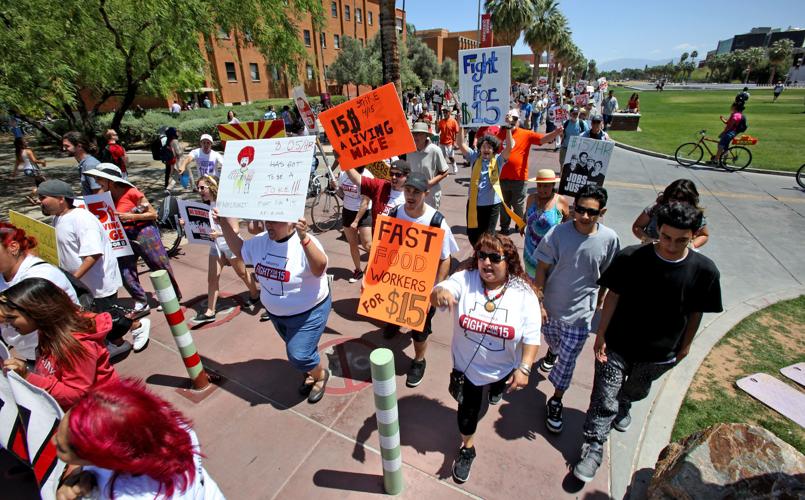
Marchers walk along the University of Arizona Mall during a nationwide protest to a rally that was held featuring adjunct faculty and teaching students. Proclaiming social injustice, protesters wanted an increase in the minimum wage asking for $15. The purpose for the protest on Tax Day was to focus attention on the strain low wages place on public budgets and taxpayers.
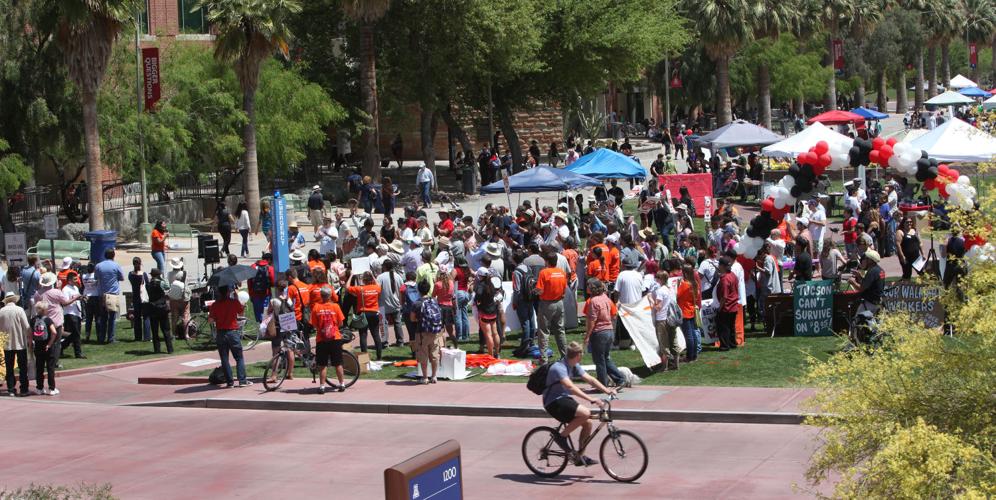
Protesters gather on the University of Arizona mall as they listen to speeches and cries for a higher minimum wage. Proclaiming social injustice, protesters wanted an increase in the minimum wage asking for $15 an hour and criticizing such businesses as McDonald's, Wendy's, Burger King and other low wage industries.
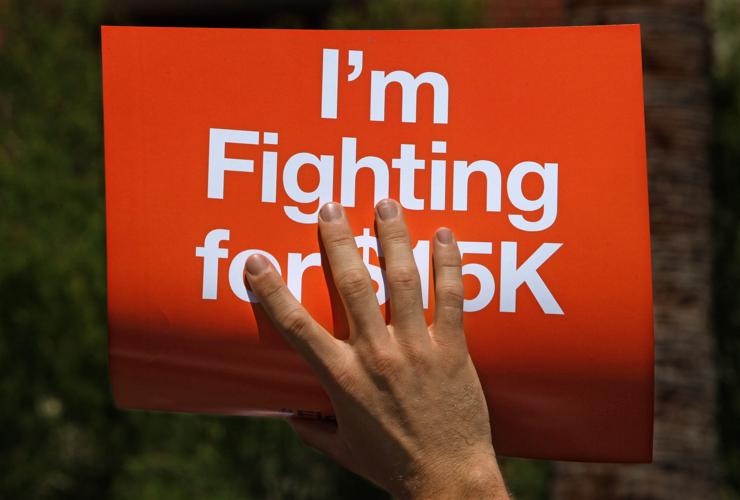
University of Arizona writing program lecturer Sean Rys holds a sign "I'm Fighting for $15 K" during a nationwide protest on the mall involving the fast food industry and other low wage earners. Proclaiming social injustice, protesters wanted an increase in the minimum wage asking for $15 an hour.
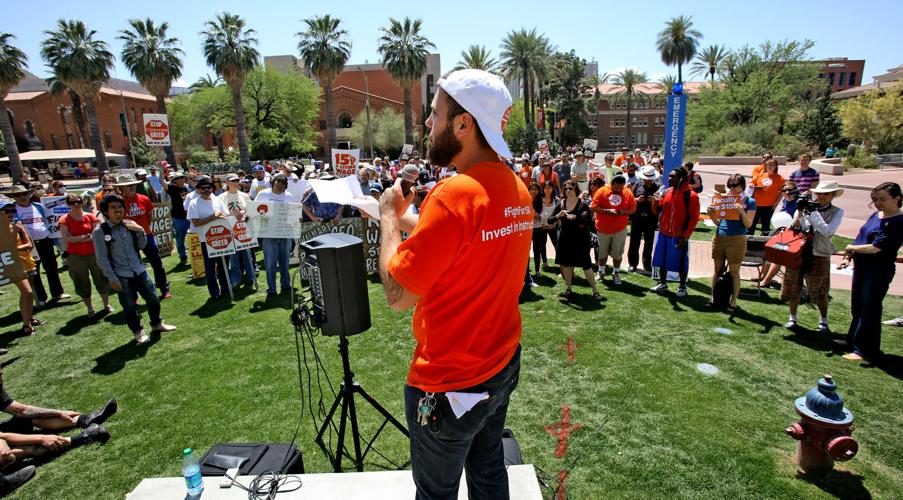
University of Arizona graduate student, Alex Karaman who also teaches Gender and Women Studies, talks to fellow protesters on the UA Mall. They were gathered there during a nationwide protest involving the fast food industry and other establishments that offer low wages to their workers. Protesters proclaimed the need for social justice and indicated a need for an increase in the minimum wage to $15 an hour.
McDonald's employee Luis Frias, 22, uses a bullhorn while chanting in front of the fast-food restaurant on 1711 E Speedway during a protest involving the fast food industry and other businesses that offer low wages. The protest was part of a nationwide push for higher wages. Proclaiming social injustice, protesters wanted an increase in the minimum wage asking for $15 an hour and criticizing such businesses as McDonald's, Wendy's, Burger King and other low wage industries.
A.E. Araiza / Arizona Daily Star
Nearly a hundred protesters stand in front of the McDonald's restaurant on 1711 E Speedway which was part of a nationwide protest involving the fast food industry and other businesses that offer low wages. The group marched from the McDonald's to Old Main at the University of Arizona where a rally was held featuring adjunct faculty and teaching students.
A.E. Araiza / Arizona Daily Star
Marchers walk along the University of Arizona Mall during a nationwide protest involving the fast food industry and other businesses that offer low wages. The group marched from the McDonald's at Speedway and Campbell to Old Main at the University of Arizona where a rally was held featuring adjunct faculty and teaching students. Tenured and non-tenured graduate students workers, community members and others demand that schools put more money towards instructors and students.
A.E. Araiza / Arizona Daily Star
Marchers walk along the University of Arizona Mall during a nationwide protest to a rally that was held featuring adjunct faculty and teaching students. Proclaiming social injustice, protesters wanted an increase in the minimum wage asking for $15. The purpose for the protest on Tax Day was to focus attention on the strain low wages place on public budgets and taxpayers.
A.E. Araiza / Arizona Daily Star
Protesters gather on the University of Arizona mall as they listen to speeches and cries for a higher minimum wage. Proclaiming social injustice, protesters wanted an increase in the minimum wage asking for $15 an hour and criticizing such businesses as McDonald's, Wendy's, Burger King and other low wage industries.
A.E. Araiza / Arizona Daily Star
University of Arizona writing program lecturer Sean Rys holds a sign "I'm Fighting for $15 K" during a nationwide protest on the mall involving the fast food industry and other low wage earners. Proclaiming social injustice, protesters wanted an increase in the minimum wage asking for $15 an hour.
A.E. Araiza / Arizona Daily Star
University of Arizona graduate student, Alex Karaman who also teaches Gender and Women Studies, talks to fellow protesters on the UA Mall. They were gathered there during a nationwide protest involving the fast food industry and other establishments that offer low wages to their workers. Protesters proclaimed the need for social justice and indicated a need for an increase in the minimum wage to $15 an hour.