


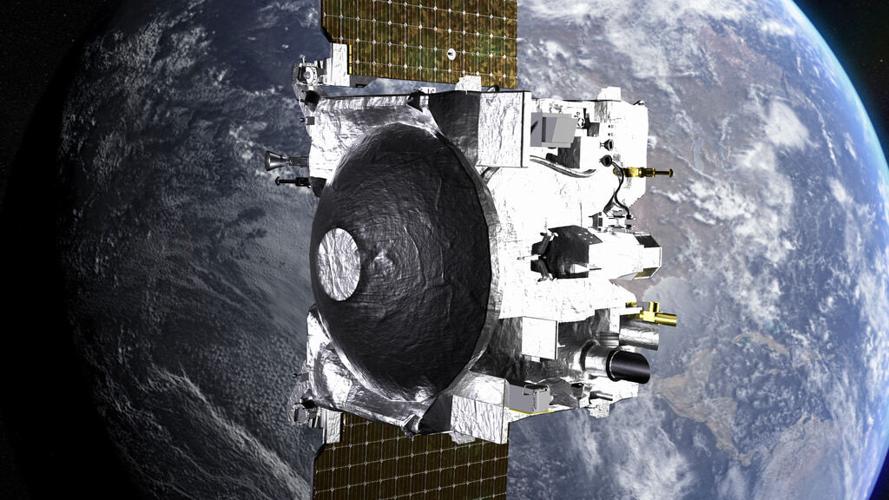


Three months after leaving Earth with its dust, the Tucson-born OSIRIS spacecraft just passed its hottest test yet.
Preliminary data indicates the robotic probe survived its closest ever approach to the sun as it maneuvers into position for its extended mission to a second asteroid.
On Jan. 2, the spacecraft formerly known as OSIRIS-REx passed within about 46.5 million miles of the sun, a distance well inside the orbit of Venus.
That’s about 25 million miles closer to the sun than the spacecraft was designed to operate during its original voyage to collect and return samples from the asteroid Bennu.
“We’ve done a lot of modeling to ensure the spacecraft will be safe, but any time you take a piece of space flight hardware beyond the design criteria you incur risk,” said University of Arizona assistant professor Dani DellaGiustina, principal investigator for the extended OSIRIS mission.
The spacecraft’s new destination is another potentially dangerous near-Earth asteroid named Apophis.
Top-down view of the trajectory of NASA’s OSIRIS-APEX spacecraft from September 2023 through December 2031. The animation begins with the robotic probe formerly known as OSIRIS-REx making its return to Earth on Sept. 24, 2023, to drop off a capsule containing samples from asteroid Bennu.
NASA approved the unscheduled detour in 2022, adding another $200 million in funding to a project that has already cost almost $1.2 billion.
As soon as the spacecraft released its return capsule of samples from Bennu during a pass by Earth on Sept. 24, the name of the probe and its mission changed to OSIRIS-APEX, short for Origins, Spectral Interpretation, Resource Identification, and Security — Apophis Explorer.
As of now, NASA said, the spacecraft is still transmitting a telemetry signal and otherwise operating normally.
Once OSIRIS-APEX is farther from the sun in March, the craft will be instructed to point its high-gain antenna toward home so mission team members can download the data they need to tell them how the increased heat and radiation impacted it as it passed roughly half the distance between Earth and the sun.
The spacecraft won’t reach Apophis until June of 2029, about two months after the potato-shaped asteroid as long as the Empire State Building narrowly misses the Earth on April 13, 2029.
Scientists say the space rock will be close enough on that date to be visible in the night sky over parts of Europe and Northern Africa.
Once OSIRIS-APEX does rendezvous with Apophis, it will enter orbit to collect detailed images, data about the asteroid’s composition and maybe some telltale signs of water.

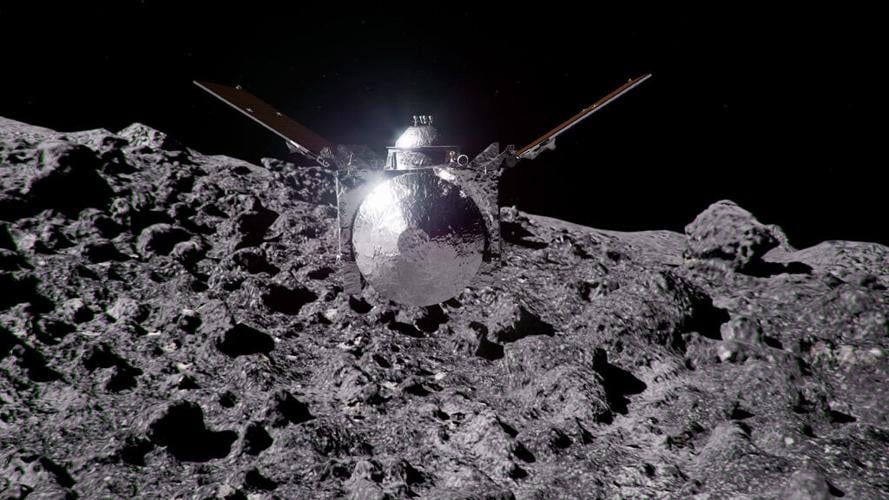
A NASA animation shows the spacecraft now known as OSIRIS-APEX as it prepares to use its thrusters to stir the surface of asteroid Apophis in a maneuver scheduled for September of 2030.
The spacecraft is not set up to collect any more samples, but in September of 2030, the team plans to steer the probe close enough to stir the surface of Apophis and expose whatever material lies beneath.
DellaGiustina has said they might even try to “poke” the asteroid with the probe’s sampling arm.

DellaGiustina
First, though, OSIRIS-APEX must survive five more close encounters with the sun and three gravity-assist slingshots around Earth in order to catch up with its new target.
To keep sensitive components safe during these passes, engineers at mission partner Lockheed Martin Space developed a creative spacecraft configuration team members call “the fig leaf.” It involves tucking one of OSIRIS-APEX’s solar arrays so that it provides shade for critical parts of the probe while the other array remains extended to generate power.
“We are most creative when the spacecraft is in flight and we’re pushing boundaries to meet mission needs,” said Sandy Freund, Lockheed Martin Space’s program manager for both OSIRIS-REx and OSIRIS-APEX.
The aerospace company in the Denver suburb of Littleton, Colorado, built the passenger-van-sized spacecraft for NASA and the U of A.
Top-down view of the trajectory of NASA’s OSIRIS-APEX spacecraft from September 2023 through December 2031. The animation begins with the robotic probe formerly known as OSIRIS-REx making its return to Earth on Sept. 24, 2023, to drop off a capsule containing samples from asteroid Bennu.

