


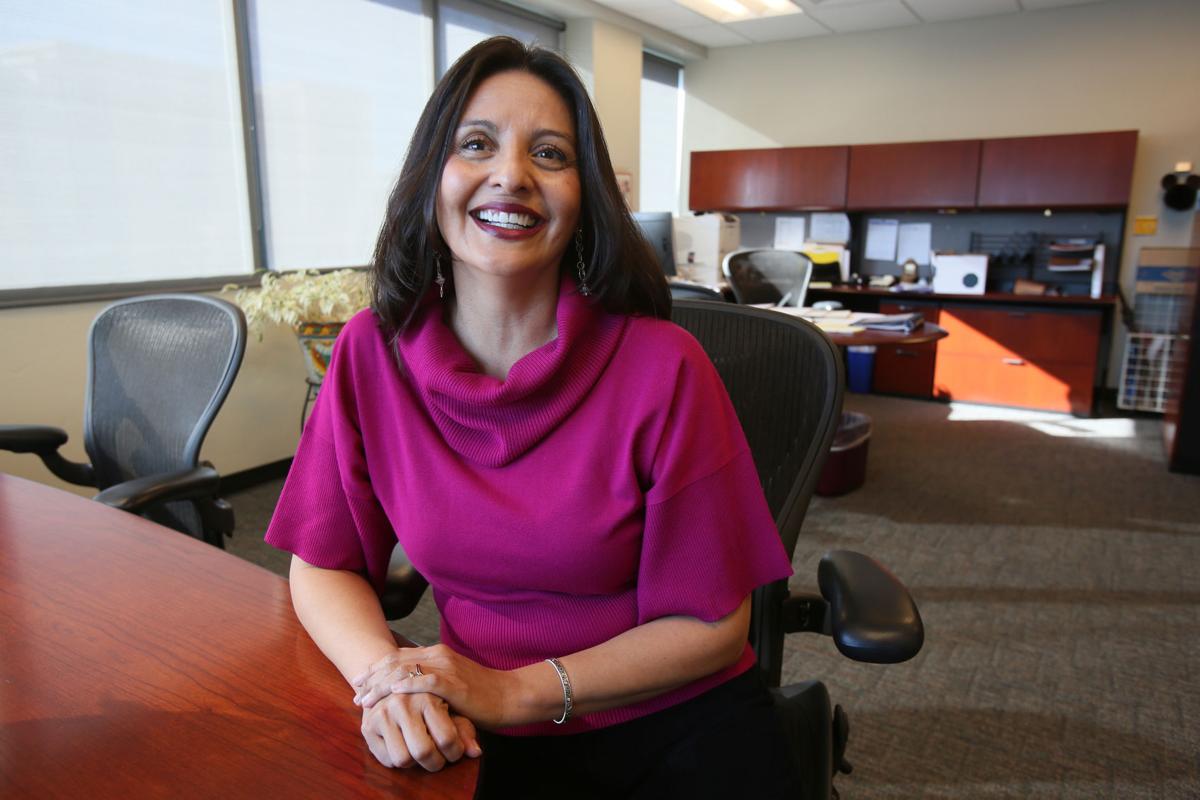
Christmas came early for new Pima County Transportation Department Director Ana Olivares, who got the news she’d be dropping the interim part of her title on Dec. 24.
Olivares served for over a decade as deputy director under her predecessor, Priscilla Cornelio. Before that, the Cholla High graduate spent 16 years at the Arizona Department of Transportation, which she left as assistant district engineer in Tucson.
The Road Runner sat down with Olivares to get a sense of her goals for the department and the hundreds of miles of roads — many of which are in failed or poor condition — it is responsible for.
She takes the helm at an interesting time for local transportation funding. Projects were recently approved for the first year of the Road Property Tax, roughly $8 million of which will go to unincorporated areas. That’s the first substantial repair funding for local streets in years.
There is also an ongoing effort to explore the possibility of a county sales tax, the proceeds of which would be much larger than the property tax and — some say — actually up to the task of getting the area’s roads back to fair condition.
Question: What are your principal goals as the new county transportation director?
Answer: “In the past, because of the many needs we have in the county, we have been a very reactive department. We react to all the needs and requests that come in. My goal is to become a more proactive department, to be able to spend more time on what needs to be done, and plan it and do it, instead of reacting to it. That’s the big emphasis, to become more proactive and to become more efficient, with better customer service at a reduced cost.
“We have a lot of systems for people to contact us. We’re in the process of organizing so there’s one contact place, one contact number, one area of the department inputting our service requests so that we can better track it. I want to be able to know that everyone knows where to look for the information so we don’t have to search for it.
“Another thing that would be nice is sometimes we get requests, ‘You need to put in a left turn lane here,’ or ‘It’s extremely congested here,’ or ‘Come fix my guardrail.’ I’d rather have our staff spend their resources and time identifying those, planning those and then have them fixed.”
Q: What are the main obstacles or challenges to achieving those goals?
A: “The biggest obstacle or challenge for us is we have many systems where we track stuff. Crash data, where we have all our sign information, where we have all our striping information, where we have all our service requests, they’re in different programs. Our biggest challenge this next year to year-and-a-half is, with the help of our IT department, to identify a system where we can consolidate all that.”
Q: Most roads in unincorporated Pima County are in failed or poor condition. How do you explain how we got here?
A: “The reason I believe we got to this point is the big focus was congestion relief. Every available funding source, the public wanted congestion relief. That’s what we and every other agency focused on: expansion, adding lanes. But it came at the detriment of not focusing on the continuous maintenance of our roads. We spent the last 10 years expanding, now we just need to shift. We’re shifting our focus to more maintenance and paying more attention, and making sure we are organized there and finding every available resource. But we have to keep focus on where things are growing and where we need expansion. We also need to make sure do a better balance than what we’ve done.”
Q: What will the Road Property Tax be able to do, and what will it not be able to do?
A: “It’s dedicated to local roads, it will help us start improving local roads. In the past when we had some funding, it was limited, so you try to do the most benefit with the money you have. We focused on the arterial and collector streets. They have the most volume, and the local neighborhood roads did not get any service. That’s one of the best things about this tax: It’s specifically designated just for neighborhood roads.
“The thing that you’ve probably heard other places is that it’s just a drop in the bucket of what the need is. Nineteen million dollars is not nearly enough to start improving what we need. It just makes it difficult to decide where to start.”
Q: Supervisor Ally Miller and others have argued that the roads problem could be addressed without additional resources by properly prioritizing current funding. Are there things your department could do to stretch money further?
A: “Yes, there’s always room for improvement. That’s part of this process improvement, to try and generate some efficiencies by becoming more organized and consolidating some of our divisions, to try to generate some savings. But the things is, the savings that we’re going to generate are an even smaller drop in the bucket. Every penny that we save will be redirected back to roadway improvement, but it’s not a significant amount to start eating away at the problem that we have.”
Q: If the Road Property Tax is not enough to address the issue, what measures would be?
A: “What we need is a funding source that is significant and continuous. A few years ago, the Board of Supervisors allocated some general-fund money for pavement preservation.
“But then it stops, so all you do is repair a road, and then there’s no continuous source of money to maintain it.
“At one point at the Legislature we requested a 10-cent increase in the gas tax statewide, or allow the counties to increase the gas tax. It’s a national issue. There are other states that have taken it on themselves because the gas tax has not risen.
“The next proposal we have is a sales tax dedicated to road improvement. A gas tax or a sales tax would generate the most money in as fast a time as possible.”

