

PHOENIX — Lawmakers gave final approval Wednesday to a controversial measure that would allow students and parents to sue teachers personally over what they contend are antisemitic statements and actions in the classroom.
The 38-20 vote by the Arizona House for HB 2867 came over the objections of most Democrats, who sought to differentiate between the issue of antisemitism and what’s in the bill. The Senate previously gave its approval by a 16-12 margin.
“Antisemitism is wrong. Period. End of sentence,’’ said Rep. Nancy Gutierrez, a Tucson Democrat who is the assistant minority leader. “However, that does not make this bill or policy worthy of passing.’’
Before the vote, she urged other Democrats to oppose it. “We’re setting teachers up to fail with this,’’ Gutierrez said.
Consider, she said, the fact that Arizona law now requires teachers to provide instruction into the Holocaust.
“This opens the door for teachers who are teaching to have personal liability because they said something that a student didn’t agree with or didn’t like,’’ Gutierrez said.
Part of the legislation would allow any student who is at least 18, or that student’s parents, to file suit against a teacher who acts in what they say is an antisemitic way to create a “hostile education environment.’’
The bill was altered so that a complaint would first have to be made to either the Department of Education in the case of K-12 students or to the highest ranking official at any institution of higher education. But it would still permit a civil suit — with the teacher personally responsible for hiring an attorney — if a student or parents are dissatisfied.
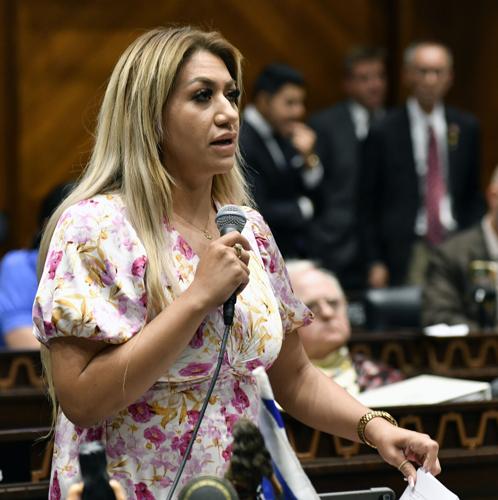
The opposition from Democrats — all House Republicans voted for the bill — drew an angry reaction from Rep. Alma Hernandez. The Tucson Democrat said she was not moved by their assurances they are against antisemitism but, in her way of looking at it, they don’t find the problem serious enough to support the measure.
“Let me tell you as someone who’s from the (Jewish) community, it is really bold to have elected officials say that this bill is not worthy of passing,’’ Hernandez said. “And I take great offense to that.’’
She said the scope of the problem of antisemitism was underlined just this past week when a man in Colorado threw Molotov cocktails at elderly Jews “in the name of freeing Palestinians.”

Rep. Alma Hernandez
More to the point of this legislation, Hernandez said the bill targets what she contends occurs in Arizona schools.
She said a Palestinian flag was put in the window of Drachman Montessori K-8 Magnet School in Tucson last year. She provided a photo of it to Capitol Media Services and said she had complained to Tucson Unified School District. There was no immediate response Wednesday from TUSD to a Capitol Media Services’ query.
“I would love to know what is being taught in that classroom,’’ Hernandez said. “I have a problem with that. Why? Because that flag is not a flag of a country, for those of you who confuse it. It is a political statement which should not be allowed in our public schools.’’
Hernandez contends there is evidence professors in Arizona were giving extra credit to students who were participating in demonstrations against Israel’s policies toward Palestinians.
The measure now goes to Democratic Gov. Katie Hobbs, after it was opposed by every Democrat in the Senate, while just four of 28 House Democrats were in support.
The governor has until Tuesday to make a decision.

Hobbs
Hobbs, in response to questions from Capitol Media Services, has sought to navigate the politically thorny issue of what she believes does and does not constitute antisemitism. Some lawmakers from her party argue the definitions in the bill are so broad, they could encompass criticism of the activities and policies of Israel, including its conduct of the war in Gaza.
“I’m not going to answer a question like that,’’ Hobbs said. “Of course, antisemitism is wrong. It’s not up to me to decide what qualifies as antisemitism.’’
On Wednesday, before the vote, the governor again sidestepped a question of whether she believes criticism of how Israel treats residents of Gaza is antisemitic.
“I don’t think it matters what I believe or not,’’ she said. “I think that we should all do everything we can to tone down the rhetoric so that people are not resorting to violence as a way to solve problems or make statements. No matter what you believe, it’s not OK to target another group who believes something different with violence.’’
The bill being sent to the governor will force her, however, to confront the question of what is antisemitism.
It would incorporate into state law a definition of antisemitism that comes from the International Holocaust Remembrance Alliance, a definition adopted by the U.S. State Department in 2016. Specifically included are “contemporary examples of antisemitism identified in the adopted definition.’’
Some are fairly straightforward, such as calling for the killing of Jews “in the name of a radical ideology or an extremist view of religion.’’
Others are a bit more vague, such as making “stereotypical allegations,’’ such as Jews controlling the media, economy, government or other societal institutions.
But it also includes any claim that the existence of Israel is a “racist endeavor’’ and “drawing comparisons of contemporary Israeli policy to that of the Nazis.’’
All that drew the concern of Sen. Analise Ortiz — especially in the context of how it could affect classroom lessons.
“Under HB 2867, what can a teacher say about sensitive foreign policy issues like the genocide in Gaza?’’ asked the Phoenix Democrat.
“Can a teacher state a fact that an 11-week Israeli blockade of aid pushed more than two million Palestinians toward famine?’’ she asked during Senate debate. “Can they show the images of families caged between barbed wire fences waiting hours in the heat to receive meals?’’
Others had their own reasons for opposing the bill.
“I’m standing today in support of Arizona teachers,’’ said Sen. Lauren Kuby during the Senate debate. “I respect their ability to manage their classrooms and won’t allow them to be unfairly targeted, harassed based on their speech.’’
The Tempe Democrat called the bill “chilling,’’ saying it mirrors attacks by the Trump administration on education freedom, violates the First Amendment, and “uses antisemitism as a pretext to attack students, teachers and administrators for their free speech.’’
“And I speak from the point of view of someone who has a Jewish family,’’ Kuby said. “We shouldn’t be using our religion to justify our political positions.’’
Sen. Mitzi Epstein, D-Tempe, in an effort to make the measure more palatable from her point of view, sought to strike all references to “antisemitism’’ and instead replace them with references to “unlawful discrimination.’’ But that was rejected by the Republican majority.
Only one Republican voted against the measure.
“The bill was poorly drafted,’’ Sen. Jake Hoffman told Capitol Media Services.
The Queen Creek lawmaker said he has problems with that definition of antisemitism from the International Holocaust Remembrance Alliance. He called it “extremely problematic and open-ended’’ and “highly subjective, with far too great a possibility being weaponized against free speech.’’
Hoffman said he offered an amendment but it was rejected. “Had we been able to achieve a more concrete definition, I would have been fully in support,’’ he said.
It also was that incorporation into state law of the definition of antisemitism from the IHRA that caused the National Council of Jewish Women to go on record opposed to the bill.
In a memo Wednesday to lawmakers before the House vote, Civia Tamarkin, the organization’s president, said Kenneth Stern, the definition’s lead drafter, said it was “created primarily for European data collectors measuring hate speech’’ over time and across borders — and that “it was never intended to be a campus hate speech code.’’

