





Tucsonan James Van Horn was just 17 years old when he was killed along with 1,176 of his crewmates on the USS Arizona.

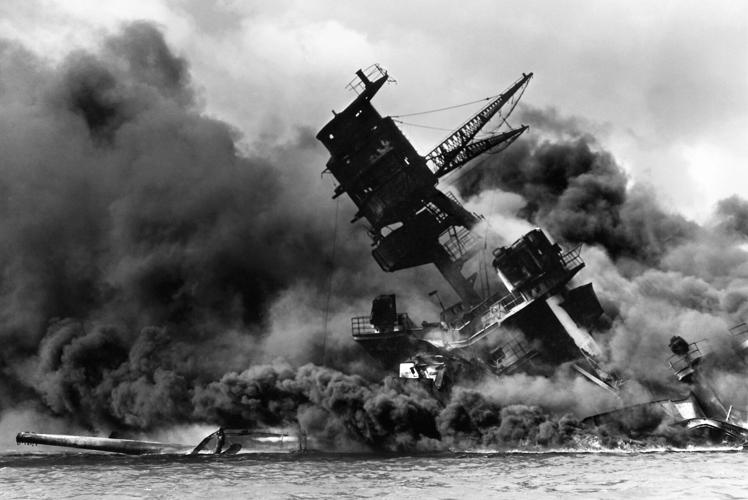
The USS Arizona burns after the Japanese attack on Pearl Harbor on Dec. 7, 1941. Most of the 1,177 sailors and Marines killed on the Arizona were entombed inside the battleship when it sank.
Now a man who shares more than just Van Horn’s name has joined a new campaign to identify and honor at least 85 casualties from the Arizona who are still buried as “unknowns,” some in mass graves, 82 years after the Japanese attack on Pearl Harbor.
In honor of his uncle, Jim Van Horn of Corona, California has submitted a sample of his DNA to the Armed Forces Medical Examiners System, joining a growing, all-volunteer, civilian-led effort to finally identify the battleship’s unknowns.

Jim Van Horn
USS Arizona Operation 85 was launched early this year by Kevin Kline, a Northern Virginia real estate agent whose great-uncle, Gunner’s Mate Second Class Robert Kline, died on the Arizona at the age of 22.
Kline said he grew up hearing stories about his great-uncle. He always assumed the young man’s final resting place was on the sunken ship.
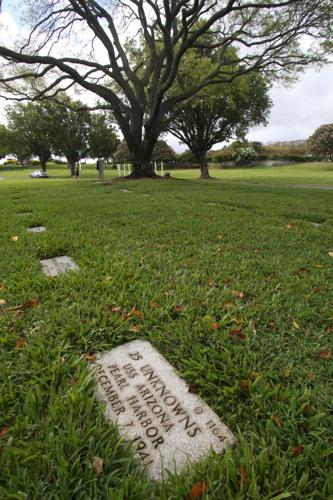
Then last year, after a trip to Pearl Harbor, Kline learned about a burial plot at the National Memorial Cemetery of the Pacific, nearby in Honolulu, for Arizona crew members whose remains were recovered but never identified.
“It kind of infuriated me that they were just left there — 85 guys sitting in those commingled graves,” he said.

Gunner’s Mate Second Class Robert Edwin Kline was killed on the USS Arizona on Dec. 7, 1941. Like most of the 1,177 sailors and Marines who died on the battleship that day, his remains were never recovered and identified.
Kline founded Operation 85 with one mission in mind: Collect enough DNA samples from the descendants of fallen Arizona crew members to allow for a new forensic examination of those graves.
The federal Defense POW/MIA Accounting Agency has told him it needs so called “family reference samples” for at least 60% of the ship’s unrecovered crew before the agency will consider disinterring remains from the cemetery commonly known as the Punchbowl.
Most of the 1,177 sailors and Marines killed on the Arizona were entombed inside the battleship when it sank. Only 105 bodies were recovered and identified.
So far this year, Kline said, he and his small team have made contact with 672 family members representing 346 lost crew members.
The Defense Department now has reference DNA on file for more than 190 men from the Arizona. That puts Operation 85 almost a third of the way towards its goal of securing genetic samples for at least 643 crew members, the minimum amount DPAA has said it needs to begin the identification process.

Some of the unidentified remains of USS Arizona casualties are buried commingled in mass graves at National Memorial Cemetery of the Pacific in Honolulu. A civilian-led effort has reached its goal of collecting enough DNA samples from the living relatives of the battleship’s crew to prompt the Defense Department to consider reexamining dozens of the unidentified servicemen buried in Hawaii after the Pearl Harbor attack.
“We’re not going to stop,” Kline said.
Difficult search
Operation 85 has already won the support of several members of Congress and officials from the Navy, the Marines and the Pentagon, Kline said. The effort is also being backed by Pacific Historic Parks, a Hawaii-based nonprofit that supports the Pearl Harbor National Memorial and other historic sites.
Tracking people down is the biggest challenge, so Operation 85 sought help early on from a Tucson woman with as much experience researching the Arizona crew as anyone.
Former Arizona Daily Star Editor Bobbie Jo Buel spent more than five years compiling profiles of every sailor and Marine who died on the battleship. The work involved scouring newspaper archives and public records, contacting relatives of the men and collecting snapshots and personal letters.
Kline said he and Buel connected about a year ago. “She really started me out by giving me her list of people she had contacted,” he said.

Kline
The Operation 85 website now hosts Buel’s profiles of the crew, an arrangement that is helping to draw new attention to both the project and her work.
“It’s exactly what I was hoping for,” she said. “We want all of this to live on.”
Based on her own experience, Buel thinks Kline and company have their work cut out for them.
“It’s really hard to find people. You’re looking for people who don’t even have the same last names,” she said.
And it only gets harder as time passes and the earlier generation of relatives dies off.
So far, though, Buel has been impressed by Kline’s methodical approach and his tenacity. “If anyone can do it, I think he’s the guy,” she said.
Kline expects the process to take a while. Conservatively, he hopes Operation 85 can reach the minimum number of genetic samples to trigger DPAA’s identification process before Dec. 7, 2026, the 85th anniversary of the Pearl Harbor attack.
The response from those contacted so far has been overwhelmingly positive, he said. Only a handful of relatives have declined to participate. “And for almost everyone who said no, we found another family member who said yes,” Kline said.
He would love to eventually see samples on file for all 1,072 lost crew members, but he said they have already come across at least one family that has no sources of DNA left.
The effort is focused solely on the graves of the unknowns at the Punchbowl. The sunken battleship itself would not be disturbed as part of Operation 85.
“We’re just interested in giving a name back to those who were recovered and buried as unknowns,” Kline said. “It just kills me that we have these graves that say unknown on them.”
Unknown uncle
Jim Van Horn only has one picture of his uncle, who dropped out of Tucson High to join the Navy in 1941, after Rear Admiral Isaac Kidd, another eventual Arizona casualty, gave a recruiting talk at the school.
“He’s a 17-year-old gangly kid, that’s all he is,” Jim Van Horn said, describing the photo of James in his Navy whites.
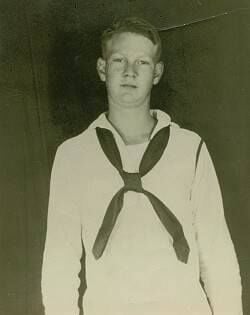
James Van Horn
The seaman second class was the only Tucsonan lost on the Arizona.
The younger Van Horn said he has known where his name came from since he was a teenager, but he was never told much about the uncle who died 20 years before he was born.
“It was not something that was talked about,” he said. “Everything I’ve learned, I’ve learned on my own.”
Van Horn’s father, Dudley, was especially tightlipped about the loss of the big brother he idolized.
“It was a very, very sensitive subject to him,” Jim Van Horn said. “He just kept that all bottled up.”
USS Arizona Operation 85 executive director Kevin Kline talks about his organization's all-volunteer, civilian-led push to identify the 85 or more Arizona crew members whose commingled graves at the National Memorial Cemetery of the Pacific in Honolulu are marked as unknowns.
Van Horn and Kline found each other on Facebook early this year. By April, Van Horn’s DNA was on file with the government.
He said the process was free and easy, if a little bureaucratic. Before he could collect his own DNA with a swab inside his cheek, he had to fill out a form authorizing the military to send him the test kit. “Typical government, you have to get permission to get permission,” he joked.

A marble wall inside the USS Arizona Memorial at Pearl Harbor bears the name of Seaman Second Class James Randolf Van Horn, the only Tucsonan killed on the battleship on Dec. 7, 1941.
Van Horn does not expect his uncle’s remains to turn up at the Punchbowl, but if Operation 85 can answer that question definitively — for his family or someone else’s — the effort will have been worth it.
“To know the history and get the final word on his resting place? Absolutely,” he said.
But what if Tucson’s only USS Arizona casualty is recovered and identified as a result of Operation 85’s efforts?
“That’s a bridge to be crossed if we get there,” said James Van Horn’s namesake nephew. “I’d probably have him returned to the ship. It’s where he wanted to be.”

The medallion for James Randolph Van Horn, on the USS Arizona Mall Memorial at the University of Arizona, honors the 17-year-old who was the only Tucsonan killed aboard the battleship during the Japanese attack on Pearl Harbor in 1941.

