



Tucson Water violated state requirements for two straight years, limiting how much of its drinking water is lost or not properly accounted for after all of its deliveries were totaled and analyzed.
The utility's rate of what's known as "lost and unaccounted for water" topped state limits in 2024 and 2025, according to information provided by the utility and to utility records analyzed by an Arizona State University water research center. The state limit is 10% of a utility's available drinking water supply, but Tucson Water exceeded 11% both years.
"Lost and unaccounted for water" is an important bellwether for measuring how effectively a utility manages its supply, water experts say. The term reflects a utility's ability to prevent excessive leaks and water line breaks and its ability to monitor how much of its supply is actually used by people and businesses.
It also shows how well a utility's water meters are working at measuring the amount of water they receive and use. Preventing water losses and accurately monitoring water consumption is particularly important now when one of the state's main supplies — the Central Arizona Project canal system — is at risk due to sharply declining flows in the Colorado River, where its water comes from, said Sarah Porter, director of ASU's Kyl Center for Water Policy.
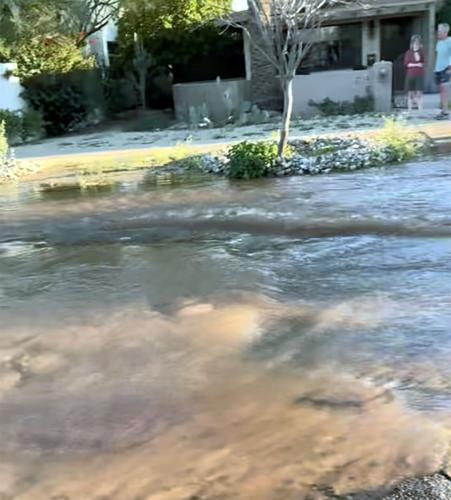
Engine 5 responded to a water main break at East 3rd Street and North Forgeus Avenue on Feb. 28. The water ripped up the pavement and was approaching nearby homes so the crew worked to secure the area and assist with managing the leak until Tucson Water arrived.
Tucson Water Director John Kmiec told the Star Friday that at this time, the city utility's officials don't know why the percentage of lost and unaccounted for supplies shot past the legal state limit. The figure for those two years was significantly higher than for the previous six years, when lost and unaccounted for water for Tucson Water ranged from 7.74% to 9.13% of total drinking supplies.
"We're still looking into why this is happening," Kmiec said. "Lost and unaccounted for water always seems to be a running gun battle for every utility in the country."
That lost and unaccounted for rate for Tucson Water amounted to 11.43% and 11.87% of its total drinking supply, respectively, in 2024 and 2025. The Arizona Department of Water Resources sets the 10% limit for larger water providers operating in Arizona's state-run management areas in and around cities, including Tucson and Phoenix.
Violators of that limit can be fined up to $100 per day that the violation occurs, the Arizona Groundwater Management Act says. ADWR couldn't respond to questions from the Star on Friday as to what if any steps it will take to enforce this limit on Tucson Water.
"We've had no communications on that" with ADWR, said Kmiec, referring to Tucson Water exceeding the state limits.
Many cities around the country experience lost and unaccounted for water at 20% to 30% of their total supplies, said Kathryn Sorensen, a Kyl Center senior researcher. But those cities have more water available than those in Arizona, she said.
'We take it very seriously'
In 2024, total "lost and unaccounted for water" was 10,592 acre-feet in Tucson Water's service area. That's enough to serve water for a year to nearly 2,650 homes. It represents more than 11% of Tucson Water's total drinking water supply that was available for delivery that year.
The utility's service area covers the city and much of the unincorporated suburban lands spreading in all directions from Tucson.
The city of Phoenix water utility fared better than Tucson Water in this measure in 2024, reporting 9.63% lost and unaccounted for water. For the six years from 2018 through 2024, however, Tucson's average lost and unaccounted for water score was lower than Phoenix's — 8.63% compared to more than 9% of the utilities' total available drinking water supplies.
Both cities' water utilities had substantially higher rates of lost and unaccounted for water than any of 11 other water utilities, including Marana and Metro Water in Pima County and nine in Maricopa County, records that the Kyl Center compiled from utility records show.

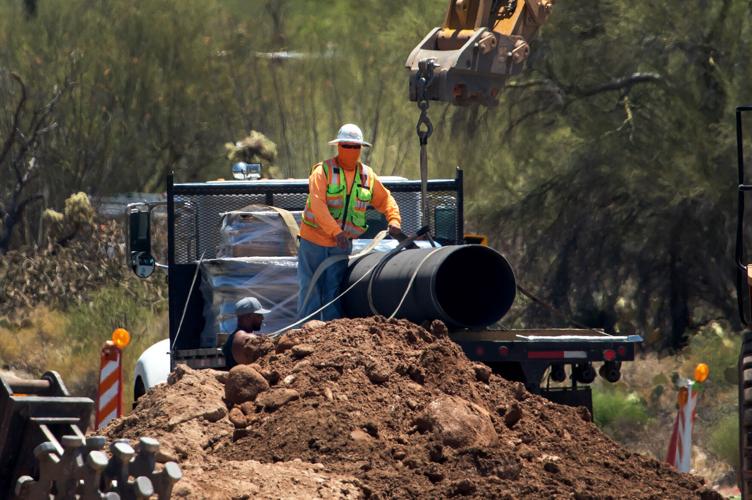
This photo from June 23, 2020 shows construction crews working after a Tucson Water line was damaged on East Orange Grove Road between North First Avenue and East Skyline Drive. Leaks aren't necessarily the biggest source of water that's lost or unaccounted for, Tucson Water officials say. But the utility's system experiences a leak or break in a water line or main about once a day, "some more spectacular than others," says Tucson Water Director John Kmiec.
Asked how serious of a problem this lost and unaccounted for water is, Kmiec replied, "We take it very seriously, on all production and on all consumption related to our water supply. We want to make sure we have the most reliable system, whether it's truly lost water through main breaks or because others dig into our pipelines, which is another huge category of lost water."
"We don’t know what percentage of that that doesn’t get billed is water theft, people stealing water," Kmiec said.
Water is precious, and every drop of drinking water that's lost carries a double cost, both in loss to the supply and the cost of replacing it, said the Kyl Center's Porter.
"I want to underscore this is very much related to the rates we pay," she added. "This is really over 'how much money is the community willing to pay for water so the system can be kept in good condition.'"

A Tucson Fire Department crew tried to stop the flow of a recent water main break at East Third Street and North Forgeus Avenue in February until Tucson Water workers could arrived.
If you have a trend line in which the percentage of lost and unaccounted water was going up, it's a problem, said Val Little, a water conservation activist in Tucson. "We may not understand why it’s happening, but we need to figure it out. You can’t just have a trend line showing the loss is going up every year. Pretty soon you're losing more every year."
But Chris Avery, an assistant Tucson city attorney for water issues, noted that historically, Tucson Water's lost and unaccounted for water was well below 11% of its supply, like 6% to 9%.
"If someone is a .300 hitter, some years they'll be a .330 hitter and some years a .280 hitter, but they are a good hitter," Avery said.
The Phoenix Water Services Department answered "no" when asked if it considers lost and unaccounted for water a serious problem.
"This is not a system failure. Phoenix is operating within the state’s requirement of less than 10%, which is a strong standard for a utility of this size," the department said in an email to the Star, adding that it has cut its percentage of leaks per mile of pipeline dramatically since 2018.
"At the same time, staff takes water loss seriously and is continuously working to improve both system performance and measurement accuracy."
ASU's Porter said that in an era of water scarcity, even 7% or 8% of lost and unaccounted for water may be too high.
"Water is worth a lot here. Paying more to keep a system from leaking precious water out is worth it," she said.
Compared to other cities around the country, even a 10% figure is "amazing," ASU's Sorensen said. She agrees that cities here should strive to stay below that level, "because replacing leaky pipes improves water quality, but it is very expensive," Sorensen said.
Leaks not necessarily the biggest problem
The Star began looking into how much water Tucson was losing or couldn't account for after its columnist Tim Steller wrote on March 29 about a water leak in the midtown area that may have taken away up to 1 million gallons, and that took Tucson Water a week to find the source and shut it off.
Four Tucsonans commented on Steller's Facebook post of that column about major leaks they've witnessed. In most, the leaks took weeks or months to fix, the commenters wrote.
A fifth resident emailed Steller about a leak she witnessed less than a week ago, in which a six-inch stream of water was running next to the Cheesecake Factory restaurant in Tucson Mall. (Mall officials didn't respond to a request from the Star about how that leak occurred.)
The comments are a sign of how seriously local residents take water leaks. But leaks aren't necessarily the biggest source of water that's lost or unaccounted for, water officials from both Tucson and Phoenix told the Star. That's even though Tucson Water's system experiences a leak or a water line or main break about once a day, "some more spectacular than others," said Kmiec.
Engine 5 responded to a water main break at East 3rd Street and North Forgeus Avenue on Feb. 28. The water ripped up the pavement and was approaching nearby homes so the crew worked to secure the area and assist with managing the leak until Tucson Water arrived.
The lost and unaccounted for water can also include losses of water from storage; inaccurate readings from water meters, which can degrade over time; differences in timing of data information from meters during different cycles of water delivery; and water theft, said Phoenix Water.
Also included are activities that are legal but difficult to measure, such as water used in firefighting, construction activity, and flushing out the water system to improve water quality, the Phoenix utility said.
Tucson's Chris Avery, however, said he's fairly convinced from his decades of experience in water issues that by far the biggest cause of lost and unaccounted for water is the differences in how the city's large water production meters and its much smaller household meters measure water. The differences are particularly large when the residential meters age and perform less efficiently, he said.
"Production meters are large meters. They're more accurate and better maintained," Avery said. "Customer meters are smaller scale. When they get older they fail in favor of the customer," meaning they show less water use than is actually the case. The water use that's missed by the smaller meters is a major part of what's not accounted for, he said.
But Tucson Water director Kmiec said he's not certain whether leaks and line breaks or water meter issues comprises a larger share of lost and unaccounted for water.
He acknowledges that with more than 170 production wells in its system last year, and 250,000 meters serving residents and businesses, "just a little bit of an error of a half percent or 1 percent can make a difference" in how much water use is measured.
"I can’t give a hard and fast percentage" of the relative contributions of water leaks, line breaks and inaccurate metering to the problem of lost and unaccounted for water," Kmiec said.
Similarly, Phoenix Water told the Star it "does not have a percentage breakdown that separates physical losses (leaks, main breaks, etc.) from other components of lost and unaccounted-for water.
"More importantly, it is not possible to precisely determine that breakdown, because many of these components cannot be directly measured," the utility said.
Tucson replacing aging pipes
Most experts say a key factor in water losses is aging infrastructure. Tucson and Phoenix are much older than their surrounding suburbs, so their pipes and water mains are also often much older and more prone to breakage, officials say.
But that distinction between older and newer water pipes is not always a factor here in which ones are most prone to breaks and leaks, Kmiec said.
"In our capital improvement programs, we don't do water main replacement based on the age of the systems but on the integrity of the systems," Kmiec said.
The utility has been using AI tools to help it determine water system integrity for five years now, he said.
"We look at a variety of factors on how our system was built over time and what our infrastructure is," he said. "Some neighborhoods may have been built in the '50s and '60s, and they may have been using different levels of pipe strengths, first with concrete and iron, and in the '70s and '80s, plastic. Now we replace them based on the likelihood of failure."
In some cities, "there may have been times where they try to replace based on age alone. But if you have a neighborhood constructed in the '40s and '50s with no break history, why spend that millions of dollars in that neighborhood, when you can go somewhere else where lines were built in the '80s have breaks 5 to 6 times a year?"
Tucson Water hopes to improve its infrastructure significantly in the next 5 years with a planned capital improvement budget of $600 million to replace aging pipes and on other water infrastructure improvements, Kmiec said. It's spending $60 million over the next few years to replace all the city's existing water meters with "smart meters" that will offer more accurate information about how much water passes through them, Avery said.
As for water leaks, "the hardest ones to fix are the ones nobody calls us about," said Kmiec. Anyone who sees what they think is a water leak should call the city at its emergency line of 311, he said.

