





It’s happening again, and cactus experts still can’t explain why.
For the second time in four years, saguaros across the Tucson area are sprouting flowers in great numbers and strange places.
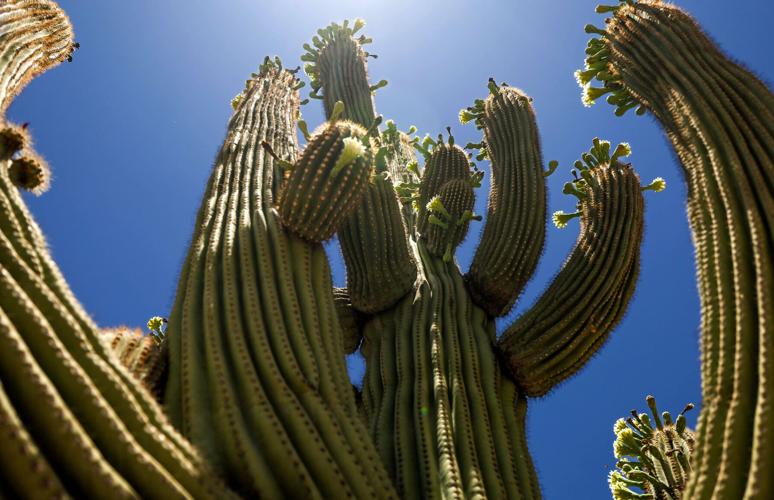
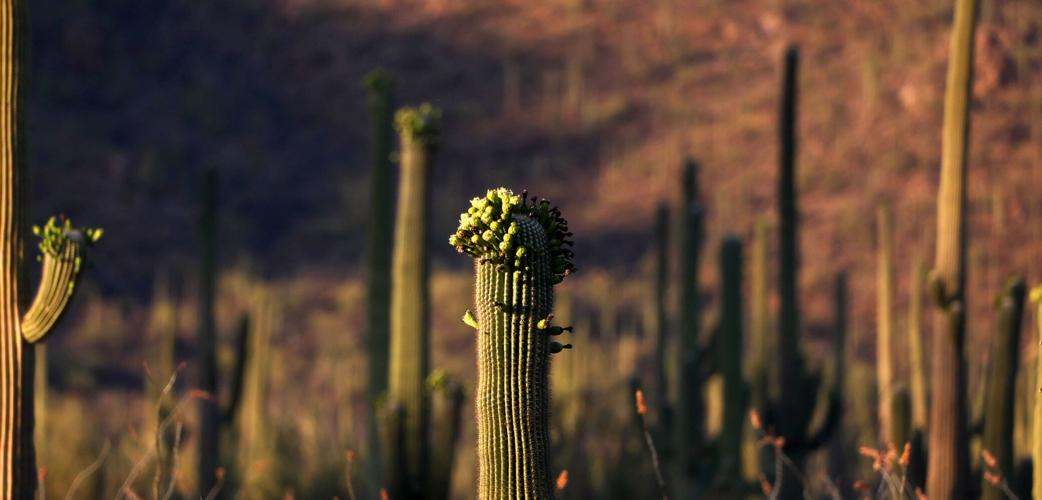
The Sonoran Desert’s signature cactus typically blooms at the tips of its arms and trunk, but this year’s bumper crop of blossoms can also be seen spilling down the sides of many plants.
This unusual flowering phenomenon was last seen on a wide scale in 2021.
“It’s a bit of a mystery,” said Peter Breslin, postdoctoral research fellow with the University of Arizona’s Desert Laboratory on Tumamoc Hill. “Some speculation says this is because of slow growth due to heat and drought. But the honest answer is no one knows.”
The last large-scale “side bloom” like this was in 2021. Some experts think this year’s event could be just as widespread.
Local desert researcher Bill Peachey said his “saguaro spies” have reported the phenomenon “across the Tucson subregion,” from the Rincon Mountains foothills to Avra Valley and at least as far north as Florence.
It’s not just happening way out in the desert, either. Saguaros studded with side blooms can be seen along busy streets and in the yards of homes all over the city.
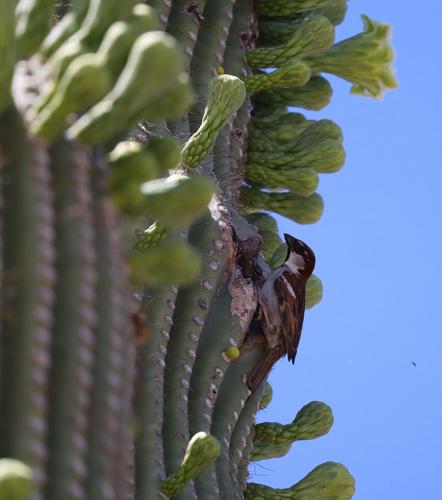
One especially eye-popping example is standing tall right now in front of a shuttered car dealership on Stone Avenue north of Grant Road, directly across the street from a sex shop. The multiarmed giant there sports hundreds of buds and blossoms that cover its stems and trunk like a rash.
Qahtan Hassan said he has owned JQ Motorsports at this location for 15 years, and he can’t remember ever seeing flowers on the saguaro out front.

Saguaros across the Tucson area are erupting with flowers in an unusual display that has puzzled experts.
Now the cactus is blooming with such intensity that it can hardly contain itself. In the trash-strewn weeds at its base, the ground is speckled with failed buds and dried flower husks.
More data needed
Before he retired on April 30, biologist Don Swann spent more than 30 years studying cacti and other wild things at Saguaro National Park. Now he works as a volunteer on several ongoing research projects at the park, including a saguaro study that, at 83 years and counting, ranks as one of the longest-running annual plant surveys in the world.
Swann said he has seen this year’s unusual flowering behavior everywhere from Sabino Canyon to the desert surrounding Saguaro’s Red Hills Visitor Center in the Tucson Mountains. The hiking trail leading into the park from the east end of Broadway is another good place to take in the show, he said.
“Based on my observations, it’s as good as it was in 2021,” Swann said. “But it’s hard to say if this is something that’s happening more often than it has in the past. We just don’t have the data.”
Researchers at Saguaro have only been studying the phenomenon since 2020, after it cropped up sporadically at the park.

Blossoms and buds cover the stems of a saguaro in front of a home near North Campbell Avenue and East Grant Road.
Swann said the major bloom the following year gave them a chance to compare the flowers on the sides of the stems to the ones on top. They discovered that side blooms generally produce smaller fruit with fewer seeds but are nonetheless still viable for germination.
“Some do survive,” he said.
Now that the bloom is back, Saguaro’s science team has a chance to gather additional data about how many blossoms the cactuses are producing and how those flowers are distributed along the stems.
There are a number of long-term scientific plots scattered throughout the 93,000-acre preserve, so Swann said they should be able to study what’s happening across a range of elevations and terrain types. They’ve also been measuring saguaro growth rates and climate conditions in the park that could prove to be vital.
“The long-term goal is to look at all of it together,” Swann said, in hopes of pinpointing what is causing these strange spurts of flower production.
“They’re responding to something in the environment in a way that appears to be optimal for them. We just don’t understand what that is yet,” he said. “But we’re getting to see more patterns we can start to hang our hats on.”
For example, widespread side-blooming seems to occur after a particularly dry summer and fall, and it appears to be linked to “years where the saguaros don’t grow as much,” Swann said.

A sparrow perches on a saguaro covered in an unusual number of buds and blossoms along North Stone Avenue north of East Grant Road.
Flowers to fruit
That certainly makes sense to Peachey.
He said saguaros typically produce flowers only at the tips of their stems because that’s where the youngest plant material is located. But while each spine cluster usually blooms just once, older ones can be reactivated if a cactus doesn’t grow enough over the course of the year to produce a new cohort of clusters on top.
Peachey has been studying the same 2-acre plot of saguaros on a rocky hilltop overlooking the road to Colossal Cave since 1997. At the moment, he’s tracking the flowering activity of 134 different cactuses with 386 reproducing stems, which requires him to walk the site and count each blossom he sees every other day or so.
He said his saguaros just started blooming on May 12, so it’s too soon to say how big a crop the plot might produce this year. Already, though, he has counted more side blooms than in any year besides 2021, when his research subjects churned out more than 12,000 flowers, nearly double their average output.
Peachey said the bloom usually peaks on his plot during the first few days of June, which gives the cactuses roughly a month to produce fruit and get their seeds distributed just in time for the start of the monsoon season.
Right now, some of the plants are sporting “a halo effect” of tightly bunched blossoms, with scattered buds trailing down the stems, he said.
Peachey thinks side blooms could be the result of several “intersecting stresses,” including extended drought, deep winter freezes and increasing bouts of extreme summer heat. And while all of those things closely match the predicted impacts of human-caused climate change, the researcher said he can’t definitively make that connection. “If I had 50 years of data, maybe I could.”

Saguaro flowers begin to bloom at Tucson Mountain Park.
No end in sight
The strange blooming behavior has led to a few apocalyptic predictions, but experts insist there’s nothing to worry about. We are not witnessing the “last gasp” of an iconic species on the verge of dying off completely. “That has been the common mythology, and it’s absolutely not true,” Peachey said.
“I think the best evidence of that is people were saying the same thing in 2021, and the saguaros are still here,” Swann added.
Just don’t expect a definitive solution to this blooming mystery anytime soon. Studying an organism that routinely lives for 200 years or more can be an exercise in both patience and humility, Swann said.
“Saguaros are really operating on different time scales than we do. We have to work together across generations to answer some of these really important questions,” he said. “If I had another 100 years, I could have more to say about this. Hopefully, the next generation of saguaro researchers will continue to take a look at it.”
Luckily, Swann said, you can still appreciate the bloom, even if you don’t fully understand why it is happening.
“It’s still spectacular to look at,” he said. “It makes for a really beautiful show, so I would encourage people to get out there and enjoy it.”

The Sonoran Desert’s signature cactus typically blooms at the tips of its arms and trunk, but this year’s bumper crop of blossoms can also be seen spilling down the sides of many plants.

