





Willem de Kooning’s “Woman-Ochre” is home.
After nearly 37 years, the painting that was cut from its frame and stolen over Thanksgiving weekend in 1985 will once again hang in the University of Arizona Museum of Art.
“I’ve been thinking about this painting in terms of it reaching certain milestones,” said Olivia Miller, the museum’s interim director. “This is the most exciting milestone for us. We are just thrilled.”
On Saturday, Oct. 8, the museum will host a reception to open a special welcome-home exhibition for the de Kooning. The exhibit will run through May 20 before “Woman-Ochre” is returned to its second floor exhibition space and kept under a case.
The painting was in that space in November 1985 when a couple visiting the museum pulled off an improbable heist, cutting the painting out of its frame and stealing it in broad daylight.
For nearly four decades, the painting’s whereabouts was a mystery until that day in August 2017 when Silver City, New Mexico, antiques and furniture dealer David Van Auker called the UA to tell them he had their painting.
“When I talked to them, the first thing I said was … I believe I have a piece of art that was stolen from you,” Van Auker recalled of that conversation.
By late the next evening, the de Kooning was on its way back to Tucson.
But the journey had just begun.
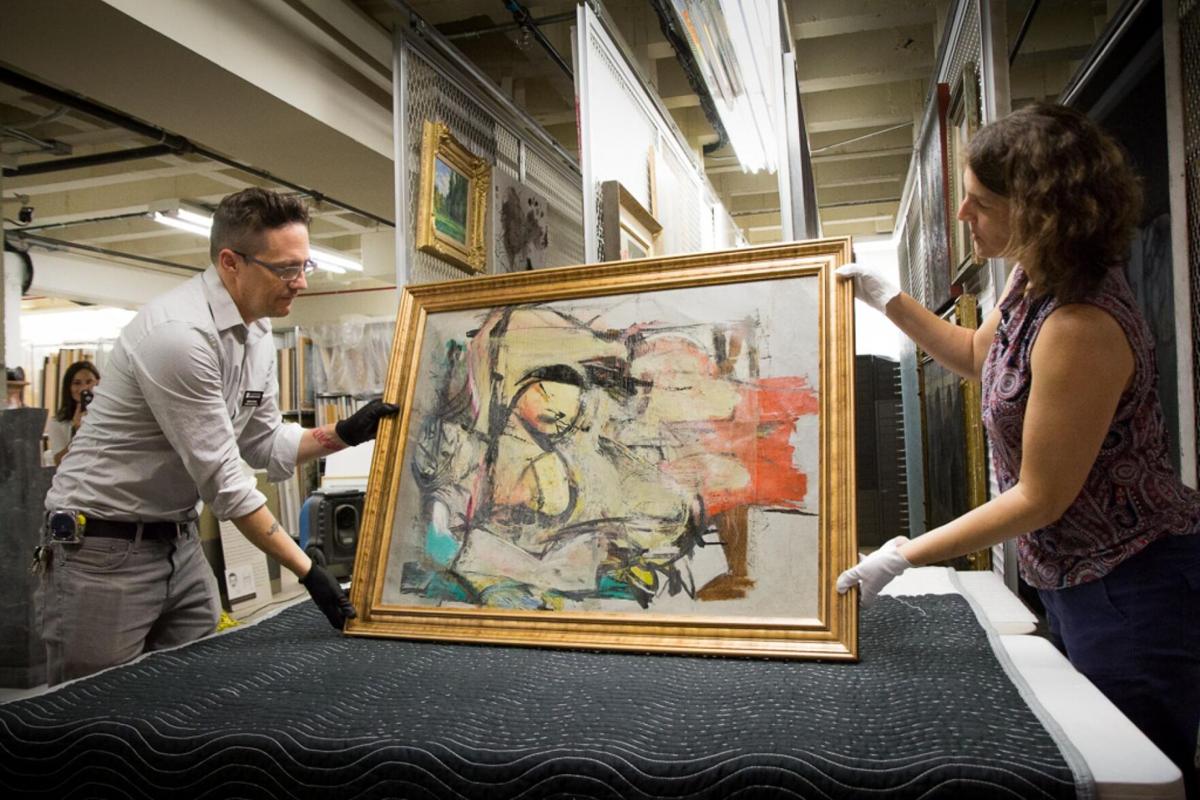
The famous "Woman-Ochre" painting by Willem de Kooning returned home to the University of Arizona Museum of Art after being stolen in 1985. The painting was found in 2017 and has spent the last few years being prepped to be returned home and hung in Tucson. The painting will be exhibited among other works in a new exhibit. Pascal Albright & Rebecca Sansett / Arizona Daily Star
A brazen heist, inconceivable recovery
No one was ever charged for the Nov. 29, 1985, theft. What police and UA Museum of Art officials know is that a couple came into the museum that day over Thanksgiving weekend when no one else was there. While the woman kept the lone security guard occupied downstairs, her male companion went to the second floor where the de Kooning, valued back then at $400,000, had hung since Baltimore developer Edward Joseph Gallagher Jr. had donated it in 1958 in memory of his son.
To this day, officials can’t say for sure if New Mexico retired school teachers Jerry and Rita Atler was the couple who stole the painting. Their nephew found the painting among their belongings when he went to clean out the couple’s home after Rita Atler died in June 2017. The criminal case is officially closed, although the FBI said in an email this week that it will investigate any leads that arise.

Police sketch of suspects in the University of Arizona art theft in 1985, which turned out to look similar to Jerry and Rita Atler.
The painting was hanging behind the bedroom door of the couple’s home in the tiny enclave of Cliff, New Mexico, outside of Silver City. Judging from the dust, it had hung there presumably for decades.
In August 2017, the late couple’s nephew reached out to Van Auker and his partners, who run the Manzanita Ridge Furniture & Antiques shop in Silver City, asking if they would be interested in buying the estate. They initially turned him down. Before the pandemic, the three partners dealt mostly in furniture resale, buying furniture and furnishing from upscale hotels. They weren’t in the business of estate sales.
When the nephew started name-dropping the mid-century furniture designers whose works filled the home and described the artwork on the walls, Van Auker said they decided to take a look.
The trio agreed to buy the estate for $2,000 because Van Auker was enamored by a lamp, a vase and two paintings, one of which turned out to be the missing de Kooning.
Van Auker said he wanted to hang the de Kooning in a guest house on the store’s property. He had no idea that the painting was anything more than interesting — an example of post-modernism that fit the style of the guest house that had been part of a former art gallery. But when a customer tipped them off that it was valuable and rare, they started doing some research.
Van Auker googled the name and came up with an article from years earlier detailing the UA theft.
His next call, was to the UA museum.
Over the next 36 hours, Van Auker and his partners spoke with Miller and law enforcement officials about returning the painting. They assured Miller that they wanted nothing in return. She had Van Auker send her photographs of the painting and its dimensions, which convinced her they had the real deal. Miller made arrangements to retrieve the painting the next night.
Meanwhile, the partners initially locked the painting up in the store’s bathroom, but as word got out around the tiny town of 10,000 that the store had a valuable piece of art, Van Auker said he worried that they would become a target for thieves.
“I’m thinking some meth head is going to get wind of this and they are going to kill me,” he recalled during a phone interview last week from his shop.
The partners turned the painting over to a lawyer friend for safe-keeping until they could return it to Miller. The lawyer, though, thought the partners should consider asking for compensation before they handed it over. He suggested the partners could demand a million dollars or at the very least a $50,000 donation for the arts program at the local college.
“I said, ‘I don’t care; we’re giving it back. It was stolen and it doesn’t belong to us’,” Van Auker said.

David Van Auker, of Manzanita Ridge Furniture & Antiques, Silver City, NM beams as he tells the story of discovering a missing Willem de Kooning painting as Olivia Miller, Curator of Exhibitions and Education, University of Arizona Museum of Art watches during a press conference at UA Museum of Art in 2017.
The partners and the lawyer went back and forth for hours over the idea of profiting from the find and when things started to get heated late that evening, there was a knock on the lawyer’s door.
UA officials, local police and the FBI had arrived, Van Auker recalled.
Restoring a masterpiece
Olivia Miller has worked for the UA Museum for 10 years so her only exposure to the de Kooning was seeing a photograph. She had imagined a day when the painting would resurface, but never really thought it would.
Until that day.
Once they got the painting back to the UA and had authenticated it, Miller knew it would take extensive work to restore the de Kooning to its original state.
“We knew that it would be an in-depth conservation project that would require the painting to leave the state,” she said.
The painting had creases in it from the thief tearing the canvas from its frame and rolling it up. Paint was flecked off and the painting was missing its borders, which were left in the frame.
Miller consulted the de Kooning Foundation and other experts who recommended the UA send the painting to the Getty Museum, which has been a leader in historic art preservation since the early 1970s. The Getty has been involved in some of the biggest headline-grabbing restoration projects of works mostly dating hundreds of years including the 2010 restoration of Giorgio Vasari’s 1546 painting “The Last Supper,” which was damaged in a 1966 flood in Italy.

Dutch-born painter Willem de Kooning is shown in Amsterdam on Sept. 17, 1968.
The Getty restores historic works free of cost to the institutions in exchange for being able to exhibit the restored works before returning them.
In 2019, the UA sent “Woman-Ochre” to the Getty and Ulrich Birkmaier, the Getty’s senior conservator of painting.
Birkmaier said that judging from the extensive damage to the painting, the thieves were unaware that the painting had a secondary canvas that was used to reinforce the original canvas after it was damaged in 1974. When the thief cut the painting from its frame, they likely expected the painting to slide easily from the frame, “but it was still attached to something,” Birkmaier said, describing the theft as an act of violence.
“They must have been miffed by the fact that it was not coming out of the frame,” he said. “When they cut into the painting, they didn’t realize it was adhered to that secondary canvas. They simply pulled the de Kooning canvas off that secondary canvas. By ripping it off, they caused all these horizontal lines where the paint flaked off where it was ripped off that secondary canvas.”
That was the first issue that Birkmaier and Tom Learner, senior scientist and head of the Getty Conservation Institute, had to address. They also had to reattach the painting’s original borders to the canvas. The UA museum had kept the original frame all those years with the canvas remnants still intact, which made the Getty’s job a little easier, Birkmaier said.
“Thankfully Arizona kept that,” he said.
The Getty began the restoration in spring 2019 but was delayed a year due to the pandemic. In all it took two years and hundreds of man hours that included remarrying the cutout canvas to its original borders and painstakenly inpainting the areas where the original paint had flaked.
The famed Getty Museum restored the famous painting that was stolen from the UA Museum of Art in 1985.
The work was finished in May and went on display in the Los Angeles museum from June through Aug. 28.
“Just like with the Jackson Pollock Mural, the painting that was restored at the Getty some years ago, these conservation exhibitions are one of the more popular exhibitions in the museums,” Birkmaier said “Part of the excitement is also due to the crazy story of the theft and the recovery. We are just so happy that we are able to bring it back to life basically. It looked pretty sad when it first came to the Getty.”

Exhibition space ready to display Willem de Kooning’s “Woman-Ochre” at University of Arizona Museum of Art. The painting will soon displayed in public for the first time since being stolen 37 years ago.
Homecoming party
Willem de Kooning’s “Woman-Ochre” returned home to the UA Museum of Art after sunset on Sept. 14, under heavy-armed guard. By some published estimates, the painting is valued at $160 million, although Miller would not disclose its value.
This week the painting will be hung in the main gallery where it will be on display Oct. 8 through May 20; a special fundraising homecoming reception is planned for Friday, Oct. 7.
Next spring, the painting will be rehung in its original second floor space, where it had been since 1959.
Miller said the UA is taking extra security precautions throughout the exhibit and beyond, although she would not disclose details, though she confirmed it will now be kept inside a case.
Birkmaier and his associates and Van Auker and his partners will be on hand for the homecoming event and the exhibit’s opening. Miller said she also invited the Atlers’s nephew, but as of last week had not received an RSVP.
Birkmaier said he and his staff are thrilled to see the painting “returned to the public in Arizona in its rightful place.”
“It is probably the greatest story I’ve ever experienced pertaining to the restoration of a painting,” he said. “It is a bizarre story. I’m just very, very happy that we were able to play a small role in the recovery of the painting.
Van Auker and his partners have visited Tucson several times since returning the painting and “it never failed, whenever we were out shopping or something there was always someone who would recognize us. ‘You guys are the de Kooning guys, aren’t you’,” he said with a laugh.
To think he and his partners had a role in this bizarre story still strikes him as surreal.
“I think it’s going to be a movie, I really do,” he said. “I think it should be a movie because I am fascinated by it.”

