



Federal proposals being considered could slash Central Arizona Project water deliveries — which Tucson uses to supply drinking water — by about one-third to nearly 100% from what U.S. law and regulations historically authorized.
That's according to a slide presentation given in Phoenix this past week by CAP General Manager Brenda Burman, outlining her agency's analysis of five federal proposals made public in late January by the U.S. Bureau of Reclamation in a draft environmental impact report on the river.
Burman also released an estimate of how large the cut would be if management of the river, which is declining from drought and climate change, continues with current strategies and no new policies or guidelines put into place.
Under the alternative offering the heftiest CAP cut, of 98%, “they are proposing to take us off the map,” Burman told a gathering of about 100 state, local, federal and tribal water officials, developers, activists and spectators at a meeting Monday in Phoenix.
Two other proposals would lead to cuts of 82% and 77%, respectively, she said.
“The alternatives that are put forth in this draft, there could be major, major cuts to the (Phoenix area) valley and the Tucson area,” Burman said. “That is not acceptable. The entire weight of the river cannot ... fall on Arizonans, and on the valley.”
The other proposed alternatives would require much lower cuts in CAP deliveries, but the cuts would be so low that the river's big reservoirs could fall to critically if not catastrophically low levels, officials have said.
A "no action" alternative, for instance, would require only a 32% CAP cut, figures released by Burman showed. But that alternative would carry a 70% risk of lowering reservoirs to "dead pool" levels, in which no water could be released from them, Burman said.
She also said, “We are willing to be partners in the basin. Some have said we are junior to the Upper Basin states. That is not true. We are not and have never been junior to the Upper Basin.”
The prospective CAP cuts were outlined by Burman at a meeting of the Arizona Reconsultation Committee, a group of water officials and experts who periodically meet to discuss and offer advice to state leaders on water issues.

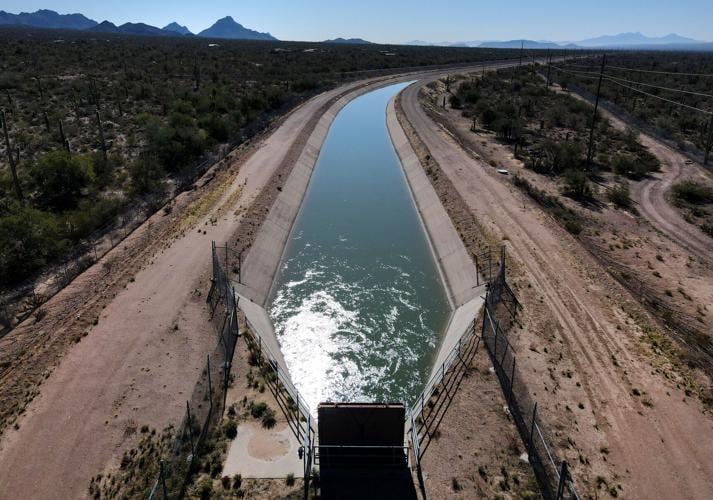
The Central Arizona Project canal near Sandario Road and Mile Wide Road northwest of Tucson, as it brings drinking water to the city. Federal proposals being considered could slash CAP water deliveries by about one-third to nearly 100% from what U.S. law and regulations historically authorized.
The specter of how large the cuts to CAP would be was raised as Burman, Arizona Department of Water Resources Director Tom Buschatzke and other committee members dissected and fretted over the ongoing seven-state negotiations over how to manage the Colorado River once its current guidelines for operating reservoirs expire later this year.
In general, committee members stood united behind positions taken by Buschatzke and Burman that the current stance of the river’s Upper Basin states of Colorado, New Mexico, Utah and Wyoming in refusing to commit to any cuts in water use, while asking the Lower Basin of Arizona, California and Nevada to swallow them all, is unacceptable.
Would not immediately shut off taps
Several speakers said cuts of the scale proposed by the new environmental report would be devastating to Arizona. But while water officials have repeatedly referred to the prospect of “public health and public safety issues” arising if these cuts occur, they stressed this past week that the cuts would not immediately shut off water to people's taps.
That’s partly because Arizona has plenty of extra water that its officials have stored underground for use in such emergencies, and partly because “water managers are very good at making sure our water supplies are secure,” Burman said.
But once those supplies are pumped out and used in an unknown number of years, cities, tribes and farms now using CAP water will ultimately likely have to return to at least some degree of additional pumping of groundwater that's there naturally, as opposed to artificially recharged, several outside experts said later.
Then, Arizona will have to confront the same problems with groundwater pumping and overdraft, such as subsidence and escalating pumping costs, that led the state to get the $4 billion CAP system authorized by Congress in 1968 to bring Colorado River water to Phoenix, Tucson and some farms via canals.
Speakers at the session, including Burman, Buschatzke, Gov. Katie Hobbs, tribal leaders and others, similarly blasted the 1,600-page environmental report for what they said was bias against the interests of Arizona, California and Nevada.
First, they said the proposed cuts are completely unacceptable to Arizona, particularly when the bureau proposes no mandatory water use cuts to the four Upper Basin states.
Second, they said the environmental analysis published by the bureau ignored the economic impacts of the water-use cuts proposed for the Lower Basin states and didn’t adequately analyze the effects on agriculture.
“There’s a complete lack of analysis as to what it would mean not just to us but to the nation,” said Max Wilson, the city of Phoenix’s water resources director. “The tribal allocations are also not acceptable."
Despite those concerns, Burman did note in her talk that in Chapter 3 of the draft environmental report, the bureau issued a warning, as it discussed the alternatives’ environmental consequences, that in some cases, the cuts may be severe enough that some municipalities may have to rely on hauled water.
Four of the bureau's proposed alternatives say that for “junior entitlements” — a clear reference to users such as CAP that have lower priority legal rights to river water than others — “there are fewer potential futures in which there is any percentage of normal delivery," the federal report said.
“Domestic shortages could manifest as reduced water allocations, delivery restrictions, or the need for additional conservation measures, which could in turn limit the capacity to meet domestic water demand,” the bureau wrote on page 193 of that chapter.
“Should shortages result in a reduction or elimination of legal access to municipal water, widespread impacts on social and economic conditions could also be possible. In some scenarios, municipalities could find the need to pursue alternative water sources or hauled water, if available, as an alternative to support continued services.”
'We will find ways'
At a press briefing after the meeting, Burman was asked what message she would want to send to Arizonans worried about the impact of these cuts on people
“Water managers are very good at making sure that our water supplies are secure. My job is to make sure it’s secure now and make sure it’s secure 40 years from now,” Burman said. “We will find ways to make sure that water is flowing to Arizona.”
People shouldn’t be worried about water not coming out of the taps in their homes because “we have the Arizona Water Banking Authority that has over 4 million acre-feet of water (stored underground) that’s recoverable,” Buschatzke said.

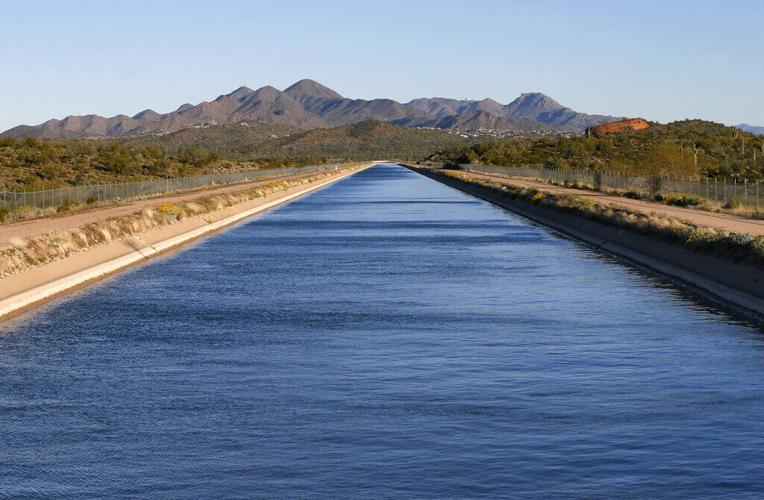
The Central Arizona Project canal cuts through the desert near Fountain Hills in the Phoenix area. The 336-mile long canal system is the largest single resource of renewable water supplies in Arizona, but its Colorado River water supplies are at risk.
He also cited a proposed $30 million Colorado River Protection Fund in Hobbs’ fiscal year 2026-27 budget. Some of it could be used for building infrastructure to more effectively move available water supplies to customers and to recover supplies from their source lands.
“We’ve been planning for this for a very long time. We knew CAP had a junior priority for the river water” compared to California, he said.
Reached later in the week, water researchers Sharon Megdal at the University of Arizona and Kathryn Sorensen at Arizona State University agreed that CAP water cuts generally don’t pose an immediate risk to people's drinking water supplies.
Long-range concerns
But Megdal said the cuts should push local water utilities to look carefully at their long-range plans for serving customers.
“Under the worst case scenario, or even a middle range scenario, you have to look art each utility to understand the long range implications of cuts,” said Megdal, who was a CAP board member from 2008 through 2020. “Every utility relying on CAP will have to redo its long-range plans or at least a medium term plan.”
Tucson Water is in better shape than many other utilities because of its long-term investments in groundwater recharge facilities in the Avra Valley north of the city that has allowed it to store some of its surplus CAP supplies in aquifers for future use, she said. Tucson Water has been serving CAP for drinking since the start of this century and has relied on it almost completely since the early 2010s.
But that doesn’t mean no changes in its policies are needed to deal with shortages, Megdal said.
Tucson Water and all other utilities using CAP now need to speak with their customers directly about potential impacts of the possible cuts to their supplies, Megdal said. “The reality of utilities having to indicate how they might deal with it is beyond speculation.”

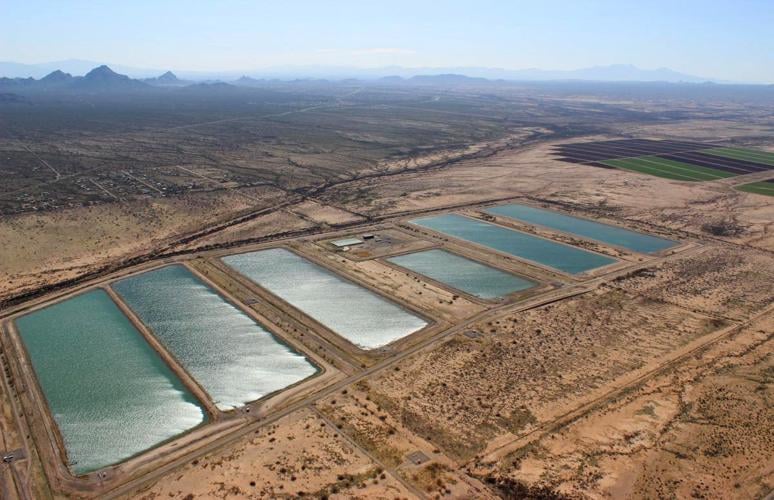
Tucson recharges the aquifer with its renewable CAP water supply from the Colorado River, including at these basins in the Avra Valley north of the city. But water experts warn that despite the underground storage, long-term planning and policy changes will be needed if and when CAP supplies are slashed due to drought and climate change depleting the Colorado River.
Sorensen said the biggest long-term impacts of CAP cuts in urban areas will be on groundwater in aquifers. That’s not only because the loss of CAP water will require more groundwater pumping, but because the vast majority of CAP water used in Arizona is recharged into aquifers for future pumping purposes and to replenish aquifers from existing pumping, instead of the water then being cleaned up for drinking in surface water treatment plants.
When and if CAP deliveries are cut, there will be less water to recharge aquifers, meaning they’ll be declining once again.
Aquifers had declined rapidly across Southern and Central Arizona cities from 1940 until CAP’s arrival in 1985, but the declines have slowed dramatically and, in Tucson’s case, reversed since then.
For the region as a whole, “the major impact is going to be on our groundwater,” said Sorensen, research director for ASU’s Kyl Center for Water Policy. “We will have less Colorado River water to replenish our groundwater pumping and that’s a big problem,” she said.
At the same time, Tucson has a “good runway” to handle CAP cuts because it’s recharged so much CAP water into its aquifer since the early 2000s, Sorensen said.
But because the city turned its CAP water treatment plant off in the middle 1990s and stopped using CAP for many years afterward, that kept the city from replenishing or protecting its aquifer during that time. That happened because when the city first delivered CAP water to customers in the early 1990s, much of the water came out brown and corroded plumbing fixtures, due at least partly to Tucson Water’s failure to anticipate the impacts of the corrosive Colorado River water.
The city didn’t resume full delivery of its legally available CAP supply until the early 2010s, meaning that until then, “you created your own shortage,” Sorensen said.
‘You were pumping more groundwater than what you were replenishing” during the pre-2010 era, she said. “That’s exactly what will happen to other places if the cuts get deep enough. Many places across Central Arizona will be pumping more groundwater than they replenish. That’s the problem.”
Today, Tucson Water has stored about six years' supply of CAP water underground, putting it in a good short-term position to deal with a shortage. Phoenix, Gilbert and Mesa have also salted away considerable amounts of CAP water underground. Gilbert and Mesa actually have recharged more water into their aquifers compared to their annual water use than Tucson has.
Tucson Water officials have said their CAP supply is so bountiful that even with a 50% cut in deliveries, they will not have to do much if any pumping in excess of naturalrecharge.The utility currently serves around 100,000 acre-feet of CAP water annually to its customers, out of a total annual supply of 144,000 acre-feet.
But some outside experts have questioned that on the grounds that continued warming weather will reduce natural recharge, in turn increasing the over-pumping of the aquifer.
Concerns hit tribes hard
At Monday’s meeting in Phoenix, the most powerful statements on the seven-state negotiations and on the river’s condition came from Stephen Roe Lewis, governor of the Gila River Indian Community in Central Arizona, and Verlon Jose, chairman of the Tohono O’Odham Nation headquartered west of Tucson.
Lewis said the prospects of success for Arizona in the negotiations “we all know seem pretty dim. I hope we can remain committed to reaching some level of consensus with some path forward, at least (with) the Lower Basin states. We are all preparing for the prospect of failure, as we all should do.”
“Arizona has to remain as unified as we can possibly be and avoid taking positions on what divides us around the table,” said Lewis, whose tribe holds the largest share of CAP water rights of any contractor, including cities such as Tucson and Phoenix.
Emphasizing the Lower Basin states’ view that the 1922 Colorado River Compact requires the Upper Basin states to release at least 8.25 million acre-feet of water annually from Glen Canyon Dam, Lewis said meeting that obligation is not just a matter of respecting the historic Law of the River governing river management.
“It was an essential element of our water settlement in 2004, the largest (tribal) water rights settlement in history,” said Lewis, referring to the Arizona Water Settlements Act that gave the Gila River Indian Community its CAP supply in return for the tribe giving up the right to sue over non-Indian depletions from the Gila River.
“It was clear that our standing of 8.23 million acre-feet is a matter of settled law and policy which the federal government respected,” Lewis said.
His father, the late tribal Gov. Rod Lewis, relied on that commitment when he was doing “due diligence” before signing the 2004 agreement, Stephen Roe Lewis said.
“It was the foundational principle for the community’s acceptance of Colorado River water in lieu of groundwater,” he said. “Our settlement relied on the compact and the community relied on that in good faith.”
Jose punctuated his comments with repeated references to the role “the Creator” has played in providing the river water.
“When we think about this, we’re sitting here, we’re all concerned about this. We start to point fingers at how we got here, how we did it, how the Upper and Lower Basin did it. We all created this."
Adding “we must learn to work together,” Jose said the Tohono Nation’s goal is to be sure the Colorado River exists as a “sustainable, reliable source for all of us."
“Together we are stronger, maybe not so much in the now but for the future. What are we doing for future generations? It is on all of us to give," Jose said.
While the tribe anticipates filing written comments on the draft environmental report, “We need to think beyond that,” he said.
“There’s this dark cloud. It’s not raining, it’s a dark cloud. We do think there will be no agreement. But I know ... the Creator will have an agreement for all of us.”

