



Sweetening doggie breath is spelling sweet success for uPetsia, a University of Arizona technology startup that recently won an innovation challenge sponsored by pet-food giant Purina.
uPetsia, which has developed a harmless bacteria strain that can counter stinky dog breath, was one of just five companies picked as winners in Purina’s 2022 Pet Care Innovation Prize, among more than 120 companies from 75 cities worldwide that applied.
The company, founded in 2020 by associate professors Eric Lyons and David Baltrus in the UA College of Agriculture & Life Sciences School of Plant Sciences, and the other prize winners received $10,000, mentorship from Purina and will participate in a “virtual accelerator boot camp” with experts from across the company and the pet-care industry.
During a final pitch competition in March, the startups will get the chance to present their businesses to an audience of industry influencers and investors. A grand-prize winner will be chosen at the Global Pet Expo, a major industry trade show set for March 23-25 in Orlando, Florida, and receive an additional $10,000 in cash.
“For us, it’s a really big deal and it’s wonderful for us to get this validation for the company,” Lyons, uPetsia’s chief science officer, said of the Purina prize.
uPetsia was launched in 2020 with the help of the university’s commercialization arm, Tech Launch Arizona, and is going through a comprehensive incubation program at the UA Center for Innovation-Oro Valley.
uPetsia’s technology solves the problem of bad dog breath by modifying natural canine oral bacteria to produce mint aromas.
While other products, such as canine toothpastes and chew treats, use flavors and scents to cover bad breath and last for only a few minutes, the harmless bacterial strain Lyons and Baltrus developed enters a dog’s mouth and remains for about two hours, producing a pleasant smell.
The bacteria could be incorporated into specially formulated treats, chews and food for dogs, making them easy to use, said Lyons.
Lyons said the company is now working to increase the minty smell the bacteria produces and improve the duration of the product’s effectiveness up to eight or 12 hours, with plans to develop other scent offerings.
The company is in the process of optimizing its first prototype product to submit it to an independent lab for safety testing, Lyons said, adding that it would then be up to the U.S. Food and Drug and Administration to review the findings.
uPetsia isn’t required to perform the testing or get formal FDA approval, Lyons said.

uPetsia has developed a harmless bacteria strain that can counter stinky dog breath.
“We want to use an independent party just to make sure that both internally and externally we are generating products that are safe for our pets,” said Lyons, adding that it also will also reassure potential business partners and investors.
uPetsia is working to attract industry partners capable of bringing its doggie-breath-busting technology to market through new products or as an additive to current products, in a business-to-business model going forward with new technologies and products, Lyons said.
“We want to stay focused on the research and development and developing these novel applications of bacteria for microbiome applications,” he said. “We don’t want to get into the business of manufacturing and selling.”
Following development of the doggie-breath treatment, the company plans to perfect a breath-saving formula for cats — and perhaps eventually, for humans, Lyons said.
“The same kinds of technologies are going to work in cats and other mammals, such as humans,” he said. “I would love nothing more than to see this product incorporating something like chewing gum, where instead of just having that burst of minty freshness when you chew gum, you get something that might last for hours.”
uPetsia is so far self-funded by its founders but is in early discussions to raise some outside capital to help fund its research and development programs, Lyons said.
Lyons said the company has received critical support from Tech Launch Arizona, and the UACI, as well as from the Oro Valley Chamber of Commerce and the greater Tucson community.
With help from TLA, Lyons founded the company with business-development expert Scott Zentack, now uPetsia’s CEO.
TLA helped to refine, protect and license the intellectual property, helped fund product development and provided mentorship and coaching through its Mentor-in-Residence and National Science Foundation i-Corps programs.
The company was admitted to the UACI-Oro Valley last year, after winning the center’s Sponsored Launch by the Oro Valley Chamber of Commerce competition.
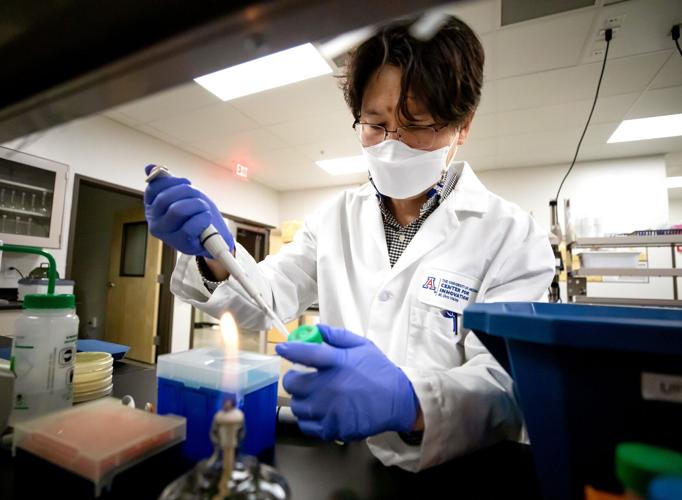
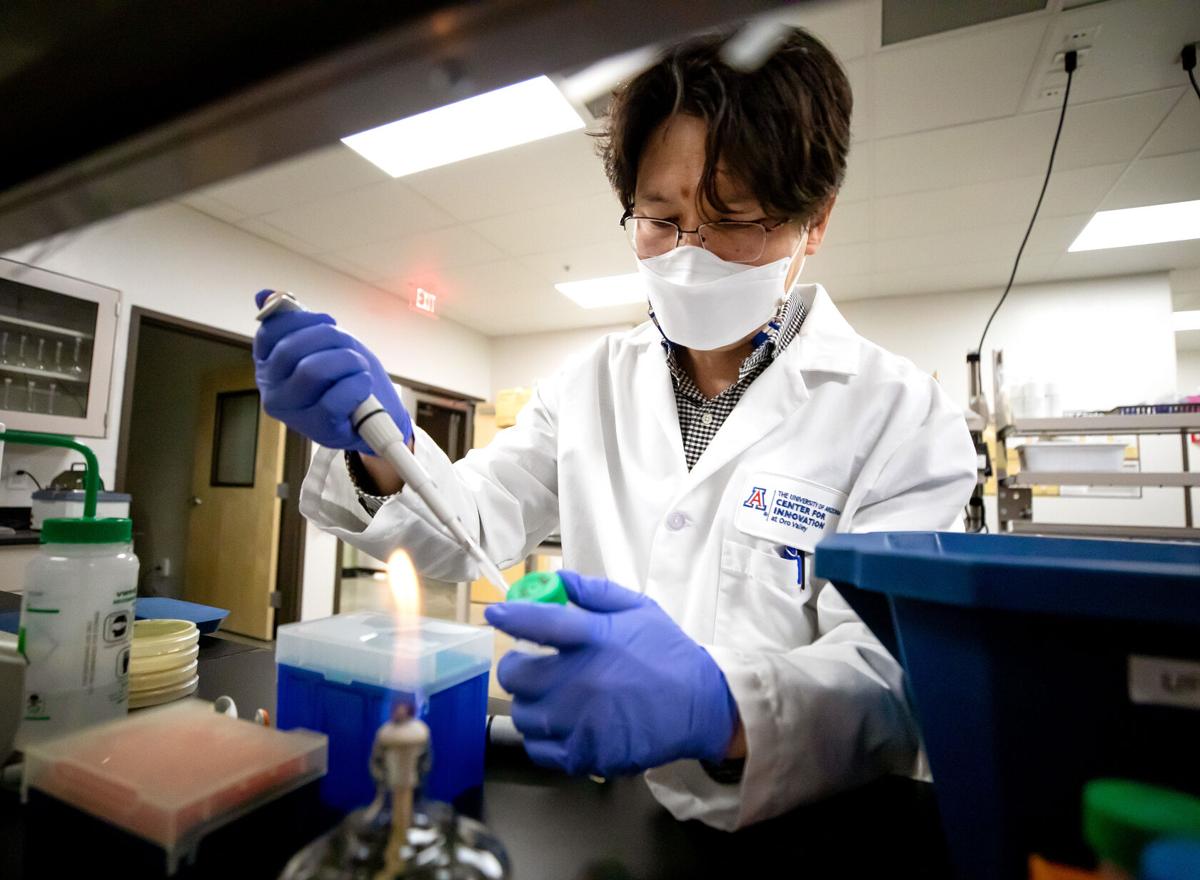
uPetsia uses shared labs at the UACI-Oro Valley and recently hired Choong-Hwan Ryu, a molecular biologist and longtime UA postdoctoral researcher, as its laboratory director.
TLA Associate Vice President Doug Hockstad called uPetsia’s Purina award a great achievement.
“This team has taken an innovation that started as a scientific idea and worked tirelessly to bring it to the world,” Hockstad said. “We’re excited to see their vision and impact coming to fruition, and gratified that market leaders like Purina are recognizing that excellence, as well.”
The four other Purina prize-winning startups boast some cool pet innovations, too:
Minnesota-based Bright Planet Pet makes 100% plant-based dog treats that taste and smell like meat; FluentPet of San Diego has developed an electronic device that allows dogs, cats and other animals to communicate with humans; Los Angeles-based Paway launched a social network just for dogs; and Boston-based QSM Diagnostics has developed disposable sensors to quickly diagnose bacteria infections in dog and cats.
Photos: New Star/Citizen building and downtown Tucson in 1954
Star/Citizen/TNI building, 1954
Updated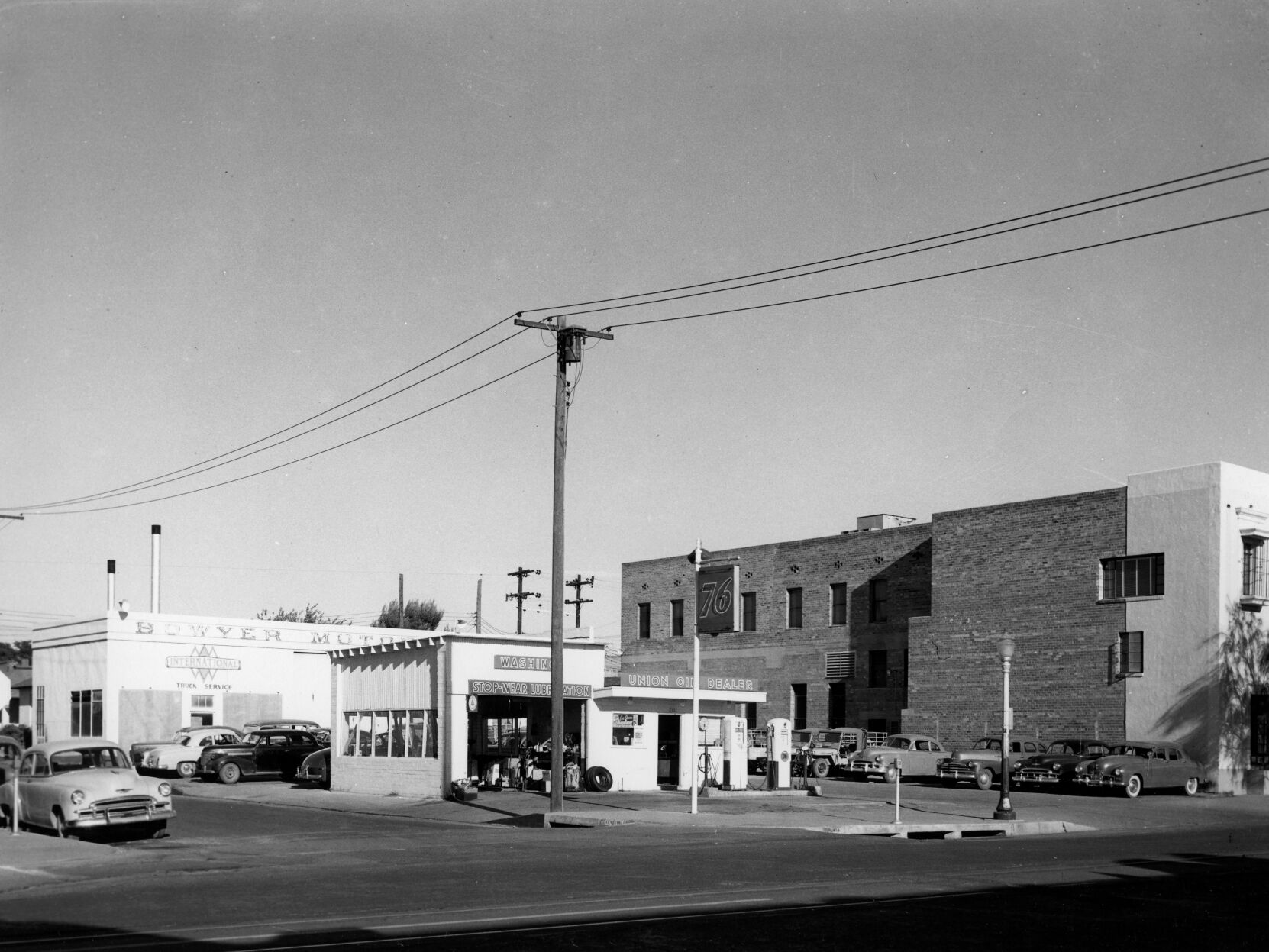
A Union 76 service station and Bowyer Motor Co. (behind) on Miltenberg Street and Stone Ave. were demolished in 1953 to make way for the addition to the Tucson Newspapers building (Arizona Daily Star and Tucson Citizen) in 1953. Bowyer Motor Co. moved to Stone and Mabel.
Star/Citizen/TNI building, 1954
Updated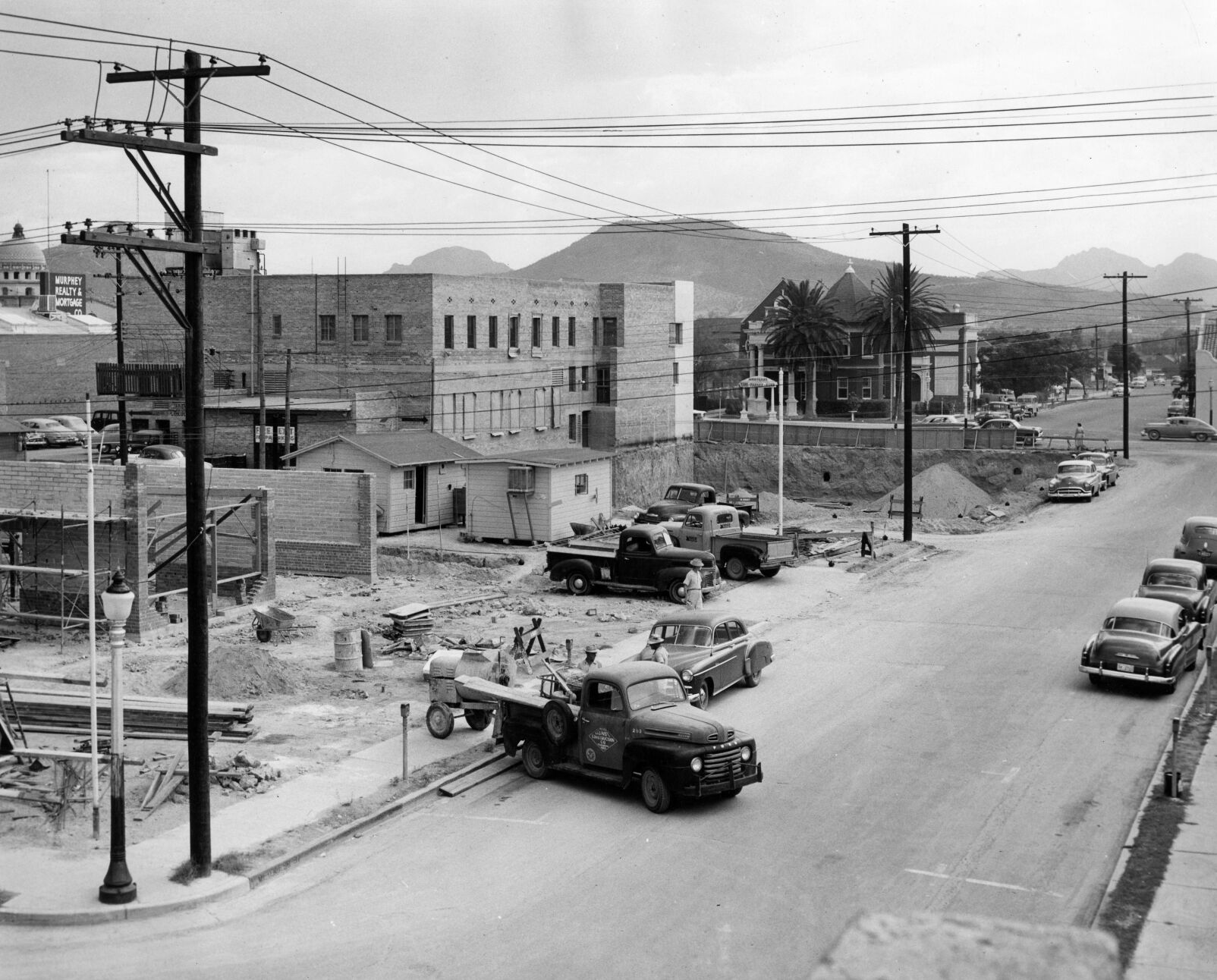
Excavation for the addition to the Tucson Newspapers building (Arizona Daily Star and Tucson Citizen) at 208 N. Stone Ave. in 1953. Looking West on Miltenberg Street from the rear of the building. A service station is under construction at left.
Star/Citizen/TNI building, 1954
Updated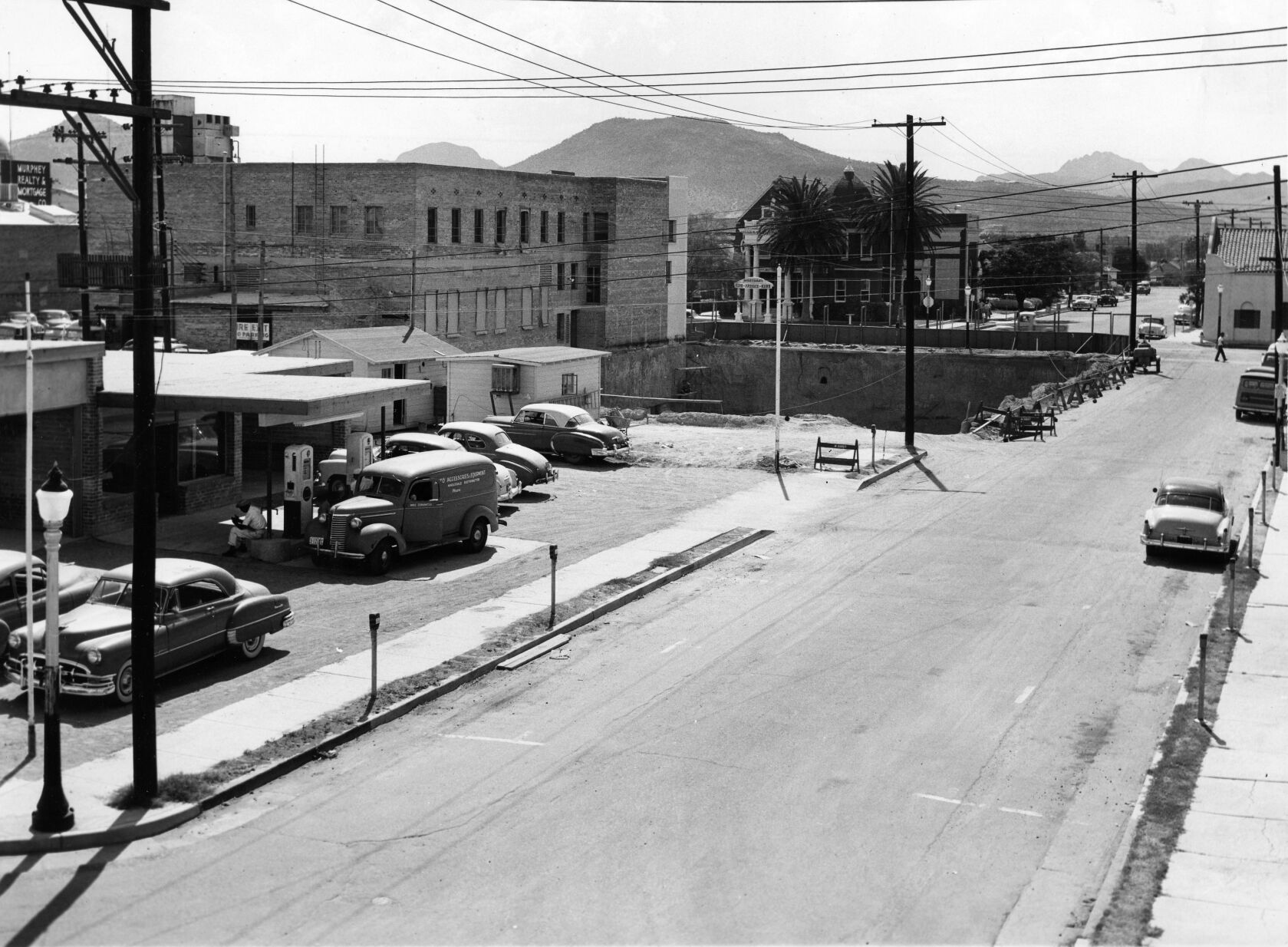
Excavation for the addition to the Tucson Newspapers building (Arizona Daily Star and Tucson Citizen) at 208 N. Stone Ave. in 1953. Looking West on Miltenberg Street from the rear of the building. Note the completed service station at left.
Star/Citizen/TNI building, 1954
Updated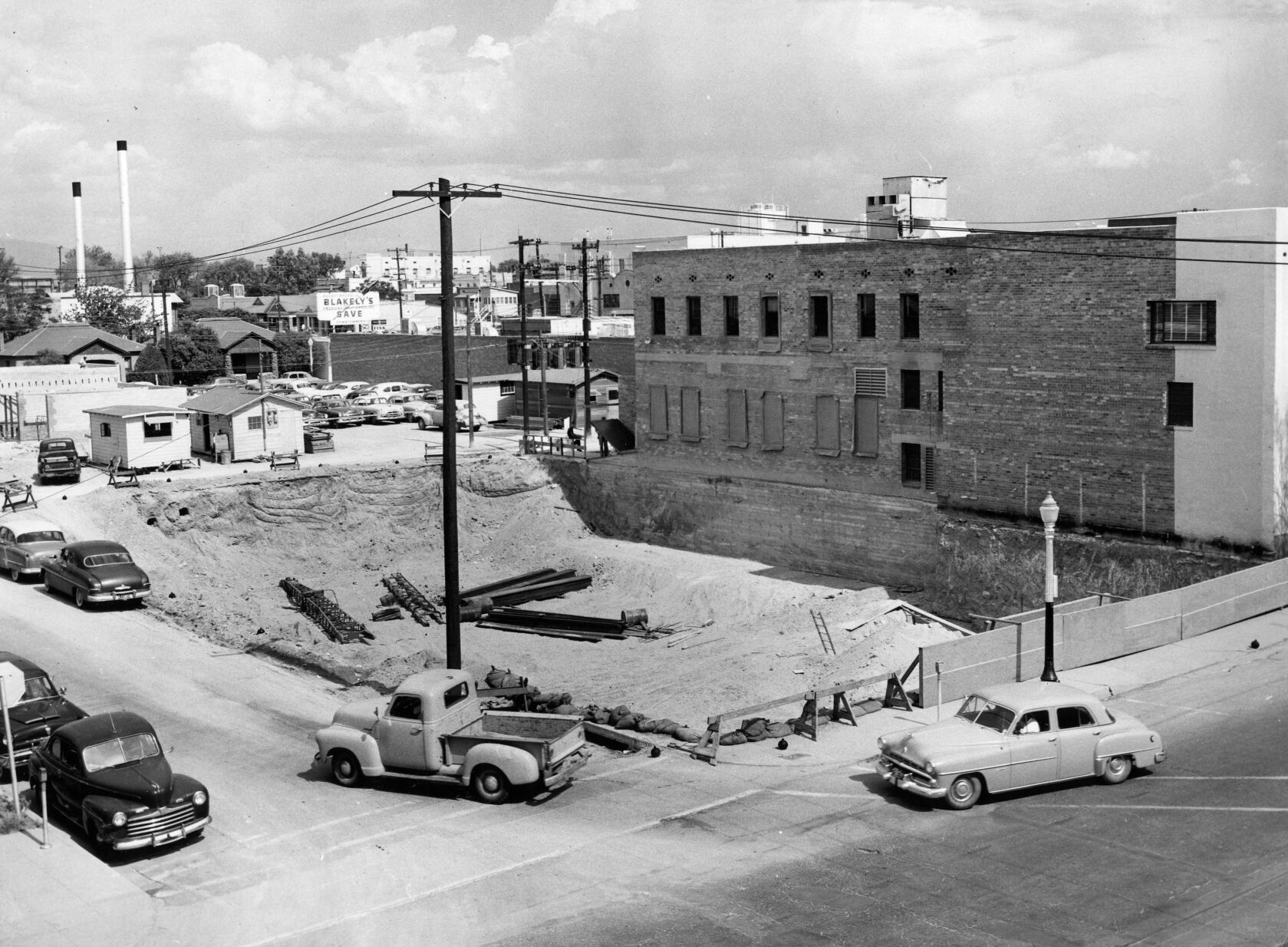
Excavation for the addition to the Tucson Newspapers building (Arizona Daily Star and Tucson Citizen) at 208 N. Stone Ave. in 1953. Looking southeast from the corner of Stone Ave. and Miltenberg St.
Star/Citizen/TNI building, 1954
Updated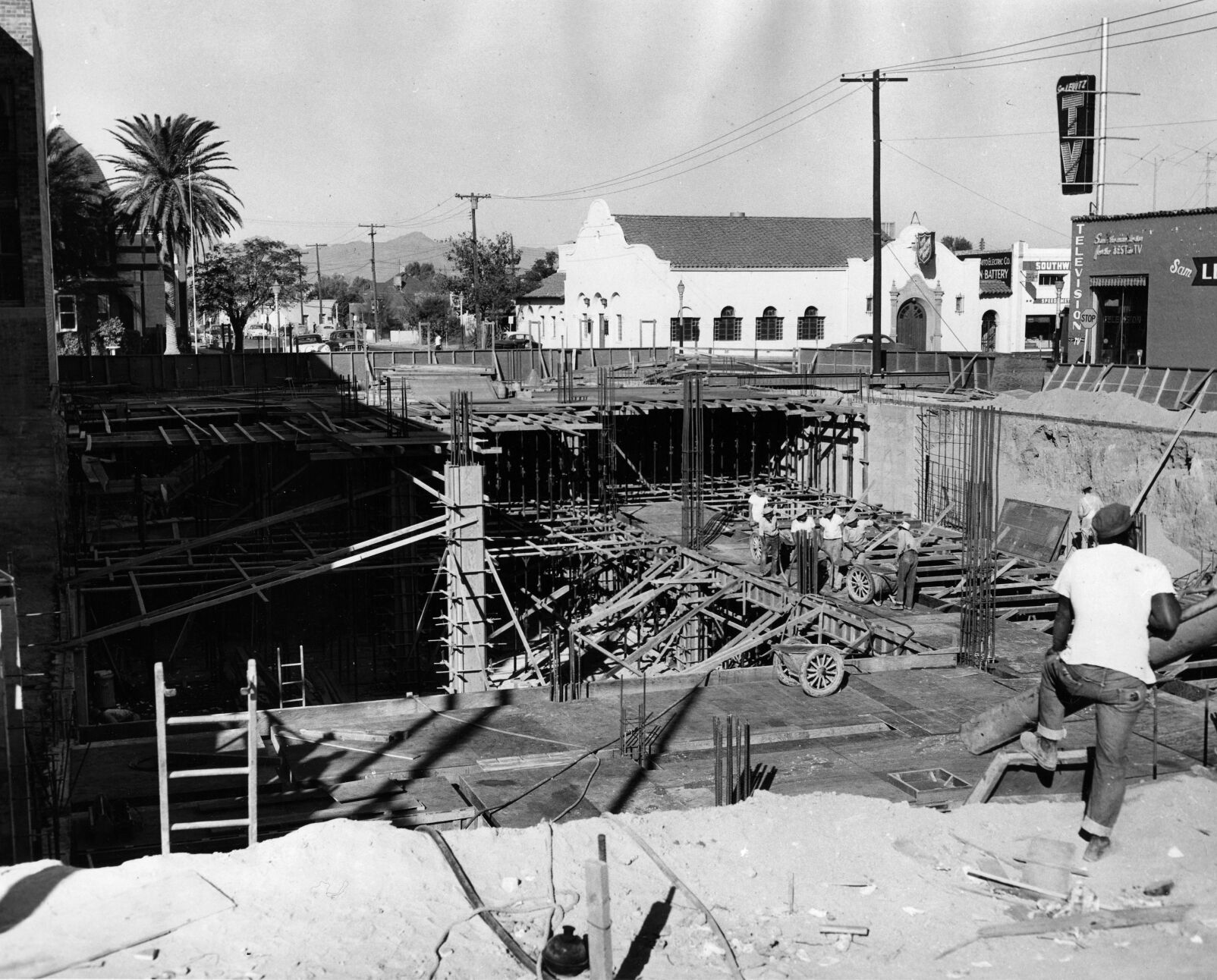
Wooden forms for poured concrete and steel rebar for supporting columns are constructed at the addition to the Tucson Newspapers building (Arizona Daily Star and Tucson Citizen) in 1953. Looking west from towards Stone and Council.
Star/Citizen/TNI building, 1954
Updated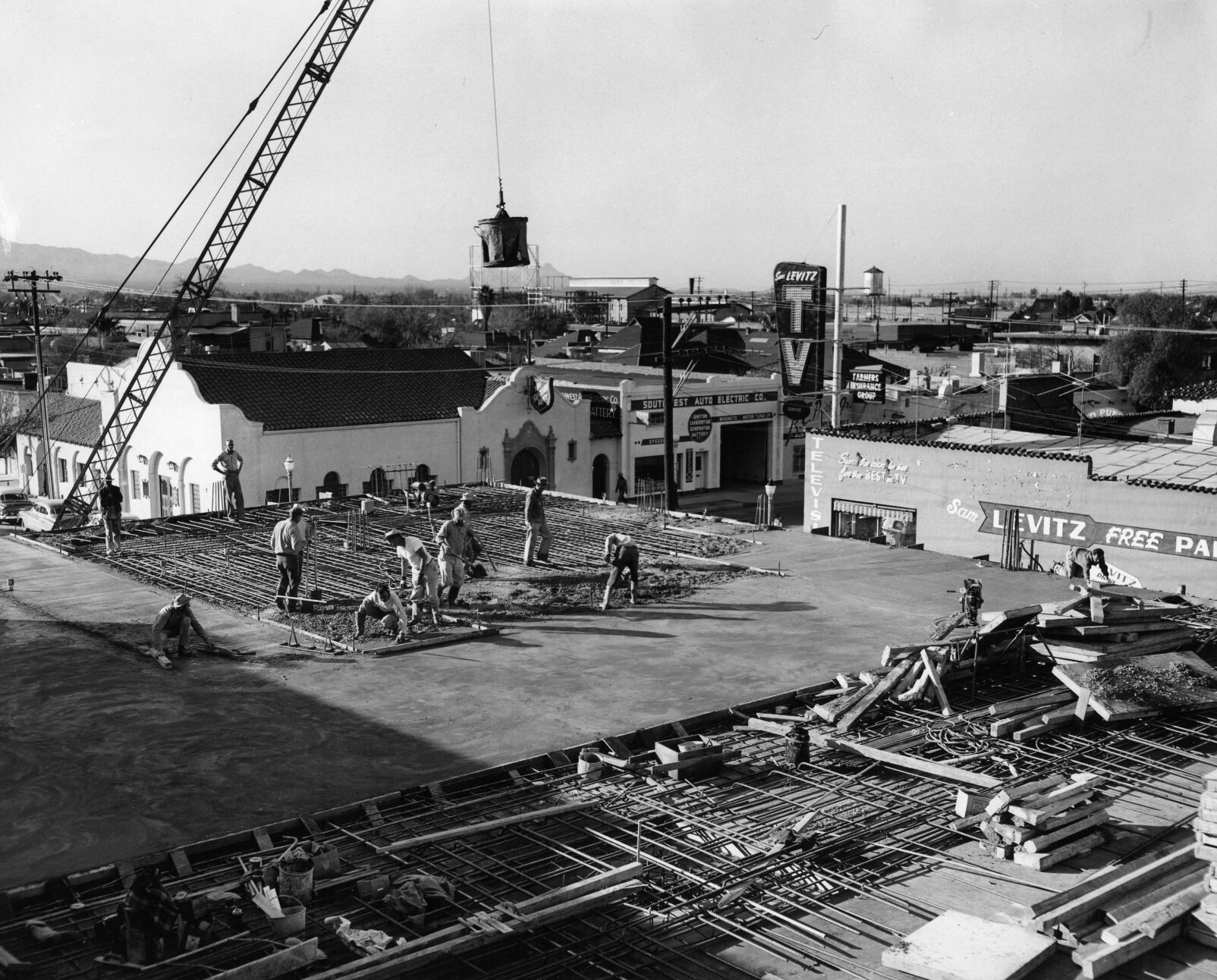
Concrete pour for the second floor of the addition to the Tucson Newspapers building (Arizona Daily Star and Tucson Citizen) in early 1954. No pump trucks in these days. It was one bucket at a time. Looking northwest. None of the buildings across the street exist today
Star/Citizen/TNI building, 1954
Updated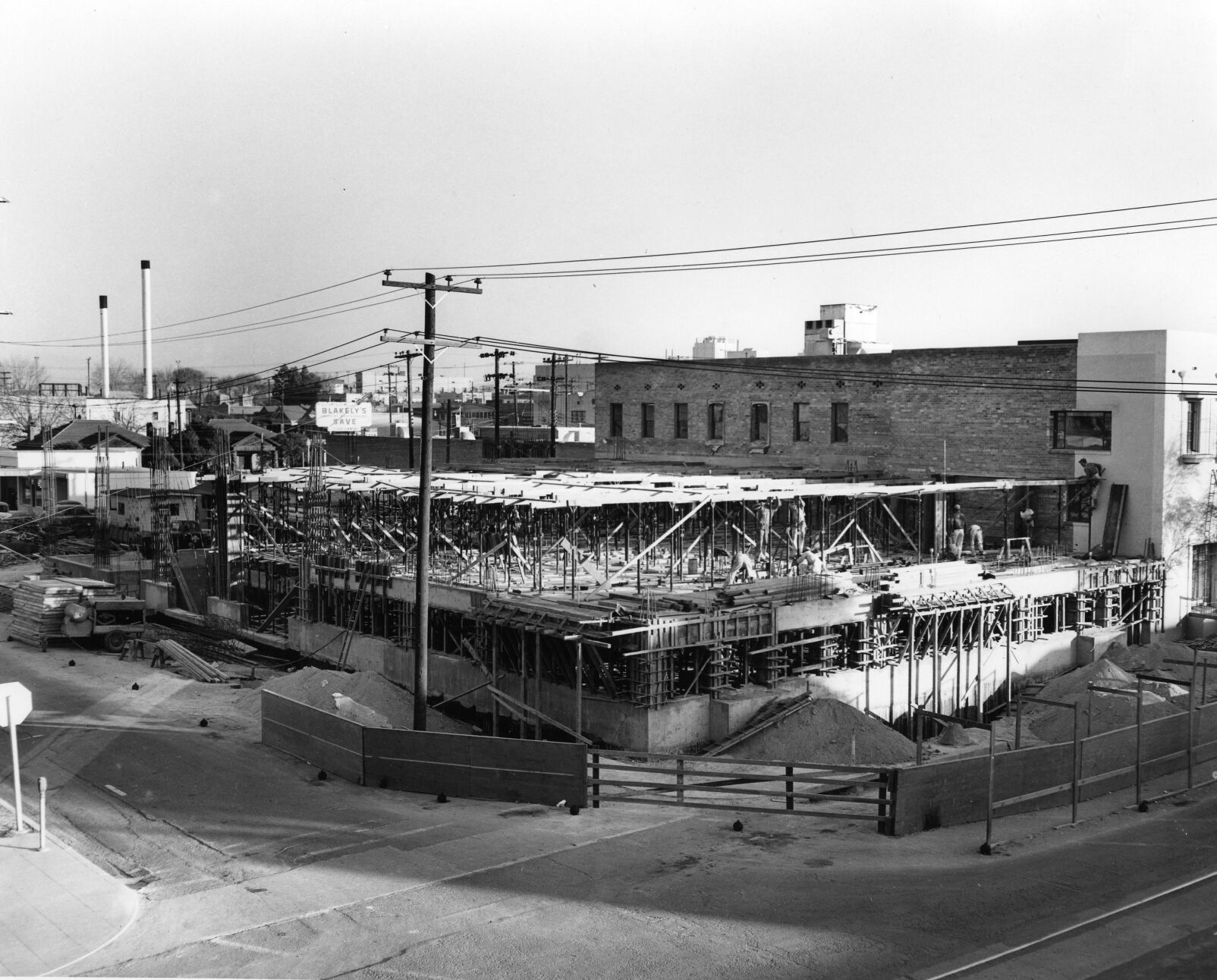
Forms for the third floor concrete deck are constructed for the addition to the Tucson Newspapers building (Arizona Daily Star and Tucson Citizen) in late 1953.
Star/Citizen/TNI building, 1954
Updated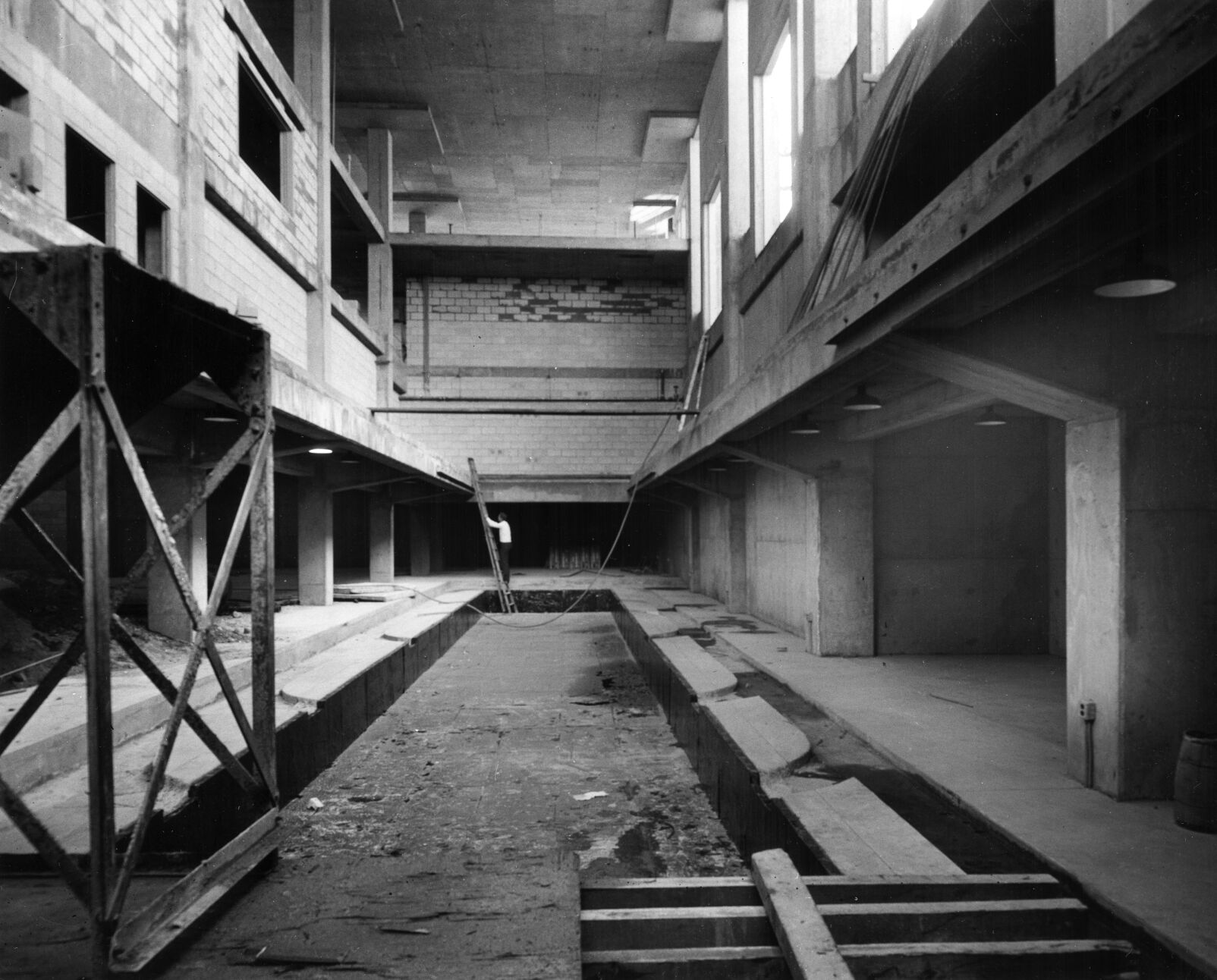
The bay for the new 4-story Goss printing press in the addition to the Tucson Newspapers building (Arizona Daily Star and Tucson Citizen) in 1954.
Star/Citizen/TNI building, 1954
Updated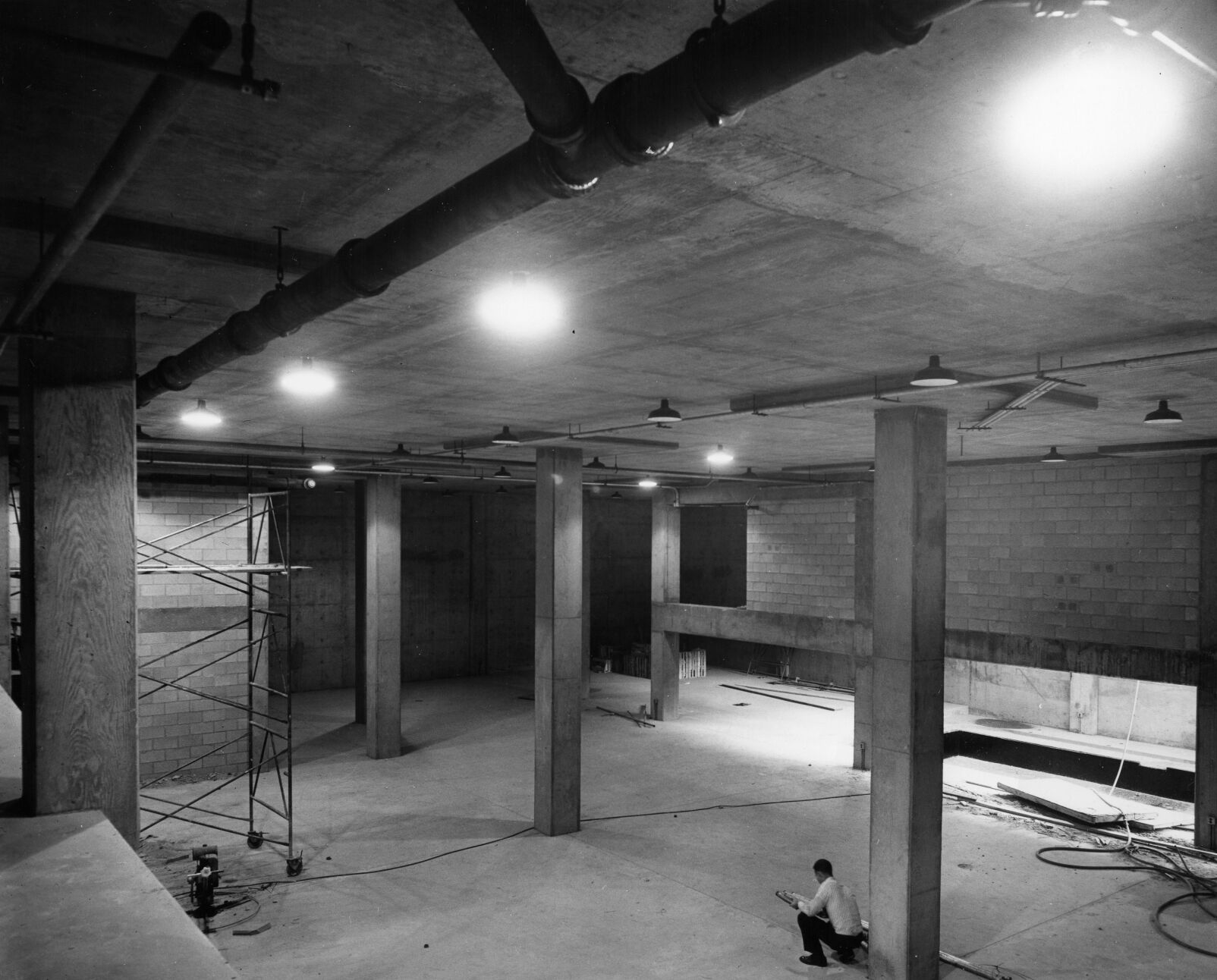
The newsprint warehouse was built to hold 900 tons of newsprint, as part of the addition to the Tucson Newspapers building (Arizona Daily Star and Tucson Citizen) in 1954.
Printing press for Tucson Newspapers
Updated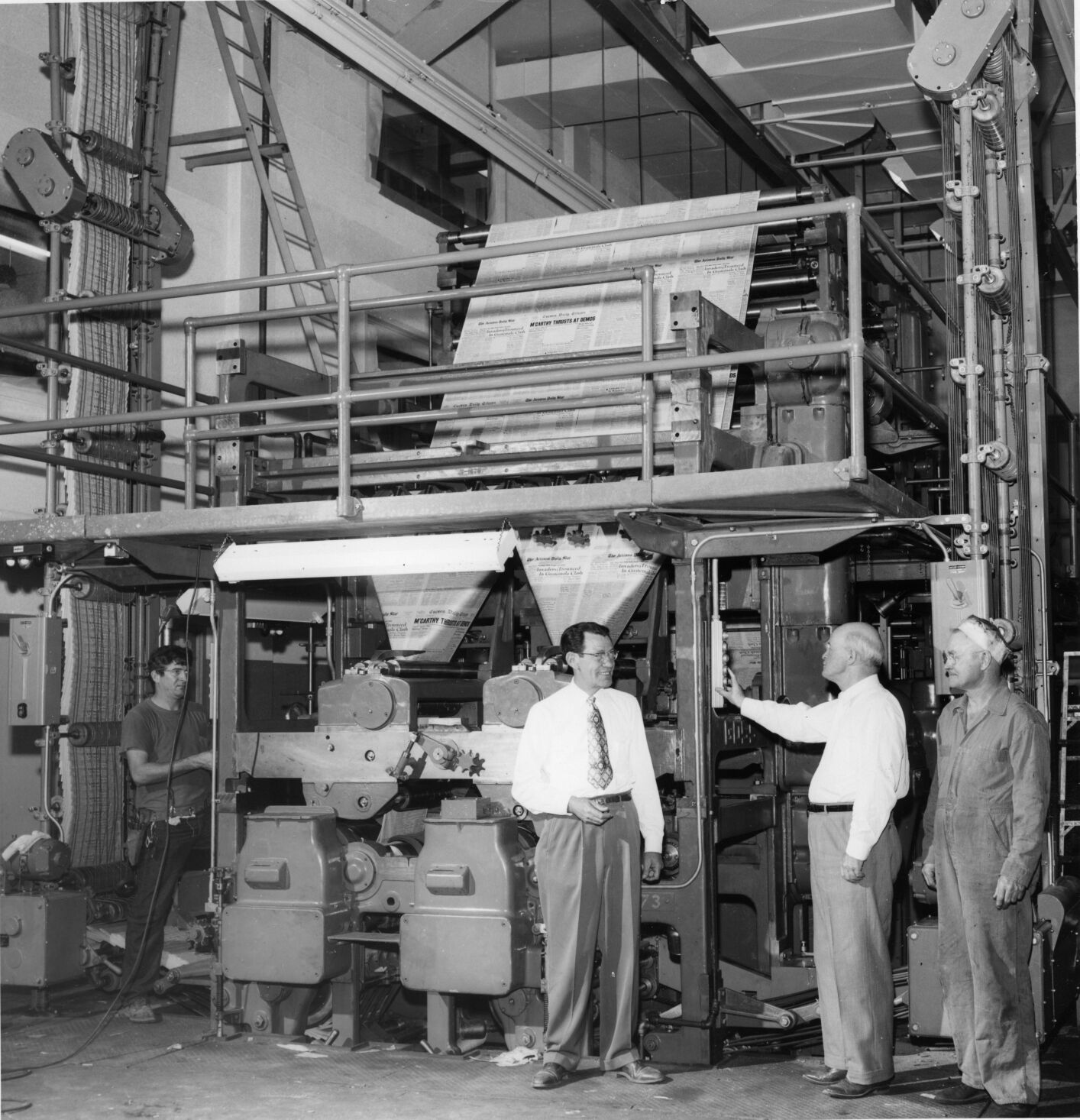
William R. Mathews, editor and publisher of the Arizona Daily Star, pushes the button that starts the New Tucson Newspapers' Goss Headliner presses in the company's new building at 208 N. Stone Ave. on July 4, 1954. The entire Star/Citizen mechanical departments were moved from the one building to another in 17 hours.
Star/Citizen/TNI building, 1954
Updated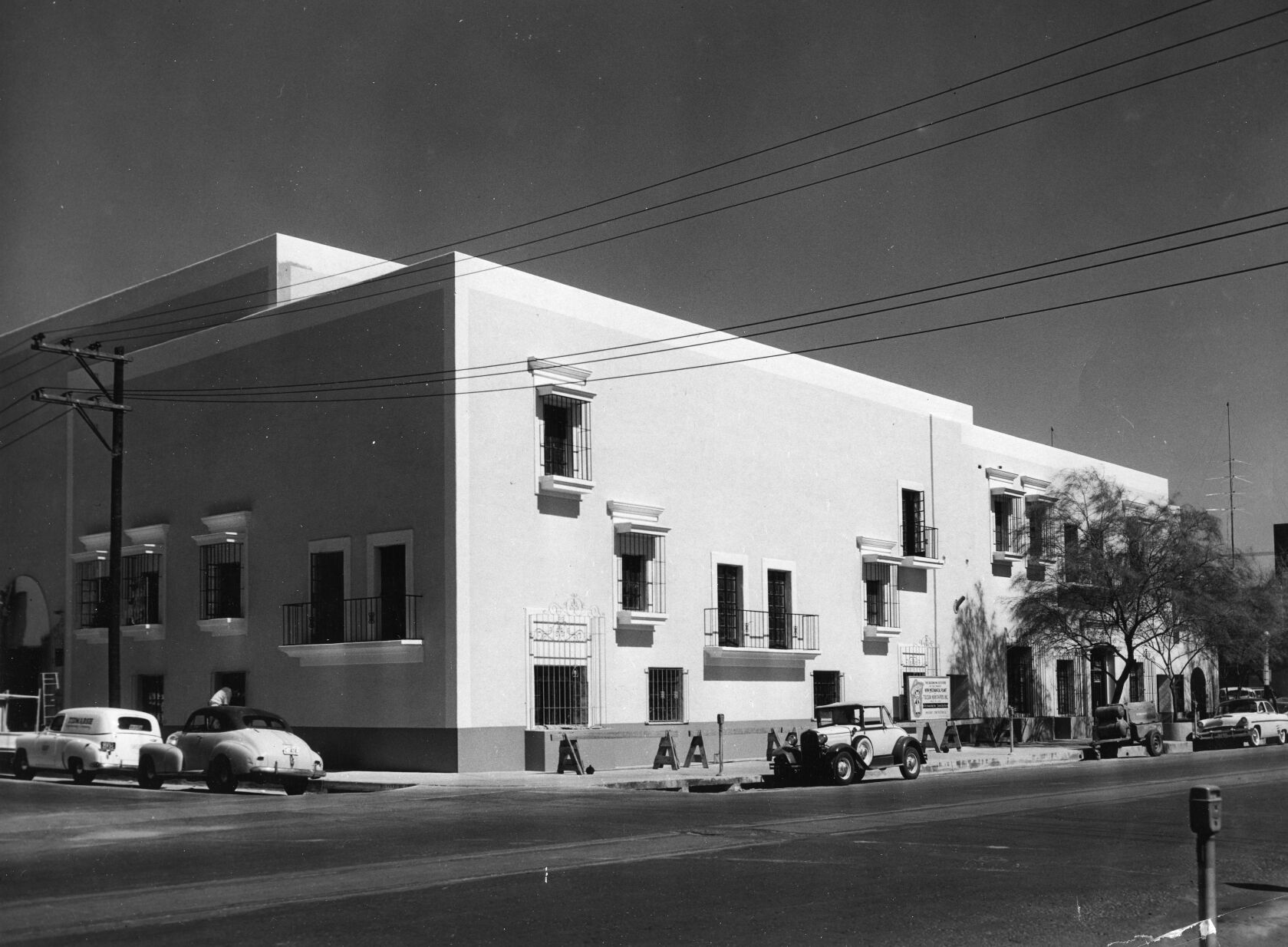
The completed exterior of the addition to the Tucson Newspapers building (Arizona Daily Star and Tucson Citizen) in 1954.
Star/Citizen/TNI building, 1954
Updated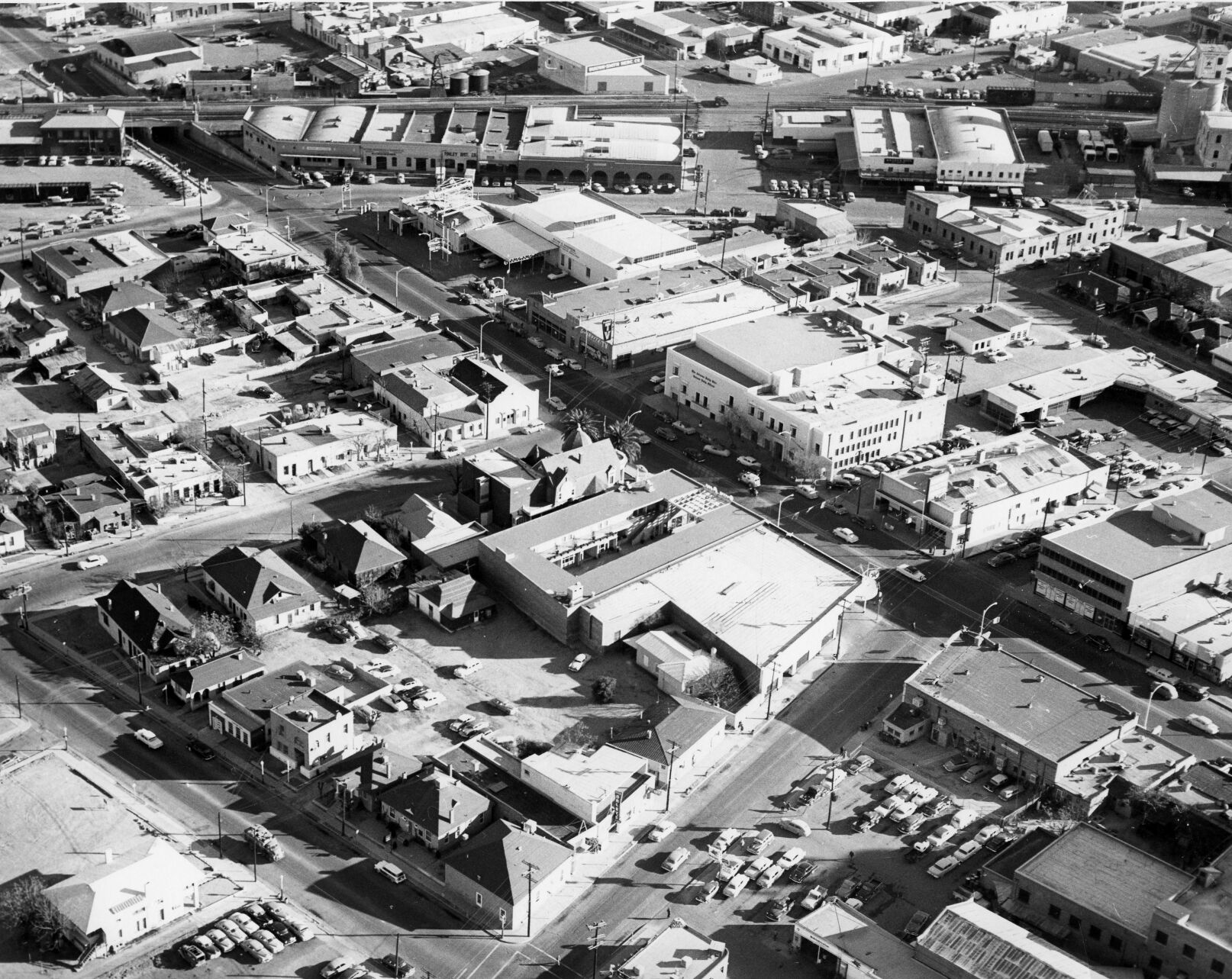
Aerial photo of downtown Tucson showing the completed Tucson Newspapers building (Arizona Daily Star and Tucson Citizen) in 1955. The newspaper is center right (white building). The Pima County Consolidated Courts building and parking garage now occupy roughly the same area down to Toole Ave. (upper left). Miltenberg Street, to the north of the TNI building, became part of Council Street in 1960.
Star/Citizen/TNI building, 1954
Updated
Aerial photo of downtown Tucson showing the completed Tucson Newspapers building (Arizona Daily Star and Tucson Citizen) in 1955. The newspaper is lower right. The Pima County Consolidated Courts building and parking garage now occupy roughly the same area. Miltenberg Street, along the bottom of the photo, became part of Council Street in 1960. It was demolished in recent years during redevelopment.

