





Our former colleague Ignacio Ibarra has been seeing military helicopters fly by his house south of Bisbee, near the Mexican border.
Some are Blackhawk helicopters, but not the kind used by Customs and Border Protection, and some are even bigger, said Ibarra, who covered border issues for the Star for decades.
“The other day, I saw one that looked like it would carry 8 or 10 passengers,” he told me Friday.
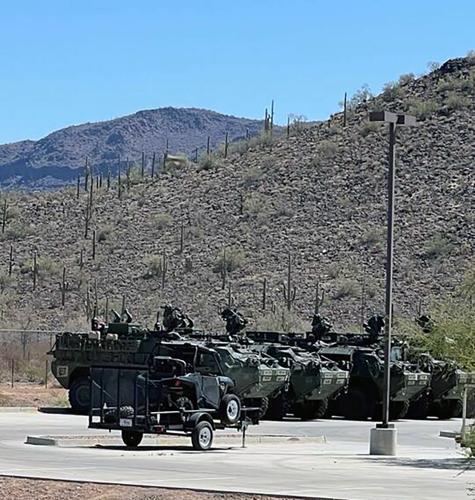
It’s just one sign of the large interdiction force and effort that is building up along the U.S.-Mexico line. Another sign appeared to the west of Tucson, at the U.S. Border Patrol station near Why, last week: A line of at least five apparent U.S. Army Stryker vehicles.
The federal government has been amassing a force to fight migration and the supply of illegal drugs across the U.S.-Mexico border. They’ve assigned the strip of land along the border to the military, designated the drug cartels as foreign terrorist organizations, threatened military strikes inside Mexico and imposed tariffs (but removed them in some cases) as an effort to reduce the supply of fentanyl.

U.S. Army Stryker vehicles were recently parked at the Border Patrol station near Ajo.
While this massive effort to fight the supply has grown, though, the efforts to reduce demand for illegal drugs like fentanyl are withering or endangered. The Trump administration proposed in its budget released Friday to eliminate the federal agency that fights drug abuse. It has also proposed to cut a $56 million grant to distribute the overdose-fighting medication naloxone and train emergency responders.
Perhaps the biggest threat: The proposed massive cuts to Medicaid, which is the biggest payer of substance-use disorder treatments in the country. The existing congressional spending resolution proposes cuts of up to $880 billion, though that is being debated heavily in Congress.
The policy shift back to fighting supply is a return to our decades-old Drug War focus. This free spending on stopping supply combined with penny-pinching over reducing demand strikes Dr. Melody Glenn as the wrong formula.
“I really think that our country’s drug policy should be focusing on addiction treatment, the medical model of addiction as a disease,” said Glenn, an addiction-treatment specialist and emergency physician at Banner-University Medical Center and assistant professor at the UA medical school. “Doing so will reduce the demand for illicit substances. I recommend that over focusing on the supply side.”
Ground zero for drug policy
All these issues flow together in the Tucson area and Southern Arizona. We have the increasingly fortified Mexican border to the south, we have a city saturated in drugs and addiction, and we have a wealth of treatment centers scattered across the area.
Patrick Sullivan moved from rural Illinois to Tucson in 2008, a move that might have been risky for someone like him at the time.
“When I moved out there, I was active in my opioid use. I was doing heroin,” he said.
But rather than becoming mired in Tucson’s drug scene, he went the opposite direction. He went into methadone treatment in May 2009 — and stayed sober. He ended up working at treatment centers in Tucson, circling back to work for the company that had helped him get sober in 2009, Community Medical Services, before moving back to Illinois to continue working for them there in 2022.
“Treatment around here (in rural Illinois) was you grin and bear it. You go cold turkey,” Sullivan said. “I had done that a few times, but I got to the point in my addiction where I couldn’t do that anymore.”
Now he’s the correctional health programs director for the same company who treated him 16 years ago. While his own treatment was paid for privately, that’s not the case with most patients he’s seen go through medical drug treatment, Sullivan said.
“The vast majority that are on this kind of treatment are funded through Medicaid and grant funding,” he said.
While Medicaid funding is only threatened right now and hasn’t disappeared, some money has also been stricken from the system, Community Medical Services’ CEO, Nick Stavros, noted. About $12 billion in grants made under pandemic programs that were destined for addiction and behavioral health services were canceled a month ago.
“Now it’s in court. The executive order itself is being contested,” Stavros said. “It doesn’t mean the money’s gone. The cash is gone. We don’t have the cash we were counting on.”
That’s already hurting some treatment centers. Aimee Graves, CEO of The Haven, said the agency lost three positions and a program for alumnae of The Haven as a result of that cut.
Theory meets budget cuts
Based on the statements Robert F. Kennedy Jr. has made so far, you would think the Trump administration would be leaning toward greater support of drug treatment.
Kennedy, secretary of the Department of Health and Human Services, recounted his 14 years as a heroin addict in a speech April 24 to the RX and Illicit Drug Summit in Nashville, a conference focused on addressing the opioid crisis.
“We have to do all the nuts-and-bolts things that you are all involved in, the practical pragmatic things,” Kennedy said. “We need suboxone, we need methadone we need naltrexone, we need Narcan, we need good fentanyl detectors that can detect it on pills, etc. so the kids are less likely to overdose. We need prevention, we need education, and we need treatment.”
He added, more esoterically, though, that he thinks “Throwing money at it alone is not going to work. We need to focus on re-establishing these historic ties to community. We have this whole generation of kids who have lost hope in their future.”
Asked to elaborate on the department's position, spokesmen sent a statement after initial publication of this column saying: "The Secretary understands the vital role of federal programs in saving lives and promoting recovery. The Substance Abuse and Mental Health Services Administration (SAMHSA) will continue under the Administration for a Healthy America (AHA).
"By consolidating SAMHSA's operations under AHA, we aim to streamline resources and eliminate redundancies, ensuring that essential mental health and substance use disorder services are delivered more effectively. This restructuring will enhance the ability to address public health needs by fostering a more coordinated approach to prevention, treatment, and recovery services."
Any efforts to bolster drug treatment are running into the buzz saw of the so-called Department of Government Efficiency’s effort to slash spending all over the federal government.
Everywhere, that is, except in the militarized parts. Trump’s proposed budget revealed Friday would increase spending in the Department of Homeland Security by about $44 billion and increase spending in the Defense Department by $113 billion.
The people with the guns get more money. The people with the medicines and counseling get less.
‘An entire iceberg underneath’
One of the misunderstandings people have of our drug problem is that it is reflected mostly in the street people we see begging on corners, camping in washes, or using at bus stops.
At an April 22 discussion by the Tucson City Council of how to spend money from an opioid-lawsuit settlement, council member Lane Santa Cruz said this is not the case.
“I know there’s a perception that a lot of our unhoused neighbors are the ones using, but that’s what we see, visible,” she said. “There is an entire iceberg underneath that of folks in our community who are also dealing with this that we don’t see, because they’re doing it behind closed doors.”
It’s that whole population that people like Stavros, the Community Medical Services CEO, and Glenn, the UA physician, would like to see getting access to proven treatments.
“We have extremely, extremely effective medicines, more effective than pretty much anything else we have for almost any other chronic disease,” Glenn said, referring to buprenorphine and methadone.
The results, she said, include “Reduced deaths. Keeping people in treatment. Reduced risky behavior. Reduced side effects of drug use. They’re very effective, affordable medications, but very underutilized.”
Missing an opportunity?
The attacks on supply can prove beneficial to reducing demand, too, because of how it affects the local illicit markets where users get their drugs, Stavros said.
“When there’s a drug seizure, we see more people seeking treatment,” he said.
That’s because the drugs may become temporarily unavailable from their usual sources.
But treatment has to be available for those who want it. Stavros’ company has 26 centers in Arizona alone. He said 75% of the patients have their treatment paid for by Medicaid and about 10% by federal grants. That payment system is what’s in doubt now.
And it’s what could solve the problems experienced by Ibarra, who told me he has had guns and bicycles stolen that he suspects were taken by residents of his area.
“My concern isn’t stuff coming across the border,” he said. “It’s the fentanyl in the houses in and around my neighborhood.”
If we don’t reduce users’ demand, no amount of military buildup is going to stop that supply.

