


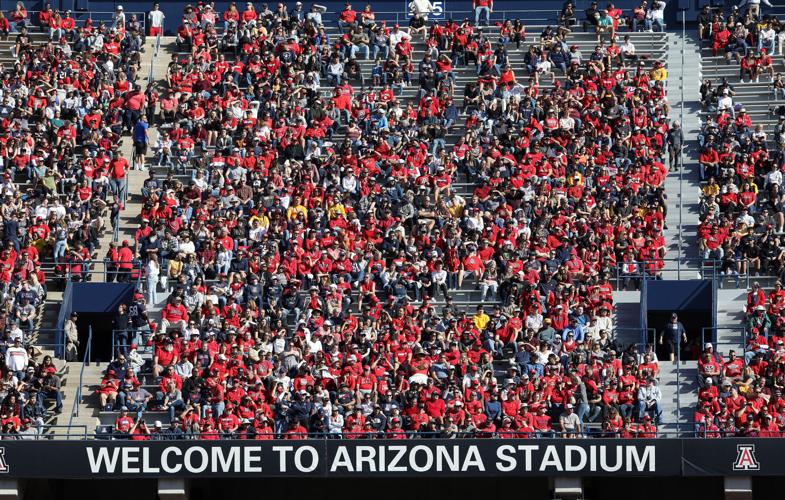


The University of Arizona’s athletic department should raise ticket prices and sell the naming rights to the football stadium to raise up to $18 million in new revenue, outside consultants say in a new report.
The UA’s athletic department is closing its fiscal year with a deficit of more than $30 million. Following the report’s recommendations for generating new revenue — while also saving $3.5 million to $6 million on “cost efficiencies” — could take up to five years, consulting firm Ernst & Young says in its report compiled for the school.
If no action is taken, the report warns, the deficit could grow to $35 million next year.
Over the past five years, the athletic department’s expenses have “grown at three times the rate of revenues, and faster than expenses at peer institutions,” according to the report.
“Arizona Athletics is inconsistent in the way it classifies accounting transactions which in turn inhibits the department’s ability to provide budget-to-actual spending reports quickly and accurately,” the report says.
When a new fiscal year starts, sports programs “may already find themselves in deficits,” which means that “many coaches have not seen a clear, realistic budget for over three years.”
This in turn, the report states, “creates a context where Arizona Athletics employees do not trust the budget.”
Other findings include that the athletics development office “receives less gift revenue and employs more staff” than peer departments and that its ticketing pricing tool is “relatively basic” compared to its peers.
The UA athletics department revenue has grown 3.1% annually between fiscal year 2019 and 2023, which is lower than the median peer benchmark growth rate of 4.5%. The only schools lower in the Big 12 than the UA are the University of Kansas, West Virginia University and Arizona State University.
Compounding that situation, the athletics department had the second-highest growth in expenses among Big 12 peers. The UA’s expenses grew at a rate of 9% annually. The median growth rate in the conference was 5.6%.
“Arizona Athletics’ internal operations — lack of clarity on budget processes, insufficient spending controls, gaps in approval processes and limited coordination across sports programs — have also led to spending growth beyond the rate of revenue generation,” the report says.
“While Arizona Athletics has contained costs, financial pressures are expected to increase, in part due to recent settlements related to student-athlete revenue sharing that could add up to (approximately) $20 million in annual costs for athletics departments.”
Additionally, the outside firm found that travel, meal and recruiting costs at the UA have grown faster than costs at other peer institutions.
The university spent approximately $11 million on team travel (hotels, flights, meals and ground transportation) last year, which was the highest among Big 12 peers for both fiscal year 2022 and 2023.
Meals (non-travel) have seen the highest rate of growth among sports program spending categories at 18%, with the athletics department using in-house options for just 29% of non-travel meal spending.
Coaches and budget managers do not receive regular, up-to-date reports that would “allow them to make informed decisions about where to adjust spending throughout the year,” which is unusual compared to peer institutions.
And, though the athletics department’s corporate sponsorship, advertising and licensing revenue was above the Big 12 median, the highest-earning schools in the conference receive approximately double the revenue that the UA does.
Ticket data
Ticket sales in fiscal year 2023 represented about 19% of revenue generated by the athletics department. According to the report, historically:
Close to 90% of ticket sale revenue comes from football (50%) and men’s basketball (40%).
On average, 60% of football’s ticket sales were seats for individual games, while 40% were season ticket holder packages.
On average, 30% of men’s basketball’s ticket sales were seats for individuals games, while 70% were season ticket holder packages
Arizona Athletics recently implemented ticket price increases in its football and men’s basketball programs to be close to the Big 12 median. Starting this year, football ticket prices will increase by 15%-40% and for men’s basketball there is a planned 20% increase for tickets in all sections.
While attendance at Arizona football games has increased in recent years, it is below the median of Big 12 schools. Men’s basketball, on the other hand, places ranks third highest among Big 12 schools.
One recommendation from the report suggests “adjusting single-game pricing for multiple variables such as time and opponent to capture value,” which it states could be “particularly useful for football.”
Revenue opportunities
The report estimated that if the UA athletics department restructures its development office to “align with benchmarks for efficiency, rebalance portfolios” and increase goals, the department could expect to make $9 million to $10 million in the next one to five years.
The department can expect to make between $2 million and $5 million in the next one to three years if it increases football attendance, explores strategies to enhance dynamic pricing and optimizes return from complimentary ticketing strategies.
Finally, the report suggests launching an in-house multimedia rights model to “strengthen connections with corporate sponsors, elevate Arizona Athletics’ brand and enhance values to partners” as well as “explore opportunities to monetize naming rights for McKale (Center) and the football stadium” to make between $2 million and $3 million in the next one to five years.
If the UA is able to reduce personnel-related opportunities and better manage its travel, meals and recruiting budgets, it can expect to save between $3 million and $6 million in the next one to three years, as well, the report states.
Arizona athletic director Desireé Reed-Francois sat down with the Star this week to talk about her plan for UA athletics, the future of college sports, Arizona football and the Big 12, among other things. (Video by Justin Spears / Arizona Daily Star)



