



PHOENIX — In a lawsuit filed Friday, Arizona Gov. Doug Ducey contends President Theodore Roosevelt had no legal right to simply declare all that land along the border, now known as the Roosevelt Reservation, to be the property of the federal government.
“Article II of the U.S. Constitution does not explicitly provide for the president to exercise his executive power to secure land or property without congressional approval,’’ wrote Brett Johnson, a private attorney Ducey has repeatedly hired in his legal battles with Washington. That didn’t change simply because Roosevelt declared his act to be for the benefit of “public welfare,” Johnson told U.S. District Court Deborah Fine.
“Accordingly, the Roosevelt Reservation was outside of President Roosevelt’s authority at issue, and as such is unconstitutional as a matter of law and has no force or effect,’’ the lawsuit contends. More to the point, Johnson said it “conflicts with the state’s sovereignty of that land.’’
The dispute is more than academic.
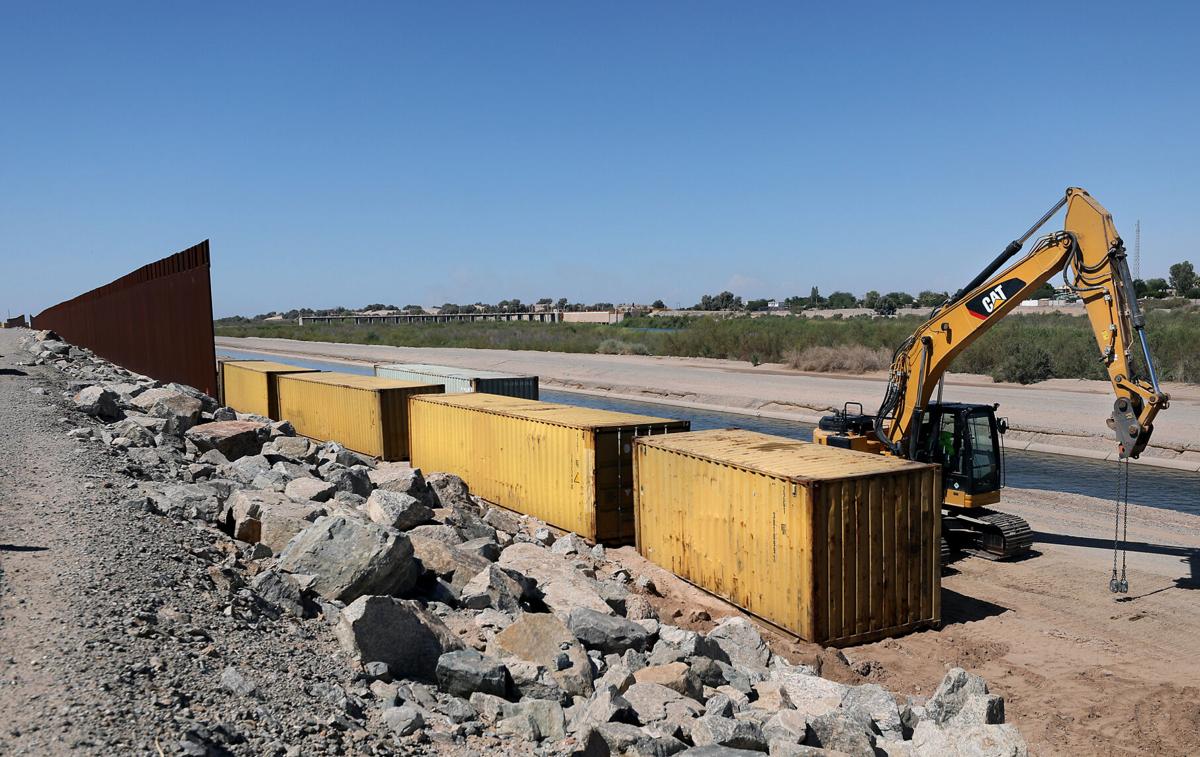
Officials from the Bureau of Reclamation are demanding that the state remove the double-high wall of shipping containers it has placed along a 3,820-foot gap in the border wall near Yuma, saying the state has trespassed against the United States. A dispute is also brewing with the Forest Service over the governor’s plans to close a 10-mile gap in Cochise County in the Coronado National Forest.
If the judge declares the Roosevelt Reservation to be invalid, that would eliminate the ability of federal officials to block the state’s actions.
“With this lawsuit, we’re pushing back against efforts by federal bureaucrats to reverse the progress we’ve made,’’ the Republican governor said in a prepared statement. “The safety and security of Arizona and its citizens must not be ignored.’’
Ducey has pointed out that the federal government was building a border barrier until President Joe Biden, on his first day in office, halted construction.
The Biden administration announced earlier this year it will close some of the gaps that remain in that wall. But Ducey has noted the lack of action to date.
“Arizona is going to do the job that Joe Biden refuses to do — secure the border in any way we can,’’ Ducey said. “We’re not backing down.’’
Ducey’s lawyer is not relying exclusively on what could be an uphill battle to get federal courts to void the conditions that already were in place when Arizona became a state in 2012, five years after Roosevelt’s actions.
“Even assuming the Roosevelt Reservation is constitutional (it is not), Gov. Ducey alleges further that when Arizona was admitted to the Union, the United States did not retain exclusive jurisdiction over the Roosevelt Reservation,’’ Johnson wrote. That gives the state “concurrent jurisdiction’’ over the property, he contends.
“Presuming that the Forest Service and Bureau of Reclamation has jurisdiction over its asserted areas of the Roosevelt Reservation, they at most possess an easement over the state’s underlying possession of the land subject to the Roosevelt Reservation,’’ Johnson said. “Accordingly, its attempt to assert sole jurisdiction over the Roosevelt Reservation is outside its scope of authority.’’
And if that doesn’t sway the judge, Johnson has another legal theory of why Ducey can place the storage containers along the border.
That starts with a constitutional requirement for the federal government to “protect each of the state against invasion,” he said.
There’s another provision that allows the state, when “actually invaded or in such imminent danger as will not admit delay’’ to “engage in war,’’ without congressional authority, Johnson said.
That’s precisely the advice that Republican Attorney General Mark Brnovich gave the governor in February. He told Ducey that the “invasion’’ need not be in the traditional sense of a military force but can be applied to “invasion by hostile non-state actors such as cartels and gangs.’’
Ducey did not act on that advice or make such a declaration.
But Johnson told the judge that the governor, in authorizing the state Department of Emergency and Military Affairs to close the gaps, is essentially citing the constitutional provisions.
On one hand, he said, the federal government is not living up to its obligation to protect the state. But at the same time, Johnson said, the actions by the Bureau of Reclamation and the Forest Service prevent the state from defending itself.
“Gov. Ducey seeks a declaration from this court pursuant ... that the state has the constitutional authority to take immediate temporary steps ... to stem the imminent danger of criminal and humanitarian crises related to the Arizona border,’’ the lawsuit states.
Finally, Johnson has one other legal theory he is floating in court. He said the failure of the federal government to act “presents a public nuisance which the state is authorized to abate.’’

