





Some artists spend months or perhaps a few years on a single project.
The UA’s newly named Arizona Arts dean has spent 20-plus years ... and counting.

Elahi
Hasan Elahi began what he calls “my hit song, my version of ‘Free Bird’,” shortly after he was erroneously reported to be a terrorist not long after the 9/11 attacks in 2001.
“Tracking Transience” is not a single work of art but rather a database of sorts containing some 150,000 images taken since Elahi convinced the FBI that he was not a terrorist, as a concerned citizen had suggested.

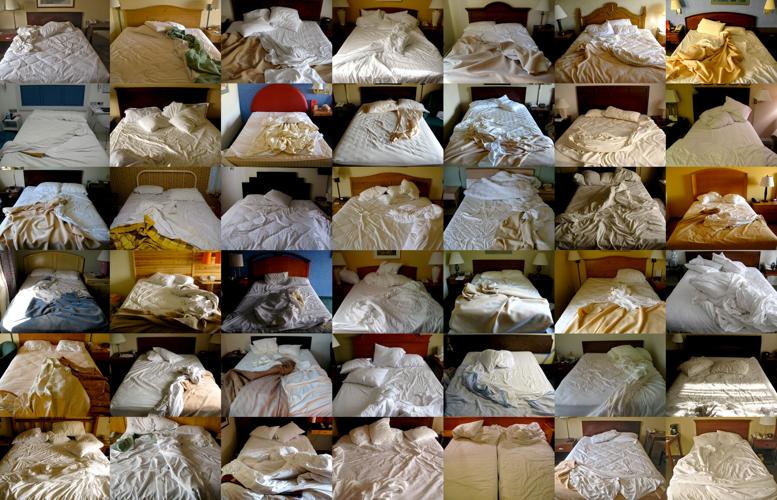
UA Arizona Arts Dean Hasan Elahi spent more than 20 years documenting his whereabouts, including his hotel rooms, for “Tracking Transience.”
“You know, brown guy, Muslim,” Elahi explained.
He was recalling the story in an interview days after the UA named him to replace Andrew Schulz as dean of Arizona Arts, the umbrella for all of the performance and fine arts venues on campus, as well as the College of Fine Arts (schools of music, dance and film and theater).
Elahi, who comes here from Wayne State University in Detroit, spent “six months of my life justifying to the FBI that I was not a terrorist ... justifying every moment of my existence to them.”
In the end, they agreed that he was not a terrorist.
So what now? he asked them. Is there some sort of “I’m not a terrorist” get out of jail free card to show the next airport customs official who pulls him over for closer inspection?

Imagine taking photos of every plane/train meal you had for 20-plus years. This is Hasan Elahi’s world and his art.
Well, they told him, you can’t be not guilty if you were never charged.
“Guys, I travel a lot. All we need is the next guy to not get the memo and here we go all over again,” he pleaded.
His FBI agent, the one working most closely on his case, threw out some phone numbers and suggested he check in on occasion or call if he ran into any trouble.
That was an open invitation that led to what some on the outside looking in might consider to be an obsession.

It’s dizzying to think of all the places Hasan Elahi has passed through since the FBI mistakenly identified him as a terrorist soon after 9/11. Elahi took pictures of every place he passed through to document his whereabouts for the FBI.
“I would call my FBI agent and tell him where I was going, what I was doing, not because I had to, because I chose to,” Elahi said. “And then that just got really evolved over the years and it became really elaborate.”
How’s this for elaborate: tens of thousands of images of empty planes and trains, airports and train stations; photos of airplane meals; hotel rooms with rumpled bedding; plane and train lavatories; passing landscapes and city scenes.
All time stamped, date and place.
He’s compressed some of those into videos and collages that have been displayed at museums, galleries and venues nationwide, including an exhibit that opened last week at the State University of New York at New Palz focused on what it means to be distorted or fixed in the eyes of the law.
By his best guess, Elahi has shared “about 140,000, 150,000 images ... with my FBI agent over the years.”
“Basically what I’ve done is I’ve taken my daily life and I have time stamped it,” he said, comparing it to self-surveillance, “essentially reenacting the FBI agent’s role.”
“Twenty-plus years ago when I started this project, people looked at me like, ‘this is weird. Why are you doing this? Why are you taking a picture of your food? Why are you sending all these? Why are you telling people everywhere you are?’,” he said. “And now people look at it and say, ‘I don’t get it. What’s the big deal? This looks like my Instagram feed’.”
Elahi officially joins the UA on July 1, slipping into the role Schulz created seven years ago. Elahi said he wants to continue Schulz’s goal of expanding and nurturing the arts in every aspect of campus life, including athletics, as well as focus on supporting the academic and artistic achievements of Arizona Arts’ 1,600 students.
“When students feel that they belong somewhere, and when you actually have the dean of the college showing up and celebrating their successes, it really helps students stay with the programs and finish their degrees,” he said. “A lot of my work is focused around community and community engagement, and how universities, being these massive behemoths of economic engines, can engage with communities and work with communities.”
“Hasan brings a strong record of artistic practice and academic leadership,” Patricia Prelock, UA provost and senior vice president for academic affairs, said in a written statement. “He understands how the arts can connect research, education and public engagement in powerful ways. We’re excited for him to help shape the next chapter of Arizona Arts.”
Elahi’s annual salary will be $315,000, UA officials said.

