


For some opponents, the shift in intent by Project Blue's developer to cool its planned data centers on the Tucson area's far southeast side with air rather than water heightens concerns about noise.
It's been reported that servers, air-cooled chillers, cooling towers and air handling units in particular can generate a lot of noise. With Project Blue now planning to cool its centers with air to slash water use, an expert in audio technology says the centers are likely to generate more noise.
But Beale Infrastructure says it's confident the noise from the data centers won't be a problem, because it picked a site up to two miles away from most residences, reducing if not eliminating the likelihood the noise will disturb people.
Residents living near data centers from Chandler to suburban Washington, D.C. in Virginia have complained repeatedly about noise. One Chandler resident, Amy Weber, said on Facebook that sounds from a center a half-mile from her Arizona house were comparable to sounds from someone in a nearby car with "their hand permanently laying on the car horn."
Water-cooled data center systems are designed to give off less noise because they rely on heat transmission through contact with water rather than high-speed fans, said Braxton Boren, an associate professor of audio technology at American University in Washington, D.C. Since fans are the main source of noise in an air-cooled system, the noise is greatly reduced in water-cooled systems unless it is somehow allowing turbulent water motion to generate a similar level of noise as the fans would, he told the Star in an email.
Beale says it will build its centers far enough away that residents won't be able to hear it.
Opponents of Project Blue are skeptical and warn that more housing could be built closer to the complex reasonably soon, given the region's housing crisis and the need for more homes.
In a statement to the Star, Beale said, "Beale’s site was carefully selected, and the project design is being developed, to ensure full compliance with all applicable zoning requirements to fully mitigate potential impacts to neighbors. Beale’s Pima County site was intentionally located away from neighbors to mitigate potential impacts, with the nearest residence more than a mile away and separated by a highway," which is Interstate 10.
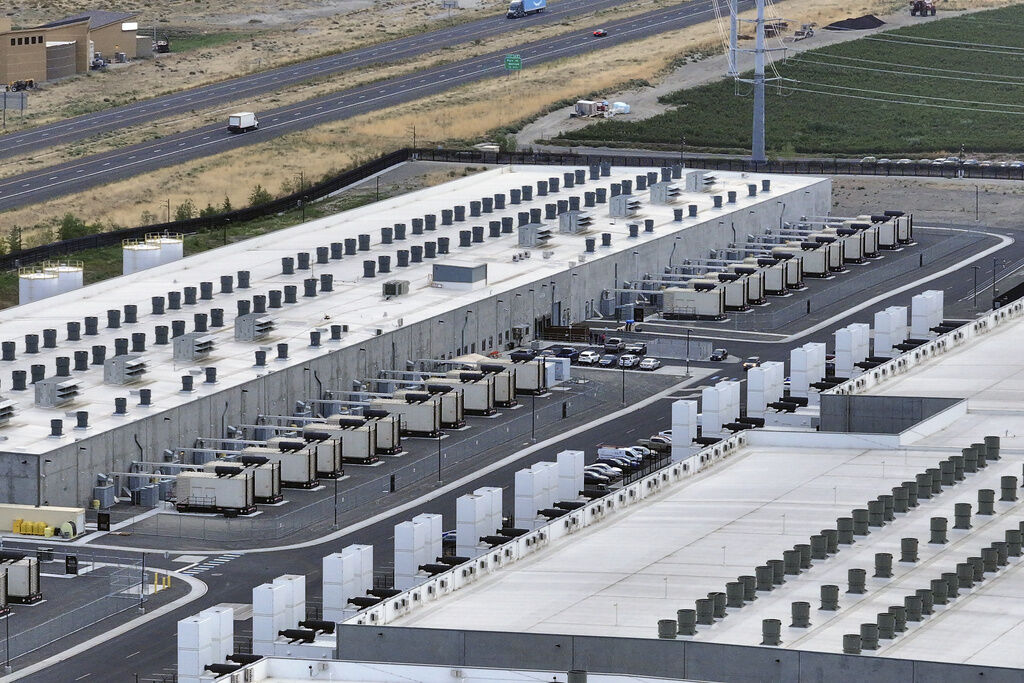
Amazon Web Services will be Project Blue's end user, according to a 2023 Pima County memo. An Amazon Web Services data center in Boardman, Oregon, is shown here.
The 290-acre site they've agreed to purchase from Pima County for Project Blue's first data center complex lies near the Pima County Fairgrounds, along Brekke Road between Harrison and Houghton roads. Most of the surrounding land is zoned as rural homestead, which allows one home per 4.13 acres.
Pima County Supervisor Matt Heinz, a Project Blue supporter, said as far as he knows, the nearest residences are at Cactus Country RV, two miles from the site. It lies north of the interstate at 10195 S. Houghton Road.
“The (data center) site currently operates as a shooting range and is bordered by another shooting range to the west, Interstate 10 to the north, and the Pima County Fairgrounds to the south, which hosts both a dragstrip and multiple speedways,” Beale's statement said.
“Although the site is surrounded by existing noise-producing uses, we will still implement noise-reduction measures to comply with local noise ordinances and the noise restrictions outlined in the site’s approved specific plan."
That plan, which county supervisors approved on June 17, said no noise or vibration shall be permitted from the site "which is discernible to the human senses of hearing and feeling at one-half mile or further from the lot line for three minutes or more duration in any one hour of the day."
On Wednesday, Beale also told the Star, "Beale’s air cooled facility will be fully compliant with current noise ordinances and produce less noise than the current shooting range on the 290-acre site, the neighboring shooting range to the west of the site, Interstate 10 to the north of the site, and the Pima County Fairgrounds, which hosts two car race tracks, just south of the site."
Asked by the Star in a follow-up question how it knows its data centers will produce less noise than the area's current activities, the company said on Thursday its spokesman is on vacation, so it can't respond until he returns.
Future housing issues?
Activist Reed Spurling countered that Beale should acknowledge there's a big difference between 24/7 low-frequency noise from a data center, and daytime noise from activities that Pima County residents visit this part of town to enjoy, such as racing or shooting. Spurling is with the opposition group No Desert Data Center Coalition.
"Persistent low-frequency noise from data center cooling systems can have negative health impacts," said Spurling, who works full-time as a University of Arizona aerospace engineer.
He said local elected officials have made a couple things clear: We are in a housing crunch, and land south of I-10 is being targeted for housing development.
"How can Beale be confident that future housing will not be built nearby?" he said, adding that an area zoned for one-acre residential lots lies barely a mile south of the project site.
But that site appears from county maps to be state trust land, meaning "it could be decades before we see anything happen on that property and if it does, new homeowners will be moving in near an existing Project Blue, not Project Blue moving in near existing homes," said Chris Poirier, an official of the Pima County Development Services Department.
"And that is assuming State Land (Department) sells it and it is developed for homes and not a different use. Highest and best use is typically not one home per acre," which is what the current zoning allows, Poirier said.
The noise restrictions in the specific plan covering Project Blue are "common sense rules," said Spurling, but he's concerned about how the county will enforce them.
"Data center operators around the country have a habit of breaking rules and then simply paying fines that they can easily afford while continuing to break the rules," he said.
Regulations vary
Pima County's regulations of noise, whether from data centers or any other major industry, are less strict than the general noise ordinance in Tucson or in other cities and towns, including Marana, Chandler and Mesa that have already enacted ordinances specifically governing data centers.
Tucson, for instance, sets maximum decibel limits for noise in its noise ordinance.
Pima County doesn't. Its general noise ordinance makes it illegal "for any person to make or continue, or cause or permit to be made or continued, any excessive, unnecessary or offensive noise which disturbs the peace or quiet of any neighborhood or which causes discomfort or annoyance to any reasonable person of normal sensitivity residing in the area." The county has separate restrictions on noise from motor vehicles, loud music and construction activities.
Also, Marana, Mesa and Chandler all have passed ordinances requiring proposed new data centers to conduct noise studies showing either how noisy the area of future centers already is, or how loud the centers will be in decibels once they're built. Chandler's ordinance also requires a prospective center to make projections for how far its noise will travel.
Pima County supervisors recently passed a series of "due diligence" policies that will allow county officials to require such analyses for new industries, including data centers, but the policies don't require the analyses.
The "due diligence" policies, approved on Sept. 2, will allow county supervisors or planning and zoning commissioners to add conditions to rezonings or special use permits to ensure such studies are done, said County Supervisor Jennifer Allen, who pushed for the policies.
Separately, the board is having the county Development Services Department reach out to other municipalities to see how they've changed their ordinances for data centers, and hopes to have new proposed ordinances in "as quick as 4 months or as long as 8 months to a year," Allen said.
'Constant hum'
The website Tech Target, which covers a wide range of high-tech issues, reported last December that as data centers expand to meet the demands of an increasingly data-driven society, "the sounds generated by their equipment and cooling systems increasingly disrupt the surrounding communities."
"From the simultaneous use of multiple diesel generators to the constant hum of cooling systems, the noise of a data center can reach alarming decibel levels, raising concerns about the surrounding community's health," Tech Target said.
Tech Target, and several other sites, have reported that noise inside data centers and coming from the centers can commonly range from a decibel level at the edge of what is known to harm hearing, about 85 decibels, to a level more than 10% noisier.
Ketchum-Walton, a national consulting firm that specializes in noise control and indoor air quality, says on its website that cooling towers, air handling units and air chillers at data centers can generate unhealthful noise levels.
Air handling units, for one, sit on rooftops and can generate decibels just at the unhealthful level or 15 decibels louder, that site said.
"This high decibel noise can easily break out and invade nearby areas," the site said.
As for outdoor air-cooled chillers, they use fans to remove heat from a data center building and release it into the atmosphere. The chiller's compressor is the main problem, producing "noise levels comparable to a Harley Davidson zooming down the highway," Ketchum-Walton said.
As for how far data center noise can travel, "there's no simple answer," said Boren of American University.
"The farther you go, it will keep getting quieter and quieter," he said. "Then it will reach a threshold where a person won’t hear it anymore. It depends on the geography. It depends on the temperature and humidity.
"It travels slightly farther in dry air. Some of the air absorption of noise comes from water molecules in air," Boren said. "If it’s a dry climate, you won’t get much air absorption; it will travel a bit farther. It also depends on the level of the frequency of the sound source itself."
In a 2024 study done for Prince William County in northern Virginia, scientist John Lyver wrote that noise from data centers can travel up to three miles. Lyver, who died shortly after the study was published, was a former NASA safety manager and a planning commissioner for that county.
His research was used to fight what opponents call "data center sprawl" in the county, which included a 37-building data center complex planned for the edge of Manassas National Battlefield Park.
Lyver's report contained no information backing up his conclusion. But Dale Browne, a resident of the county who worked closely with Lyver, said that while he doesn't know how Lyver reached that conclusion, "It is pretty easy to find sources that state that low frequency noise travels further and suffers less attenuation than higher frequencies from weather and physical barriers. Some state as far as 25 miles."
Browne cited an example of a ship's foghorn that typically emits low-frequency sounds but travels great distances, even through dense fog.
Audio technology professor Boren agreed that noise from a data center could theoretically travel up to three miles. But if a freeway forms a barrier and has few air gaps, the noise will travel less far, he said. (Typically, Interstate 10 has gaps allowing passage of air mainly at interchanges.)
"If we imagine an extraordinarily loud data center, producing 120 decibels (from more fans and/or greater fan speeds) it would theoretically be about a 50 dB hum at 2 miles, which could be audible," he said. "At 3 miles that would be about 46 dB, which could still be audible if there is a quiet environment with very little background noise. Unfortunately, we don’t always have good data about the sound power levels of the cooling installations planned for these facilities."
Low-frequency sounds do travel farther than high-frequency sounds because the high-frequency sounds are more likely to be blocked by physical barriers or absorbed by air, he said. Low-frequency sounds have higher wavelengths, he noted.
"If the high frequency sounds run into big obstacles, if you put a barrier wall around a roof, the wall will reflect back a lot of high frequencies ... but low frequencies will go over the wall and bend down again," Boren said.

