


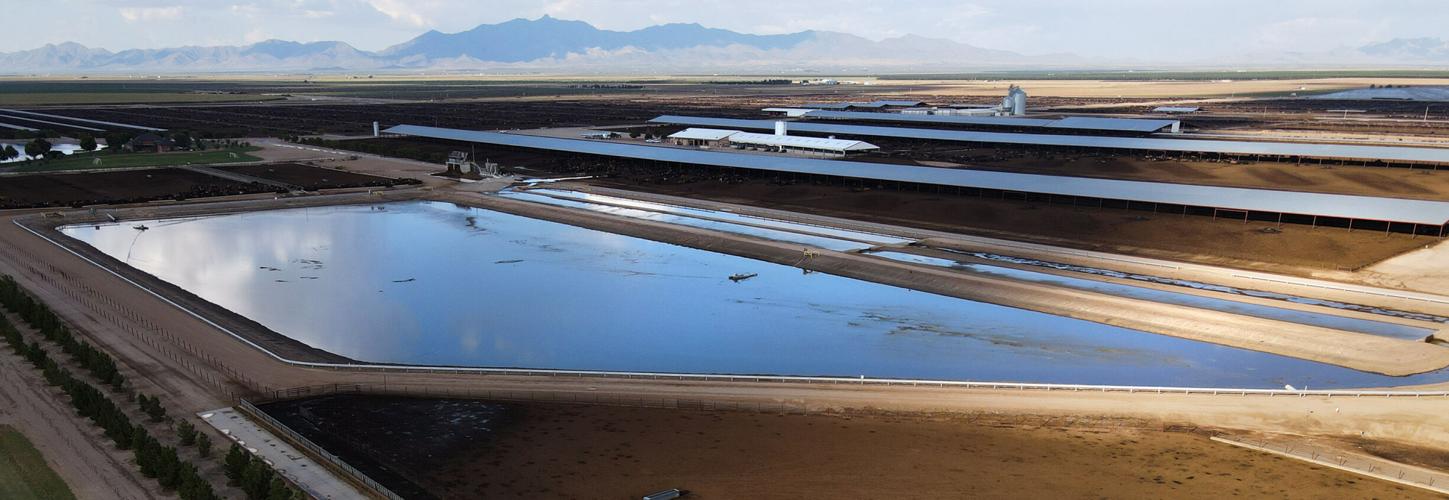

Groundwater supplies are declining rapidly in five farming-dominated basins across Arizona where pumping isn’t regulated, including in Cochise County southeast of Tucson, a new state study shows.
The five sparsely populated areas use about as much water every year as Phoenix and Tucson combined — and the cities get most of their water today from renewable surface water supplies, not from non-renewable groundwater.
The Arizona Department of Water Resources study also projected these fragile aquifers will likely lose water at an even faster pace over the next 50 years. At worst, these five basins could lose more than twice as much groundwater annually to over-pumping by 2075 than was lost over the past 32 years, the study says.
The continued declines in groundwater supplies could also increase the number of wells that dry up, the amount of subsidence — or ground-sinking — of aquifers and the presence of earth fissures in these rural areas, according to the report and to ADWR officials.
That’s even though in two of the five basins, the Douglas Active Management Area southeast of Tucson and the Harquahala Irrigation Non-Expansion Area west of Phoenix, no new crops can be planted on land that hasn’t been farmed in the five years before those two areas’ state-run management areas were created.
But at the same time, the report found the potential for significant or even dramatic increases in cropland in the southeastern Arizona Willcox and the western Arizona McMullen Valley basins.
The report found that the farmers operating and living in these five basins use a combined 418,000 acre-feet of groundwater yearly. To help put that in context, Tucson Water’s customers use a total of slightly more than 100,000 acre-feet a year.

Pecans being grown in the Willcox basin.
The report had to estimate water use by farmers and others in the five basins. That’s because water use in the state’s rural areas isn’t metered, unlike in Tucson and Phoenix.
To estimate farm water use, ADWR relied heavily on estimates done by the U.S. Geological Survey. It bases its figures largely on what crops are grown in an area and how much water such crops typically require. In areas lacking such data, ADWR did its own estimates based on the number of irrigated acres it could detect and the water use of crops grown in such areas.
This report is the first of a series of five that the Arizona Department of Water Resources will be required to produce annually over the next five years under a recently enacted state law. The law requires ADWR to produce estimates of groundwater supplies and demand, and the balance between the two, in all of Arizona’s 51 groundwater basins.
This first report examined water demands and supplies in seven rural groundwater basins. In the five this article focuses on, including those in the Willcox and Douglas areas, agriculture uses most if not virtually all of the water. The other three farming-dominated basins — the McMullen Valley, Harquahala and Butler Valley basins — lie in western and west-central Arizona.
The McMullen and Butler valley basins have garnered national media attention as critics say foreign-owned farms, including Saudi and United Arab Emirates farms, are exploiting the unregulated groundwater.
(In the two other basins included in this first state report, the San Bernardino Valley Basin in the state’s southeast corner and the Tiger Wash Basin in Maricopa County, there is no farming.)
“Really challenging”
The new report raises questions, as yet unanswered, about how long the agriculture-based economies in the heavily farmed basins can continue flourishing if over-pumping of groundwater continues.
Its findings also show that it will be “really challenging” for the aquifers in these basins to ever achieve “safe yield,” the condition in which groundwater pumping no longer exceeds recharge, said Natalie Mast, an ADWR official who oversees production of the supply-demand reports.
Even with some conservation measures imposed on the farms, over-pumping, known as over-drafting, is likely to increase by 2075 in all five basins compared to today, the report shows.
Arizona’s 1980 Groundwater Management Act created state-run Active Management Areas for five urban areas, including Tucson, Phoenix and Prescott. In those three cities, safe yield by 2025 was the stated goal, but in Phoenix and Tucson, those goals were established “with direct knowledge” on officials’ part that Colorado River water would be arriving in the 1980s and ‘90s via the Central Arizona Project canal system to offset some local groundwater use, Mast said.
Rural areas, by contrast, mostly depend on groundwater, and “they don’t have a lot of options to increase supply,” she said. “That makes it really challenging.”
While conservation can reduce demand, in the Douglas area, for instance, a lot has been done to make farming more efficient by replacing much of the area’s historic flood irrigation with center pivots, making that area more efficient than agriculture in the rest of the state, Mast said.
“It’s going to be harder to find that next phase of conservation,” she said of the Douglas area. “That low-hanging fruit has really been addressed already.”
But she declined to say there’s no hope of safe yield ever occurring. She added, “It’s not necessarily in my place to say that.”
“Mathematically possible is different than practically possible,” Mast said. “If you got rid of all agriculture in these areas, it might be mathematically possible. But that’s not practically possible, because (farming) is important for the economies in those areas.”

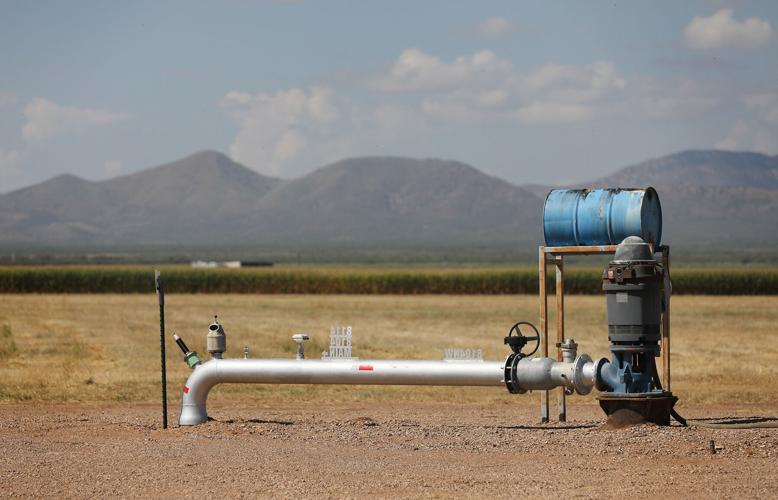
A well head stands in a field owned in Elfrida in the Willcox Basin.
Mast couldn’t say if the declining groundwater supplies in these basins will eventually mean farmers someday can’t make a living there. But in general, these declines “absolutely” could have negative economic impacts, she said.
“As you have increased overdraft, as water tables drop, it gets more expensive to get to the water, for drilling wells and pumping water to the surface,” Mast said. “You get more electricity costs, some wells go dry, it’s expensive to deepen wells and there’s an individual calculus on the part of these farms.”
Regulation debate
The report arrives as debate heats up, statewide, over whether and how heavily water use in these and other agriculture-dominated rural areas should be regulated. Under current law, rural water use is unregulated, when it’s on land outside the five state-run water management areas.
A state water policy council of 38 members, appointed by Democratic Gov. Katie Hobbs, is recommending legislation allowing the creation of locally-run, rural water management districts that would have the power to enforce mandatory conservation restrictions within district boundaries. A number of farming groups and their backers, including some top Republican legislators, oppose this idea, saying it would give government too much control and would fail to recognize farmers’ historic water rights.
Specific findings in the new report include:
Current overdraft and water loss. From 1990 through 2022, groundwater use in the five farming-dominant water basins outran available supplies by a 3 to 1 to a 4 to 1 ratio, depending on the basin. The five basins between them lost about 7.1 million acre-feet over that period.
Future overdraft and water loss. The totals will vary depending on how much additional farming occurs in the basins, on how much conservation occurs in each basin, on how much hotter the future climate gets and on how much additional water-efficient technologies future farmers employ.
But in all five basins, the ratio of groundwater pumping to recharge is projected to be larger by 2075 than in 2022 — reaching as high as 5 to 1. At worst, the five basins could lose 27.7 million acre-feet of water to over-pumping by 2075.
Water use trends: Three basins — Willcox, Butler Valley and Douglas — all used more water in 2022 than in 1990. Harquahala farmers used about the same amount and McMullen Valley farmers used less.
Willcox and McMullen Valley farmers are expected to be using much more water in 2075 than in 2023, while the Butler Valley, Douglas and Harquahala farmers are projected to be using roughly the same amount.
Biggest future water loser. Almost certainly, it will be the Willcox Basin. About halfway between the states of Rhode Island and Delaware in size, it contains enough unused state and private land for agricultural water demand to more than double between now and 2075, the report said.
If farmland does double, the basin’s aquifer could lose up to 13.7 million acre-feet of groundwater by 2075. Under lesser growth projections made in the report, based on factors such as long-term climate heating and future conservation practices, the basin will lose 7.6 million to 7.8 million acre-feet by 2075.
Drying wells. When the water table in a groundwater basin falls below the basin’s average well depth, the report gives a negative value to the amount of groundwater still stored in the basin. In such cases, peoples’ wells can or will dry up.
That’s already happened quite regularly in the Willcox Basin, an occurrence that has generated major media attention in Arizona and nationally. Because the water table has fallen below the average well depth, the ADWR report considers the Willcox Basin to have “negative storage” of groundwater, to the tune of 608,700 acre-feet.
By 2075, Willcox’s “negative storage” could rise to as much as 14.45 million acre-feet, meaning more wells could dry up. In such circumstances, “to continue mining groundwater within the basin, well owners will have to deepen wells or drill new wells at a significant financial cost.”
A similar scenario could come to pass by 2075 in the McMullen Valley, where the new study forecasts “negative storage” values ranging from 847,000 to 3.9 million acre-feet, depending on future trends in climate, water conservation and farming growth, among others. The Harquahala Irrigation Non-Expansion Area could also reach negative storage volumes by 2075, although at much lower levels of at most 274,000 acre-feet.
Less water for us. Under state law, cities such as Phoenix and Tucson can buy and transfer water rights to themselves from the McMullen, Harquahala and Butler Valley Basins. (State law forbids the purchase and transfer of groundwater rights from all but those and two other groundwater basins.)
Indeed, the city of Buckeye this year paid $80 million to buy a single acre in the Harquahala basin to obtain its 5,926 acre-feet pf water rights, for transfer into the city for future use. But if over-drafting in these basins increases, or simply continues, it will leave less water for cities outside them to buy and import.
Get your morning recap of today's local news and read the full stories here: tucne.ws/morning

