



Staffing issues at the National Weather Service in Tucson could be affecting the accuracy of monsoon storm predictions, according to a former University of Arizona atmospheric scientist.
About a month ago, Mike Leuthold and two of his fellow resident weather experts noticed that the Weather Service in Tucson had stopped posting data from its early morning weather balloon launches from the roof of its office on the U of A campus.
They soon learned that the local forecast office was no longer sending up balloons for so-called “atmospheric soundings” at 5 a.m. due to an apparent lack of overnight staffing.
There’s just one problem with that, Leuthold said: Those morning balloon flights are vital, especially at this time of year. “It’s the most important forecast tool for afternoon thunderstorms in Tucson,” he said.
Due to staffing issues, the Tucson NWS is no longer sending up a 12Z sounding. This sounding is a meteorologist's most important short-term monsoon forecasting tools. This data is also critical for the accurate weather modeling of monsoon thunderstorms. #azwx @timsteller.bsky.social
— Mike (@1074j.bsky.social) June 19, 2025 at 7:08 AM
[image or embed]
For decades, Weather Service offices across the country have been launching weather balloons twice a day to capture a synchronized snapshot of atmospheric conditions. The standard times for these coordinated soundings are at midnight and noon Greenwich Mean Time, or 5 a.m. and 5 p.m. in Tucson.
As it turns out, 5 a.m. is an ideal time to measure the atmosphere over Southern Arizona in the summertime, Leuthold said, because that’s when the weather is likely to be the quietest — after the nighttime cooling and before the day heats up and storms begin to develop. The result is clean data on temperature, humidity, barometric pressure and other measurements that can be used to predict where and how that day’s storm activity might materialize.
Recently, though, the Weather Service office in Tucson has switched to sending up its first balloon of the day at 11 a.m. — and not because that time makes the most sense scientifically.
“It’s discouraging,” Leuthold said.
Cuts hit agency
The local forecasting office still conducts its second daily launch at 5 p.m. as usual, but the afternoon thunderstorms common at this time of year can disrupt those readings. If the storm doesn’t “literally rip the balloon apart,” Leuthold said, the strong winds and precipitation can “mess up the data.”
Tucson-based National Weather Service meteorologist Glenn Lader confirmed his office’s new schedule for balloon launches.
He said the change came as a result of “staffing,” but he referred additional questions to the public affairs office at the agency’s headquarters near Washington, D.C.
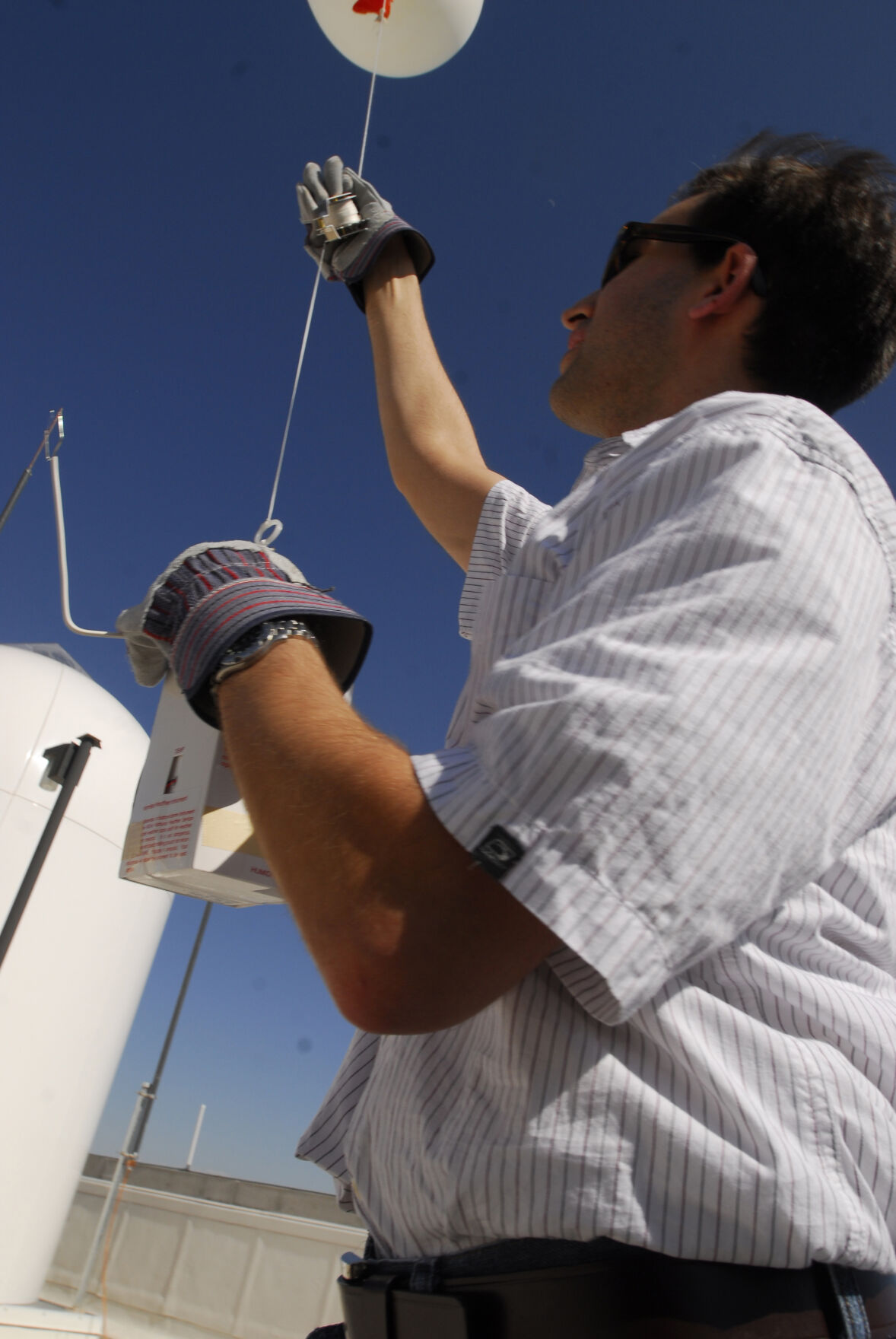
A weather balloons released from the rooftop of the Tucson forecasting office in this 2007 file photo.
In an email Thursday, Weather Service spokeswoman Erica Grow Cei said she didn’t have personnel updates “specific to any local weather forecast office.” But Cei provided a written statement describing what she called the agency’s “current staffing posture.”
“The National Weather Service continues to meet its core missions amid recent reorganization efforts and is taking steps to prioritize critical research and services that keep the American public safe and informed,” the statement said. “NWS is committed to investing in new technology and prioritizing public safety.”
Those reorganization efforts have included sweeping buyout and early retirement offers as part of the Trump administration’s campaign to dramatically shrink the size of the federal workforce. The administration also reportedly fired 100 or more probationary Weather Service employees.
The agency continues to shuffle its remaining workforce to backfill vacant roles at forecast offices with “the greatest operational need,” Thursday’s statement from headquarters said.
“A targeted number of permanent, mission-critical field positions will soon be advertised under an exception to the Department-wide hiring freeze to further stabilize frontline operations,” the statement said.
Later flights
In March, the Associated Press reported that the agency had begun reducing or eliminating regular balloon launches at eight locations in the Rocky Mountains and Upper Midwest due to massive job cuts. At the time, experts warned that such cutbacks could weaken the agency’s ability to predict severe weather events.
Leuthold said other forecast offices across the Western U.S. have also abandoned their traditional, early morning balloon launches in favor of ones 6 hours later, during the day shift. They include places such as Albuquerque; Grand Junction, Colorado; Great Falls, Montana; Amarillo, Texas; and Spokane, Washington.
“It’s not just Tucson,” he said.
Flagstaff now launches at 5 a.m. and 11 a.m., something Leuthold described as “weird.”
The helium-filled latex balloons soar to an altitude of about 100,000 feet, towing sensor packets called radiosondes that collect and transmit measurements as they rise.
Though modern forecasting is heavily reliant on computer modelling, satellites, radar and other ground-based instruments, the information gathered by balloon remains “the gold standard for atmospheric science,” Leuthold said.
The Weather Service feeds that data into its computer models and uses it to calibrate the real-time readings from its remote sensors. All the forecasts you see on TV or read in the newspaper are rooted in what gets sent back from weather balloons, he said.
Before computer modelling was developed, the sounding data was the primary method of forecasting afternoon thunderstorms, Leuthold said.
He knows something about all of this. He spent more than 30 years as a research meteorologist at the U of A. “They still use the computer model I developed starting in 2003 for forecasting the monsoon,” he said.
Pressure rising
Weather forecasting has greatly improved over the past three decades, thanks to advances in technology and modeling.
“It used to be a 30% chance of rain everyday,” Leuthold said of monsoon forecasts from the 1980s. “You’d never attempt to predict storms in specific places and times.”

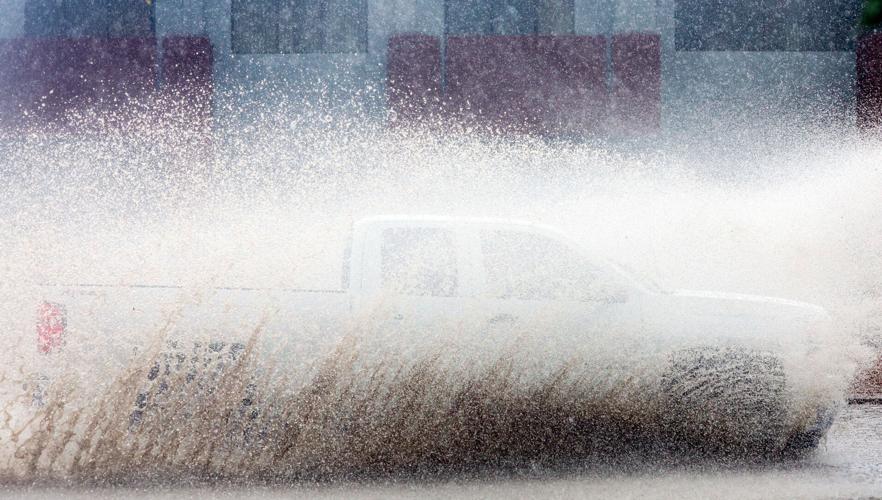
A truck drives through flooded streets as heavy rain showers hit Tucson earlier this month.
The National Weather Service has come under harsh scrutiny since July 4, when flashflooding on the Guadalupe River in Texas killed at least 120 people, including dozens of children from youth camps built along the water.
Leuthold thinks the agency and its forecasters are being unfairly blamed. “The Weather Service from what I saw did a pretty good job” issuing warnings and emergency alerts hours in advance, he said. State and local authorities simply didn’t have adequate warning and evacuation systems in place along the flood-prone river, Leuthold said.
In his opinion, predicting monsoon activity in the Southwest is “one of the hardest things meteorologists do,” because the thunderstorms form so quickly in such a localized and chaotic way, he said.
That’s why having the most accurate and timely data is so important. Just a 10% variation in atmospheric moisture level or instability can result in a “big change either way,” Leuthold said. “A small error can be really magnified. A storm can turn out to be much more severe or much less.”
The 11 a.m. weather balloon launches are “better than nothing,” he said, but the data probably comes too late to help shape the computer-model forecasts for thunderstorm activity in the afternoon.
The early-morning launch window is best for that, especially during monsoon season, he said. “Even if they were to do it only once a day, 5 a.m. is the one they should do.”

