


The effort to restore Mexican wolves to Arizona and New Mexico is going better than expected so far, according to a 5-year review by the federal agency in charge of the work.
The recent evaluation by the U.S. Fish and Wildlife Service shows that the wild wolf population in the two states has surpassed the agency’s interim recovery objectives and outpaced predictions for both abundance and genetic diversity.
But conservationists warn that the limited success in the U.S. is being overshadowed by the near total collapse of the Mexican wolf program south of the border.
“There is no functional wolf population in Mexico. There may be no wolves in Mexico at all,” said Chris Smith, wildlife program director for the Santa Fe, New Mexico-based nonprofit WildEarth Guardians.
For proof, he points to the Fish and Wildlife Service’s own review, which notes that “Mexico reported zero collared wolves alive in the wild in 2023, mostly due to illegal poisoning.”
The last overall count from Mexico came in 2022 and showed what Fish and Wildlife Service officials described as “an extremely small, establishing population” of around 35 wolves.
“If they were speaking about the 2024 population, I think they wouldn’t even go that far,” Smith said.
As far as he is concerned, the agency’s 5-year review is “lipstick on a pig.”
“Credit is due for the successes of the recovery program. But this report glosses over significant setbacks and real threats to recovery,” Smith said.
Fostering pups
The Mexican subspecies of the gray wolf was once found across the southwestern U.S. and Mexico. It was listed as endangered in 1976, after roughly a century of wholesale predator-eradication practices that drove it to the verge of extinction.
Starting in 1998, wildlife managers began releasing and monitoring captive-bred wolves in Eastern Arizona and Western New Mexico as part of a cooperative effort among nine federal, state and tribal agencies led by the Fish and Wildlife Service.

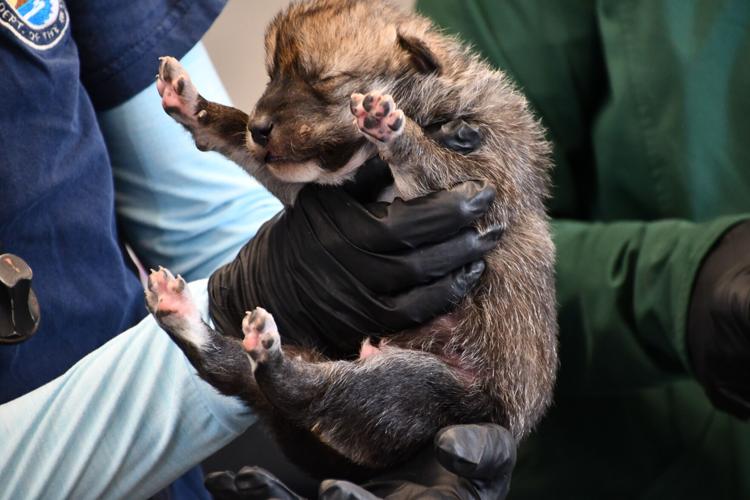
A Mexican wolf pup holds up its paws while receiving a health check by Susan Dicks, a veterinarian with the U.S. Fish and Wildlife Service, in April 2024. Wildlife officials are carefully selecting and fostering captive-born pups in wild dens to help maintain the genetic diversity of the endangered subspecies.
The agency’s 5-year program review was completed with input from the Arizona Game and Fish Department, New Mexico Department of Game and Fish, U.S. Forest Service, U.S. Department of Agriculture’s Wildlife Services branch, the White Mountain Apache Tribe and Mexico’s National Commission of Natural Protected Areas. The review covers the period from 2017 to 2022, when the wild population in the U.S. rose to at least 242, 97 more than the 5-year target set by the service’s Mexican Wolf Recovery Plan.
“This progress report shows we are ahead of where we anticipated being in achieving our recovery goals in the United States for Mexican wolves,” said Brady McGee, Mexican wolf recovery coordinator for the service. “Since its inception, this program has strived to adjust and adapt our efforts to maximize success for recovery of this subspecies. This evaluation is evidence that what we are doing is working and provides a chance to reflect and shift as needed.”
The number of wolves in Arizona and New Mexico increased again in 2023 to at least 257 animals. The population estimate for 2024 is expected to be released in the coming months.
Mexican wolves in the U.S. also exceeded genetic benchmarks over the 5-year period by retaining more than 90% of gene diversity of the captive wolf population, according to the Fish and Wildlife evaluation.
“Given the founding population of seven Mexican wolves, the ability to demonstrate such a high retention rate for gene diversity and other associated genetic measures is a paramount recovery success,” said Jim deVos, wolf recovery coordinator for the Arizona Game and Fish Department. “Through the use of an effective pup fostering program, where every captive pup is selected for genetic factors that contribute to high gene retention, our diversity goals are being achieved in the wild, boding well for sustaining recovery.”
The captive population of Mexican wolves has more genetic diversity than the wild population. That's why cross-fostering captive-born pups into wild dens has become a valuable tool for the recovery of endangered Mexican wolves.
The fostering program takes wolf pups born in captivity through selective breeding and places them in the dens of wild Mexican wolf packs, where they are cared for and raised alongside similarly aged wild-born pups.
Of the just over 100 foster pups that have been placed in dens since 2016, at least 18 are known to have survived to adulthood, based on being captured later or documented through DNA analysis.
‘Dangerous gamble’
The current recovery strategy for the Mexican wolf is to establish and maintain two resilient, genetically diverse populations distributed across ecologically and geographically diverse areas in the subspecies’ historical range in the U.S. and Mexico, according to the Fish and Wildlife Service.
So far, though, the program in Mexico has released only about half as many wolves as expected and fallen well short of its five-year population target of 100 animals.

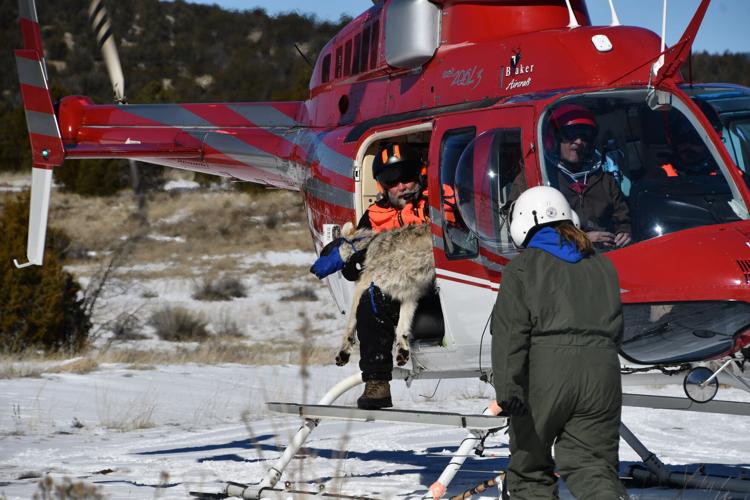
A tranquilized Mexican gray wolf is transported during helicopter capture operations in January 2023.
In its evaluation, the Fish and Wildlife Service recommends a range of possible actions south of the border, including a boost in the release and translocation of wolves, improved monitoring efforts, the identification of additional release sites and a focus on increasing the public’s tolerance of the animals.
Wolf advocate Bryan Bird said Mexico will continue to be “a death trap for the Mexican gray wolf” without additional material help from the U.S.
“Relying on our southern neighbor — with far less resources and marginal habitat — is a dangerous gamble,” said Bird, who is southwest director for the Washington, D.C.-based Defenders of Wildlife. “The (Fish and Wildlife Service) must direct more resources to Mexico and expand the U.S. population area northward. Otherwise, Mexican gray wolf recovery will remain just an illusion.”
Conservation groups have long advocated for the animals to be allowed to spread beyond the boundaries of the federally designated Mexican Wolf Experimental Population Area, which covers a vast swath of eastern Arizona and western New Mexico south of Interstate 40.

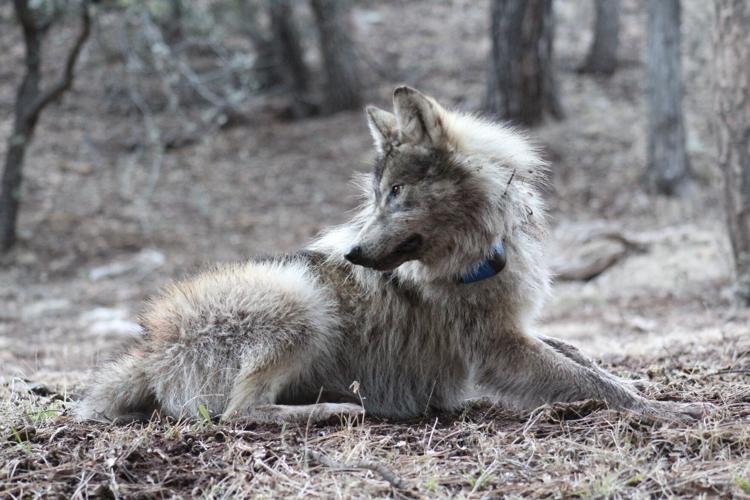
A photo from 2023 shows a Mexican wolf that was captured, given a radio collar and released back into the wild during the annual population count. A 5-year review shows better-than-expected progress in the effort to restore Mexican wolves to the U.S., but conservationists warn a related program in Mexico is near collapse.
But state and federal wildlife officials insist that I-40 is not “an arbitrary boundary,” as some conservationists have called it; it is a line meant to keep Mexican wolves from mixing with the northern gray wolves of Utah and Colorado.
Such cross-breeding with the larger northern gray wolves could lead to the loss of the Mexican wolf as a separate subspecies, Jeff Buchana, Arizona Game and Fish Commissioner, has said.
In July, wildlife officials announced plans to capture a pair of Mexican wolves spotted near Flagstaff and move them back into the Experimental Population Area south of I-40.
One of those wolves, a female with a tracking collar, later turned up dead northwest of Flagstaff in early November, triggering an investigation and a reward of more than $100,000 for information leading to a successful prosecution in the case.
The fate of the other, uncollared wolf remains unknown.

