



The city of Tucson is moving forward with a plan to expand access to free, public Wi-Fi throughout the city, particularly in areas that are suffering from a “digital divide.”
During a recent meeting, the Tucson City Council voted to use $4.4 million of federal CARES Act money — provided to local governments through the Coronavirus Relief Fund — to fund the city Wi-Fi expansion plan.
Since the pandemic began, the need for internet access has become increasingly apparent, said Councilman Steve Kozachik.
The council seemed confident that CARES Act funding would cover the project, arguing that it will support the needs of citizens and help them deal with issues that have risen as a direct result of the pandemic.
“We have pockets of the city that have zero connectivity,” Kozachik said. “Schools are about to open on a virtual platform. That alone screams of the need for us to address that digital divide.”
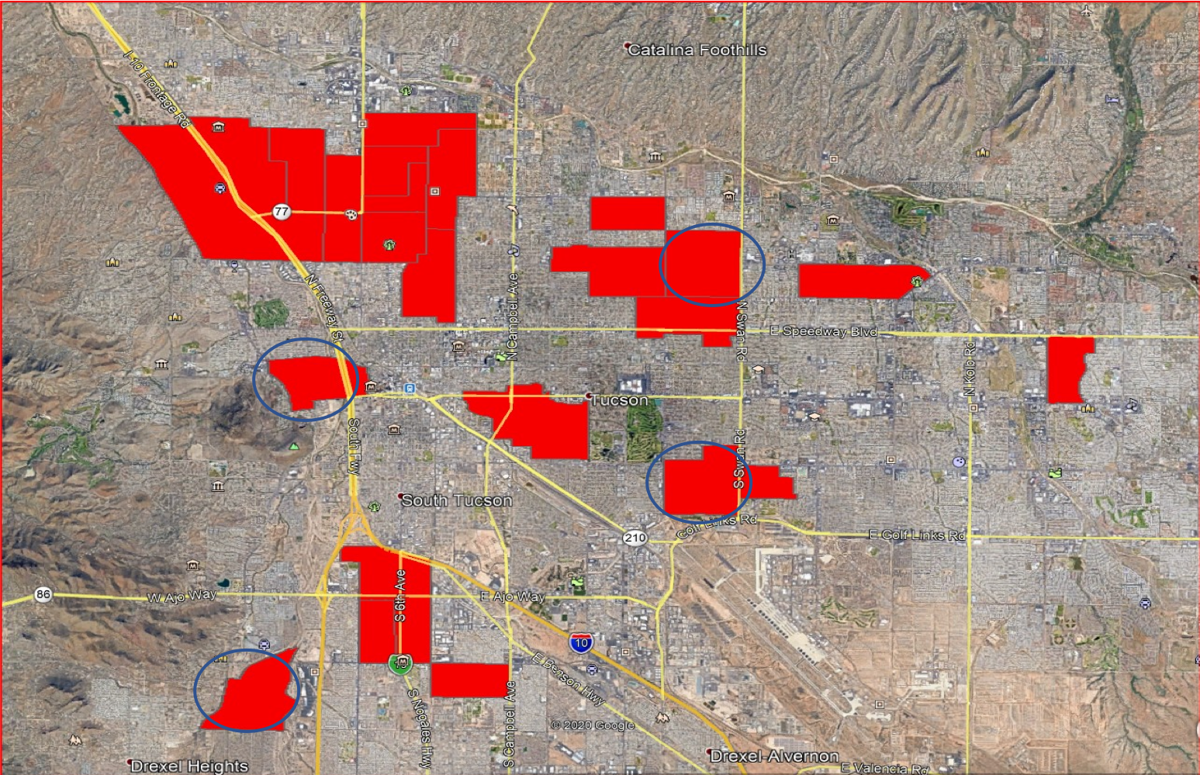
Using Census data, officials identified which areas of the city were most impacted by the digital divide by looking at income levels, population and whether there was coverage available from other broadband services such as CenturyLink and Cox.
The data showed that 10,798 households in the city do not have access to the internet. Covering nearly 20 square miles and targeting the most economically impacted areas of the city, the plan will reach nearly 54,000 households and over 116,000 people. The districts that will benefit from the plan include Tucson Unified, Flowing Wells Unified and Amphitheater school districts.
“We have four proof of concept areas, most of which revolve around parks in those hard hit areas. And then they’re going to expand out into the rest of the neighborhoods that are hardest hit,” said Tucson’s chief information officer Collin Boyce.
“The goal, if additional funding exists, is to move out into other neighborhoods that are in the lighter red or orange because there’s a deficiency in those areas as well.” The proof of concept areas, which are expected to be up and running by early November, are located at Midvale Park, Menlo Park, Freedom Park and the Garden District. Up to 47% of people in these areas are without broadband access.
Boyce, who is leading the development of the wireless plan, said the Wi-Fi connection will likely not be available throughout an entire house, but there will be certain areas where residents can reach a signal.
“We can set up a situation where kids can get internet connectivity at home and the parents don’t have to make a decision on whether their kids go out to school and get sick, or they fall behind academically,” Boyce said. “We can help bridge the gap with that.”
According to Boyce, the benefits will extend beyond in-home internet access, allowing officials to use this same infrastructure to develop smart traffic control technology.
“The same network that we’re building can be utilized to build the Smart City infrastructure that Tucson wants and desires,” he said. “This means everything from sensors in the roads to Wi-Fi in the parks when we have races. So, this is great for the citizens today and awesome for the city tomorrow in that we can leverage the same infrastructure to do a lot of cool stuff.”
Kozachik agreed, adding that even the parts of the city that do have internet connections will benefit from this kind of technology.
“Everyone benefits in bringing us along as a 21st century city,” he said.
Starting this month, officials will begin an initial assessment stage to finalize the plan and design for the project. Once the proof of concept areas are deployed in November, they will move on to other hardest-hit areas of the city. They expect to have the first phase completed by mid-December.
Photos: In Tucson, face masks are for more than just people
Face masks on objects
Updated
A Jeep sports with eyes like those from the movie "Cars" sports a COVID19 mask outside Alpha Graphics near the corner of Tanque Verde and Kolb, Tucson, Ariz., July 3, 2020.
Face masks on objects
Updated
The large Tiki head at the entrance of The Hut, 305 N. 4th Ave., wears a mask in response to the Coronavirus Disease (COVID-19) in Tucson, Ariz., on April 5, 2020.
Face masks on objects
Updated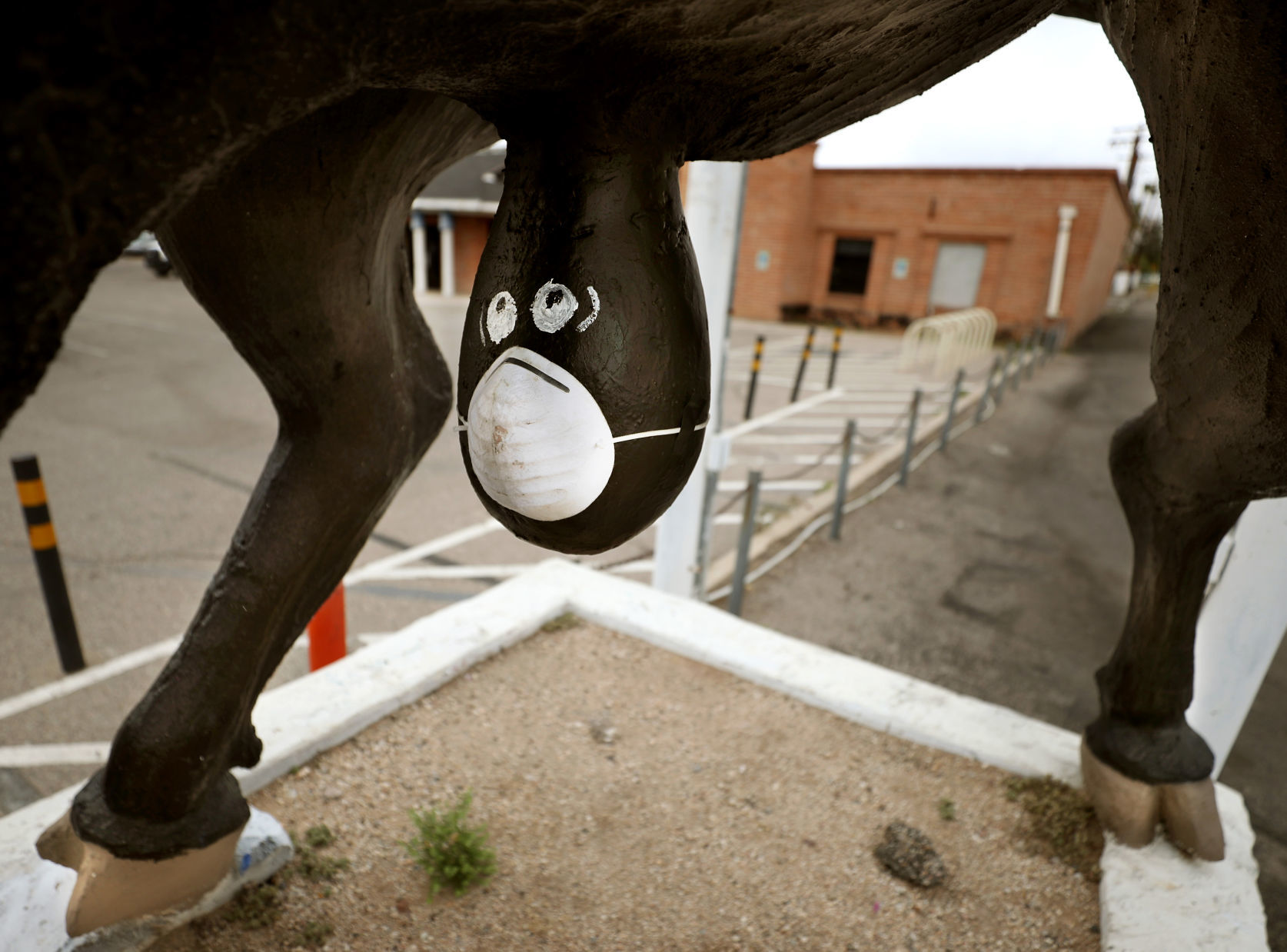
The noted bull testicles on the statue outside Casa Molina at Speedway and Wilmot, usually painted in various schemes and wild colors, are in these CONVID19 times now sporting a face mask, March 27, 2020, Tucson, Ariz.
Face masks on objects
Updated
A dinosaur statue over the doors of MATS Dojo at 5929 E. 22nd St., sports an athletic cup for a face mask in the second week of COVID-19 restrictions, March 31, 2020, Tucson, Ariz.
Face masks on objects
Updated
The venerable T-Rex outside the McDonald's at Grant and Tanque Verde comes around late, but strong, to the mask game, May 13, 2020, Tucson, Ariz.
Face masks on objects
Updated
The iconic Casa Molina bull and matador statue both sported masks on the first full week of the loosening of COVID-19 restrictions in mid-May.
Face masks on objects
Updated
Father Kino's horse practice safe social interaction by wearing a mask even if Father Kino himself isn't. The statue sits at Cherry Fields at 15th Street and Kino Boulevard, Saturday, May 2, 2020, Tucson, Ariz.

