



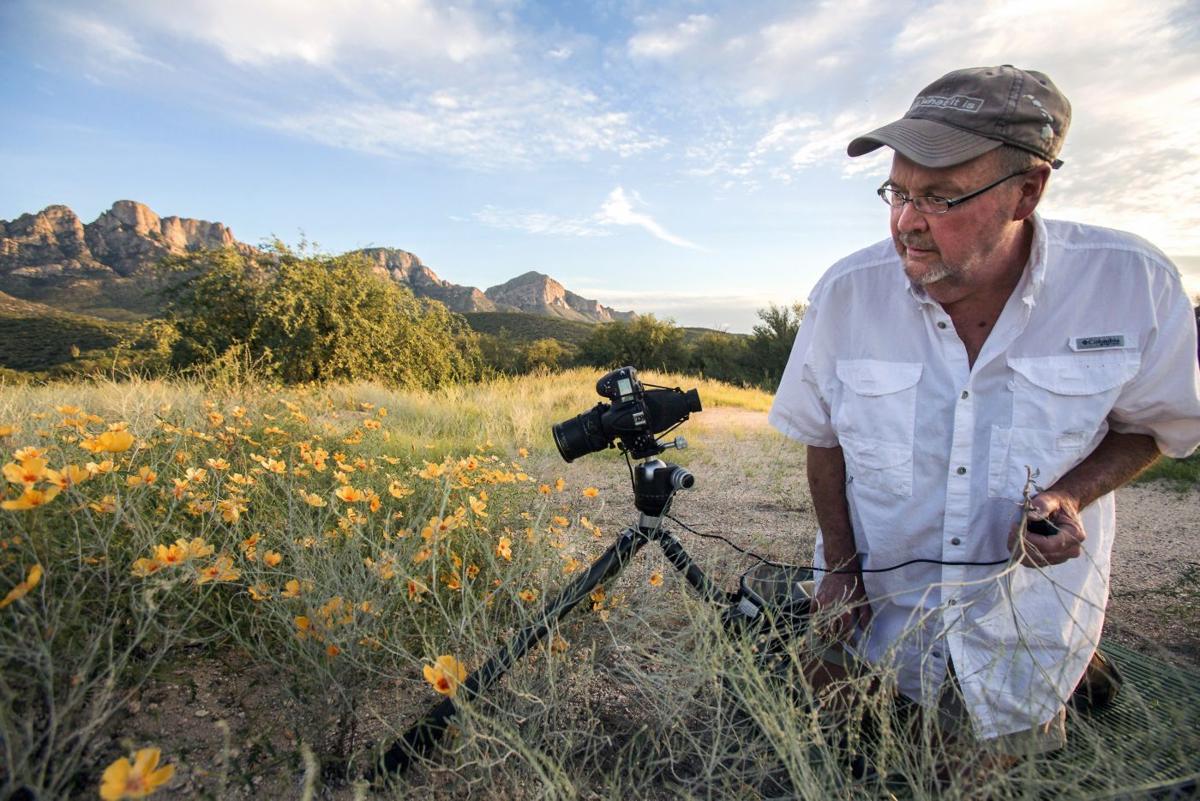
Pulitzer Prize-winning photojournalist and Tucson resident Jack Dykinga is, at 72, having what he calls an artistic rebirth.
A little more than a year ago, his lungs ravaged by a disease called pulmonary fibrosis, he was prepared to die.
He’s now back shooting landscape photos and video of the desert Southwest for publications like National Geographic and Arizona Highways. But his good health did not come without struggle.
The problems began in 2010, when Dykinga began feeling short of breath during his regular hikes around Southern Arizona. Concerned, he went to see a specialist — pulmonologist Dr. Lewis Wesselius — at the Mayo Clinic in Phoenix.
“When he told me it wasn’t lung cancer, I was ready to do cartwheels. But then he explained that what I had was bad,” said Dykinga, whose photographs of institutionalized patients in Illinois mental hospitals won a Pulitzer Prize in 1971, when he was employed by the Chicago Sun-Times.
Dykinga moved to Tucson in 1976 and worked at the Arizona Daily Star from ’76 to ’81.
On that visit to the Mayo Clinic in 2010, Dykinga learned he had what’s known as idiopathic pulmonary fibrosis — the idiopathic part means his case has no known cause. The disease is fatal.
Among possible causes of pulmonary fibrosis are airborne toxins and radiation of the lungs or breast. Viruses and exposure to tobacco smoke could also be triggers. Still, in most cases, the cause is never found, the Mayo Clinic says.
Dykinga began taking drug pirfenidone through a clinical trial he credits with slowing down the degradation of his lungs. The drug got FDA approval last year under the trade name Esbriet.
And for a while, Dykinga was able to continue his active outdoor lifestyle, though he would take oxygen containers for higher elevations. But by last year, his lungs were getting worse. During a raft trip down the Colorado River last April his lungs all but shut down.
“On the last night of the trip we had the mother of all sandstorms,” Dykinga said. “I realized I was in deep doo-doo.”
Once admitted to the Mayo Clinic Hospital, Dykinga learned his blood oxygen levels were dangerously low and medical intervention wasn’t helping. On top of everything else, doctors discovered he had an artery blockage.
He called his friend, author and journalist Charles Bowden, and asked if Bowden would write his obituary. The two had collaborated on several projects.
At that time, Dykinga was referred to the Norton Thoracic Institute at Dignity Health St. Joseph’s Hospital and Medical Center in Phoenix for a transplant.
Going to Tucson for a lung transplant was at the time not an option because the local program was on hiatus. St. Joseph’s in Phoenix and the Tucson transplant hospital, now called Banner-University Medical Center Tucson, are the only two lung transplant centers in the state.
“If he had not had a transplant, he unfortunately most likely would have passed away during his hospitalization,” said Dr. Jasmine Huang, one of the doctors who performed Dykinga’s lung transplant at St. Joseph’s on May 24. He had a coronary artery bypass at the same time.
Awakening from surgery, Dykinga was not sure whether he was dead or alive.
When he saw Bowden standing by his bedside he wondered if it was a hallucination. It was not.
“Generally when someone calls and asks me to write their obituary, I presume there is a problem,” Bowden told him.
Bowden died unexpectedly less than two months later and Dykinga delivered the eulogy at his Nov. 1 memorial service.
The last year has not been easy. Dykinga wrestled with depression, mostly over guilt. During those first weeks, he was on a feeding tube and needed help with just about everything — a task that fell to his wife, Margaret Dykinga.
He also had four different scares that sent him to the emergency room.
“You start asking yourself, ‘why did I do this?’,” Dykinga said. “There’s also anxiety, not knowing the future.”
About 80 to 90 percent of lung transplant patients are alive after a year, Huang said. After five years, the survival goes down to 50 percent.
“That is usually due to chronic rejection of the lungs,” she said. “Unfortunately organs are a limited resource. A second lung transplant can be considered but there are limitations.”
On Wednesday, Dykinga drove to Phoenix to donate photographs to the people who helped him — one for St. Joseph’s cardiothoracic intensive care unit, the other for Editha House in Phoenix, where Dykinga and his wife lived for three months after his surgery.
Dykinga will be on anti-rejection medications for the rest of his life. He takes 15 pills in the morning and 12 at night. He’s at a higher risk for developing infections and cancers. It’s harder for his body to fight other diseases and illnesses.
Doctors advise transplant patients to wear masks if they are in a place with a lot of people. Air travel is risky because of so many people in close quarters. Dykinga has not flown since his transplant.
As a photographer, Dykinga had always been somewhat of an individualist who worked in solitude. But his experience made him realize the importance of community. And it has fueled him as an artist. Lately he’s been chasing storms, photographing monsoon lightning and rainbows.
“I have an immense sense of gratitude and appreciation I didn’t have before,” he said. “When I was in the clinical trial I wasn’t even thinking about a transplant. But your mind changes when you see the white light. I’m glad I didn’t go to it.”

