



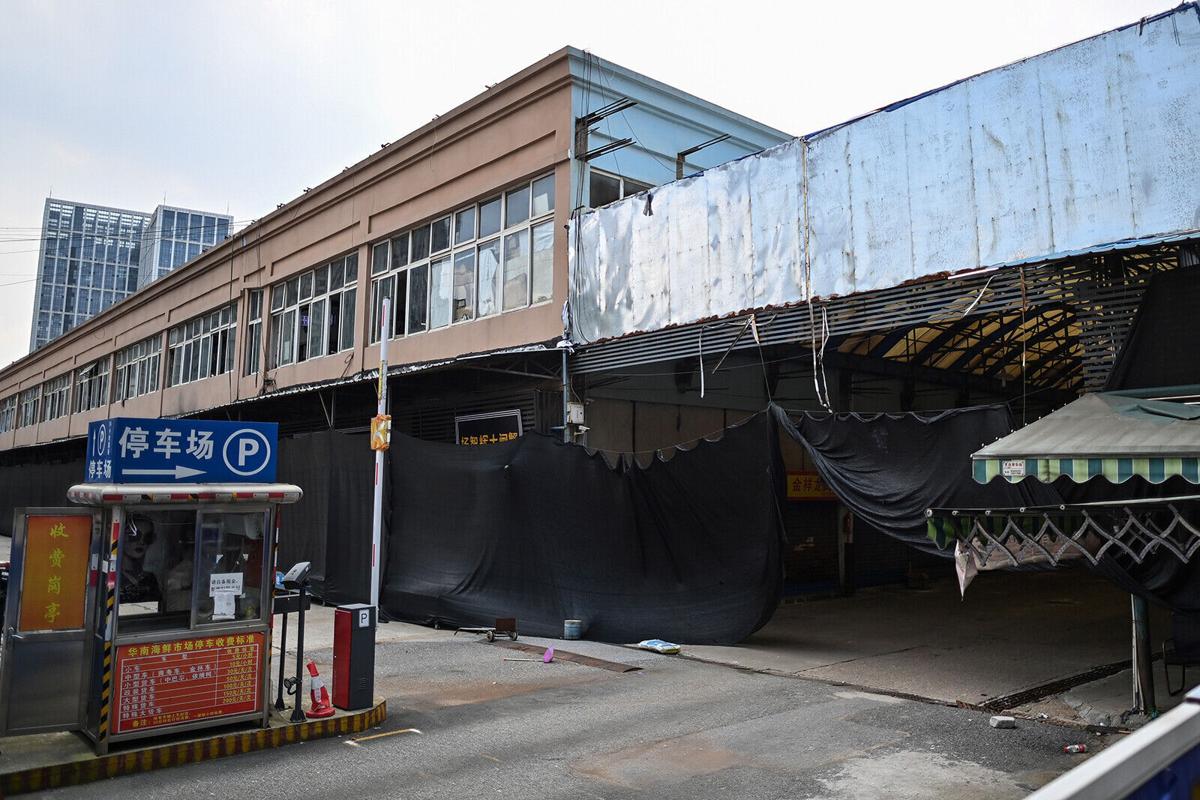
A University of Arizona scientist was part of an international research team that has concluded the COVID-19 virus originated with live animals sold at the Huanan Seafood Wholesale Market in Wuhan, China.
Michael Worobey, who is a virus evolution expert at the UA, co-authored two peer-reviewed scientific papers published Tuesday in the journal Science that explain these findings.
The first paper focuses on the geographic patterns of the virus in its earliest known period of human transmission: December 2019. Using data gathered by Chinese researchers for the World Health Organization, the authors found that nearly all of the 174 cases (155) from that time originated in Wuhan, and specifically near the Huanan Market.
According to Worobey’s and his colleagues’ findings, many of those early COVID-19 patients had no known interactions with the market but lived nearby.
That’s consistent with the idea that the virus originated in that specific market. Vendors got infected at the market, and as they brought goods to the surrounding community, it spread.
“In this 8,000-square-kilometer city, there was this very small area — about a one-third of a kilometer square — smack dab in the middle,” Worobey said at a virtual news conference Tuesday. “If you understand that, you understand that there’s a very, very strong case that the Huanan market was the epicenter.”
Later cases, however, were more concentrated around the highest population centers in the city of 11 million people. That change in trend suggests that by that point, the highly transmissible virus had spread from its epicenter at the market to the most densely populated areas across the city.
“You really need a big city for a virus like this to take hold and become a pandemic,” said Worobey, who explained that an area with a small population wouldn’t have been conducive to the COVID-19 virus’ rapid spread. “This is a virus you should expect to emerge in a big city, not a rural place.”
A second paper published Tuesday found that the virus’s spread from animals to humans likely occurred in two separate instances, from two separate viral lineages, in late November 2019.
Both of those independent events are believed to have happened at the Huanan market, possibly originating from two different species of animals sold there.
What about the lab-leak theory?
To date, the COVID-19 virus has killed 6.4 million people across the globe, including more than 1 million Americans and 29,000 Arizonans.
In the nearly three years since the pandemic took hold, pundits, politicians and social media personalities have offered their speculation about where the virus originated.
One popular, but unsubstantiated, theory is that the pandemic happened after the virus leaked from a Chinese lab.
In May 2021, Worobey and 17 other scientists published a letter, also in the journal Science, calling on the scientific community to “take hypotheses about both natural and laboratory spillovers seriously until we have sufficient data.”
More than a year later, Worobey is more confident than ever that the so-called lab leak theory is a dead end.
“At that point, we didn’t have a lot of the evidence we do now,” Worobey said Tuesday. “It has moved me to the point where I also think it’s just not plausible that this virus was introduced any other way than through the wildlife trade at the Huanan market.”
His co-author, Kristian Andersen, a professor at Scripps Research in San Diego, agreed.
“Have we disproven the lab leak theory? No, we have not. Will we ever be able to? No,” he said. Andersen added that formal, definitive proofs as they exist in mathematics rarely exist in biology.
But Andersen also cleared up another misconception about what scientists do know about the COVID-19 virus.
“There is this general sense that there’s no data whatsoever that can tell us anything about the origins of the COVID-19 pandemic, which is just untrue,” Andersen said. “These two papers in particular say we do have a lot of evidence — importantly, unfiltered early evidence — that tells us a lot about the origin of this particular pandemic.
“All of that evidence tells us the same thing. It points right to the market in the middle of Wuhan.”
Moving forward, Worobey, Andersen and the many other scientists who are working to further understand the origins and behavior of this pandemic still have unanswered questions.
But to find those answers, Andersen said, the global community will need to stay focused on its end goal.
“Importantly, all of this is only possible if we focus on the collaborative aspect of this,” Andersen said. “If we are trying to place blame for a pandemic, none of this work is ever going to happen.”
RELATED:

New data strongly suggests COVID-19 jumped to humans from a wild animal sold at a Wuhan meat market, not from a Chinese germ lab, says a prominent University of Arizona researcher who specializes in the origins of outbreaks.

It's an intriguing coincidence that the COVID-19 pandemic started in a city with a virology lab studying similar viruses. But a Tucsonan's new research shows a more compelling coincidence.

Led by a University of Arizona researcher, the study suggests public health officials had even more time to implement aggressive measures to stop the spread of the coronavirus.
Then and Now: UA campus in 50s, 60s, 70s and today
University of Arizona campus, 1965
Updated
The Park Avenue Food Services and Bookstore Center on the west side of campus is under construction on May 18, 1965. Bruce Hopkins / Tucson Citizen
University of Arizona campus, 2016
Updated
The Park Student Union at the University of Arizona offers an array of food choices plus a bookstore, gaming center, meeting rooms and the home of the KAMP Student Radio station in Tucson, on August 8, 2016. A.E. Araiza / Arizona Daily Star
University of Arizona campus, 1965
Updated
Arizona Stadium starts to take shape as 10,000 new seats are added to the west side along Vine Street as part of the University of Arizona's $1.4 million addition to structure on April 16, 1965. The completion date for the addition to the stadium was extended a month to October 2, 1965. Ralph Dohme / Tucson Citizen
University of Arizona campus, 2016
Updated
Likens Residence Hall, left, is a four to six-story hall that offers numerous sustainability features and the latest in green energy at the University of Arizona in Tucson, on August 8, 2016. A.E. Araiza / Arizona Daily Star
University of Arizona campus, 1966
Updated
The brand-spanking new Space Sciences Center at the University of Arizona was complete by September 11, 1966. Note that North Warren Avenue went all the way through to Third Street and the UA Mall. Mark Godfrey / Tucson Citizen
University of Arizona campus, 2016
Updated
The Gerard P Kuiper Space Sciences building on the mall of the University of Arizona campus in Tucson on July 26, 2016. A.E. Araiza / Arizona Daily Star
University of Arizona campus, 1965
Updated
A previously empty lot is becoming the foundation to the University of Arizona's new Administration building on May 18, 1965. Bruce Hopkins / Tucson Citizen
University of Arizona campus, 2016
Updated
The west side of the Administration Building at the University of Arizona campus while looking south in Tucson on July 26, 2016. A.E. Araiza / Arizona Daily Star
University of Arizona campus, 1971
Updated
The Student Union at the University of Arizona had just been renovated by June 23, 1971. The addition of 130,000 square feet in the new sections of the building more than doubled the previous space. The cost for the renovation was $3.5 million. Art Grasberger / Tucson Citizen
University of Arizona campus, 2016
Updated
The new Student Union Memorial Center at the University of Arizona campus in Tucson on July 26, 2016. It is one of the largest student unions in the country sitting on around 10 acres and offering food, shopping, studying, banks, a bookstore, hair salon and more. It also pays tribute in design and memorabilia to the USS Arizona. A.E. Araiza / Arizona Daily Star
University of Arizona campus, 1972
Updated
Arizona Stadium is off in the distance looking south along North Cherry Avenue on February 9, 1972. At the time the UA was proposing an addition to its football stadium adding another 10,600 seats to the east side of the structure that would involve permanently closing Cherry Avenue. It was also considering a 3,600-unit parking lot, all of which could cost around $11 million. Bruce Hopkins / Tucson Citizen
University of Arizona campus, 2016
Updated
North Cherry Avenue looking south toward the football stadium at the University of Arizona campus in Tucson on July 26, 2016. A.E. Araiza / Arizona Daily Star
University of Arizona campus, 1976
Updated
From the patio of the new University of Arizona Main Library, students hang out as construction on the east side of the football stadium, on the left, continues on April 21, 1976. Arizona Stadium's seating capacity was to increase to a total of 57,000 seats for its season opener against Auburn on September 11. P.K. Weis / Tucson Citizen
University of Arizona campus, 2016
Updated
The Lowell-Stevens Football Facility is at the north end of Arizona Stadium at the University of Arizona campus in Tucson on July 26, 2016. It is the new home of football operations and it provides club seating, concessions and it increased the seating capacity of the stadium. A.E. Araiza / Arizona Daily Star
University of Arizona campus, 1968
Updated
The new Optical Sciences building at the University of Arizona was part of a $2.6 million project on December 27, 1968. The US Air Force pledged $5.2 million in support of optical sciences research at the university. Art Grasberger / Tucson Citizen
University of Arizona campus, 2016
Updated
The back side of Optical Sciences building at the University of Arizona campus in Tucson on August 14, 2016. The college is one of the premier educational and research institutions in optics and photonics. A.E. Araiza / Arizona Daily Star
University of Arizona campus, 1966
Updated
Drivers travel around the University of Arizona campus as dirt is piled up in the center of the mall near Cherry Avenue looking towards Bear Down Gym in the background and the baseball field on September 11, 1966. Mark Godfrey / Tucson Citizen
University of Arizona campus, 2016
Updated
The Mall at the University of Arizona near the Main Library, left and Bear Down Gym in the middle in Tucson on August 15, 2016. A.E. Araiza / Arizona Daily Star
University of Arizona campus, 1971
Updated
The Student Union at the University of Arizona had just been renovated by June 23, 1971. The addition of 130,000 square feet in the new sections of the building more than doubled the previous space. The cost for the renovation was $3.5 million. Art Grasberger / Tucson Citizen
University of Arizona campus, 2016
Updated
The new Student Union Memorial Center at the University of Arizona campus in Tucson on August 10, 2016. It is one of the largest student unions in the country sitting on around 10 acres and offering food, shopping, studying, banks, a bookstore, hair salon and more. It also pays tribute in design and memorabilia to the USS Arizona. A.E. Araiza / Arizona Daily Star
University of Arizona campus, 1972
Updated
Arizona Stadium is on the left looking north along North Cherry Avenue at East Sixth Street on February 9, 1972. At the time the UA was proposing an addition to its football stadium adding another 10,600 seats to the east side of the structure that would involve permanently closing Cherry Avenue. It was also considering a 3,600-unit parking lot, all of which could cost around $11 million. Bruce Hopkins / Tucson Citizen
University of Arizona campus, 2016
Updated
A woman crosses Sixth Street along the east side of Arizona Stadium at the University of Arizona in Tucson, on August 8, 2016. A.E. Araiza / Arizona Daily Star
University of Arizona campus, 1965
Updated
The University of Arizona's Civil Engineering building nears completion on May 18, 1965. Bruce Hopkins / Tucson Citizen
University of Arizona campus, 2016
Updated
The University of Arizona Civil Engineering Building at 1209 E 2 St., A.E. Araiza / Arizona Daily Star
University of Arizona campus, 1982
Updated
University of Arizona students take time out from their classes to relax at the pool located on the north side of the Student Union on March 9, 1982. Tucson Citizen file
University of Arizona campus, 2016
Updated
The north side of the Student Union Memorial Center at the University of Arizona looking towards the Second Street parking garage in Tucson on August 16, 2016.
University of Arizona campus, 1965
Updated
The University of Arizona Speech and Hearing Sciences building at 1131 E 2nd St. in Tucson in 1965. Bruce Hopkins / Tucson Citizen
University of Arizona campus, 2016
Updated
The University of Arizona Speech and Hearing Sciences Building at 1131 E 2nd St. in Tucson on July 25, 2016. A.E. Araiza / Arizona Daily Star
University of Arizona campus, 1966
Updated
The University of Arizona Mall off East Third Street (left) and North Cherry Avenue on September 21, 1966. Note the baseball field on the left of the photo. Art Grasberger / Tucson Citizen
University of Arizona campus, 2016
Updated
The mall at the University of Arizona from North Cherry Avenue near University Boulevard in Tucson on August 16, 2016. A.E. Araiza / Arizona Daily Star
University of Arizona campus, 1966
Updated
A view of North Highland Avenue looking north toward the University of Arizona's Administration building on September 11, 1966. Mark Godfrey / Tucson Citizen
University of Arizona campus, 2016
Updated
North Highland Avenue at Sixth Street looking north toward the mall at the University of Arizona campus in Tucson on August 14, 2016. A.E. Araiza / Arizona Daily Star
University of Arizona campus, 1965
Updated
The foundation of what is going to be the University of Arizona's Administration building is underway on June 29, 1965. Art Grasberger / Tucson Citizen
University of Arizona campus, 2016
Updated
Arizona Stadium on the west side of the structure looking south at the University of Arizona in Tucson, on August 10, 2016. A.E. Araiza / Arizona Daily Star
University of Arizona campus, 1971
Updated
The Student Union at the University of Arizona had just been renovated by June 23, 1971. The addition of 130,000 square feet in the new sections of the building more than doubled the previous space. The cost for the renovation was $3.5 million. Art Grasberger / Tucson Citizen
University of Arizona campus, 2016
Updated
A portion of the new Student Union Memorial Center at the University of Arizona campus in Tucson on July 26, 2016. It is one of the largest student unions in the country sitting on around 10 acres and offering food, shopping, studying, banks, a bookstore, hair salon and more. It also pays tribute in design and memorabilia to the USS Arizona. A.E. Araiza / Arizona Daily Star
University of Arizona campus, 1965
Updated
Cranes ease giant sections of the concrete supports in place along Vine Street as part of the University of Arizona's $1.4 million addition to Arizona Stadium on March 24, 1965. Art Grasberger / Tucson Citizen
University of Arizona campus, 2016
Updated
Arizona Stadium on the west side of the structure looking north at the University of Arizona in Tucson, on August 10, 2016. A.E. Araiza / Arizona Daily Star
University of Arizona campus, 1959
Updated
University of Arizona students walk around campus mixing occasionally with traffic in front of the Social Sciences building in 1959. Tucson Citizen file.
University of Arizona campus, 2016
Updated
From the Social Sciences building looking north towards Old Main at the University of Arizona campus in Tucson on July 26, 2016. A.E. Araiza / Arizona Daily Star
University of Arizona campus, 1965
Updated
The foundation of what is going to be the University of Arizona's Administration building is underway on June 29, 1965. Art Grasberger / Tucson Citizen
University of Arizona campus, 2016
Updated
The Administration Building at the University of Arizona campus in Tucson on July 26, 2016. A.E. Araiza / Arizona Daily Star

